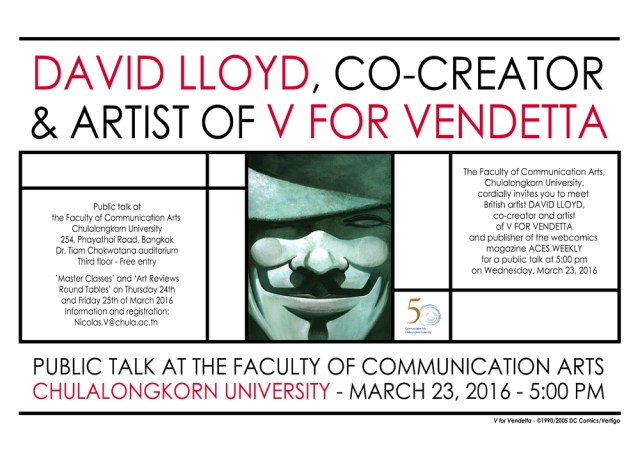
V for Vendetta co-creator and artist David Lloyd, special guest of our Faculty (Faculty of Communication Arts), Chulalongkorn University, for a public talk, a retrospective exhibition, a masterclass, a workshop and portfolio reviews. The workshop and portfolio reviews have their own dedicated post over here. Press interviews (tv, radio, magazine, newspaper) conducted with David Lloyd during his visit in Thailand are gathered at the end of this article.
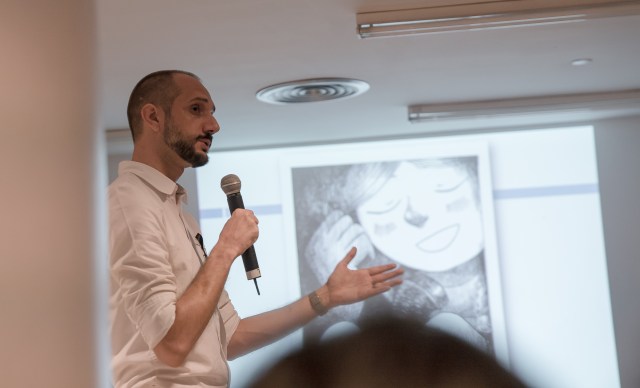
During the public talk held at the Faculty of Communication Arts on March 23, 2016, David Lloyd discussed the creation of the essential graphic novel V for Vendetta, its movie adaptation, the designing and popularity of the iconic Guy Fawkes/V/Anonymous mask, the historical launch of the “British Invasion”, the developing field of webcomics, and the composition of profound, engaged and sophisticated narratives in Comics Art.

Public Talk: David Lloyd and the Painted Smile

Public Talk: Inaugural speech by Assistant Professor Dr. Duang-Kamol Chartprasert, Dean of the Faculty of Communication Arts, Chulalongkorn University

Public Talk: Yours truly with Mr. David Lloyd

Public Talk: Yours truly with Mr. David Lloyd

Public Talk: Mr. David Lloyd and Assistant Professor Dr. Duang-Kamol Chartprasert, Dean of the Faculty of Communication Arts, Chulalongkorn University
In the early 80s, English artist David Lloyd created and designed the character of V and his now famous Guy Fawkes mask (known lately as the “Anonymous mask”). Inviting the promising writer Alan Moore to join his comics project, David Lloyd required from his collaborator to avoid any thought balloons or voice over emanating from the masked freedom fighter. The constraint, remarkable and innovative at the time in the field, strengthened the ambiguity and complexity of the inner motivations and turmoil of V as he spreads terror amongst the leaders of a corrupted and fascist government in a dystopian England evoking George Orwell’s 1984. First conceived with a stark and impressing black-and-white chiaroscuro and serialized between 1982 and 1985 in the English magazine Warrior, the sophisticated narrative drew the attention of major publishers on the other side of the Atlantic.

David Lloyd’s masterclass with the students of the Creative/Graphic Writing course, CommArts, Chula (March 28, 2016)

David Lloyd’s masterclass with the students of the Creative/Graphic Writing course, CommArts, Chula (March 28, 2016)

David Lloyd’s masterclass with the students of the Creative/Graphic Writing course, CommArts, Chula (March 28, 2016)
V for Vendetta, and David Lloyd as an artist and a liaison representative, participated to the groundbreaking “British Invasion” of American comics which led to the creation of the high-quality Vertigo imprint by DC Comics and to the publication of major graphic novels such as Alan Moore and Dave Gibbons’ Watchmen. Working with Grant Morrison on John Constantine: Hellblazer, with Garth Ennis on War Stories or with Jamie Delano on the outstanding tales Nightraven and The Horrorist, David Lloyd never ceased to explore the complexity of the human psyche without ever compromising his own artistic and political integrity. Regarded by the critics as an essential graphic novel, V for Vendetta experienced a new wave of popularity through its 2006 movie adaptation produced by the Wachowski brothers (now sisters) and starring Natalie Portman and Hugo Weaving. The Guy Fawkes mask became an anti-establishment and anti-authoritarian symbol in protests around the world, from the Occupy Wall Street movement to the Arab Spring revolutionary wave. Through its appropriation and extended use by the ‘hacktivist’ group Anonymous, it is now one of the most important revolutionary icons in recent decades with more than 100,000 official copies of the masks being sold annually. Using the gained popularity of his creation to promote the works of other (and often debuting) cartoonists, David Lloyd launched in 2012 the online comics anthology Aces Weekly, one of the first attempts of the kind in the developing field of webcomics.
On March 28, 2016, David hold a masterclass with the students of the Creative Writing (28003216 – Graphic Writing) course. He discussed comics art and visual storytelling and provided individual comments on the graphic narratives produced by the students.

Press: Interview with David Lloyd for Thai channel Voice TV.

Press: Interview with David Lloyd for Thai channel Voice TV by khun Flag.

Press: Radio interview with David Lloyd by Colin Cheney & Donald Quist for “Poet in Bangkok”.

David Lloyd interview conducted by Pim-On for “a day bulletin”.

Press: Signing for RadioMANGA.

Press: Radio interview with David Lloyd for RadioMANGA by Thai cartoonists Suttichart Sarapaiwanich, Eakasit Thairaat and Songsin Tiewsomboon.
Press interviews (tv, radio, magazine, newspaper) done with David Lloyd during his visit in Thailand.
TELEVISION:
The first of the two-part interview with David Lloyd for Thai channel Voice TV is available (in Thai) over here. The second of the two-part TV interview (in Thai) with David Lloyd focuses on the comics artform, on the banning of sound effects in V for Vendetta and on digital comics (David Lloyd being the publisher of the Aces Weekly digital comics anthology). Report shot in front of the retrospective exhibition dedicated to David’s career, right after his public talk at the Faculty of Communication Arts, Chulalongkorn University.
MAGAZINE:
Interview with David Lloyd conducted by khun Pim-On for the magazine a day bulletin #407 (at the Faculty of Communication Arts, Chulalongkorn University). Available (in Thai) over here.
NEWSPAPER:
Interview with David Lloyd and four-page “cover story” by Richard S. Ehrlich for the Bangkok Post weekly cultural supplement Brunch (April 3-9, 2016). Available (in English) on this page.
RADIO:
Podcast of the interview (in English w/ Thai translation) with David Lloyd by three famous Thai cartoonists (Suttichart Sarapaiwanich, Eakasit Thairaat and Songsin Tiewsomboon) for RadioMANGA. Available over here!
Podcast of the interview (in English) with David Lloyd by Colin Cheney & Donald Quist for Poet in Bangkok. “In this eighth episode (Episode #8: A Very Small Irony), Colin and Donald speak with acclaimed comics artist David Lloyd, co-creator and illustrator of V for Vendetta. David discusses his working class upbringing and how American culture fed his development as an artist. He gives insight into some of his earlier collaborations with Alan Moore and other writers. David also shares his impressions of Bangkok and provides his perspective on the use of his V for Vendetta Guy Fawkes mask by Thai protesters”. Available over there!

In the Press: For “a day poet”. Interview by khun Pim-on & picture by khun W. Yeedoung.

In the Press: “cover story” by Richard S. Ehrlich fo the “Bangkok Post” weekly cultural supplement “Brunch” (April 3-9, 2016)

In the Press: David Lloyd, “V for Vendetta” & RadioMANGA!
I would like to extend my sincere thanks to David Lloyd for honoring our Faculty with his visit, to Assistant Professor Dr. Duang-Kamol Chartprasert, Dean of the Faculty of Communication Arts, Chulalongkorn University, Dr. Jirayudh Sinthuphan, Communication Management Program chairperson, and all the CommArts staff for their support. I would like to express my thanks to Bird, Look-in, Lookme, Looksorn, Narada, Big, Vi, Bomb, Nic Dunlop and Colin Cheney for their valuable assistance. Aj. Nicolas Verstappen





































 from-dusk-till-drawn.com