FROM DUSK TILL DRAWN: Comics Art Studies and Graphic Narratives Composition, Workshops, Events & Zine Publishing @ Faculty of Communication Arts, Chulalongkorn University [Bangkok – THAILAND]
The inaugural post explaining the constraints of the #UltraVioletChallenge exercise is available HERE. And more results are available there.
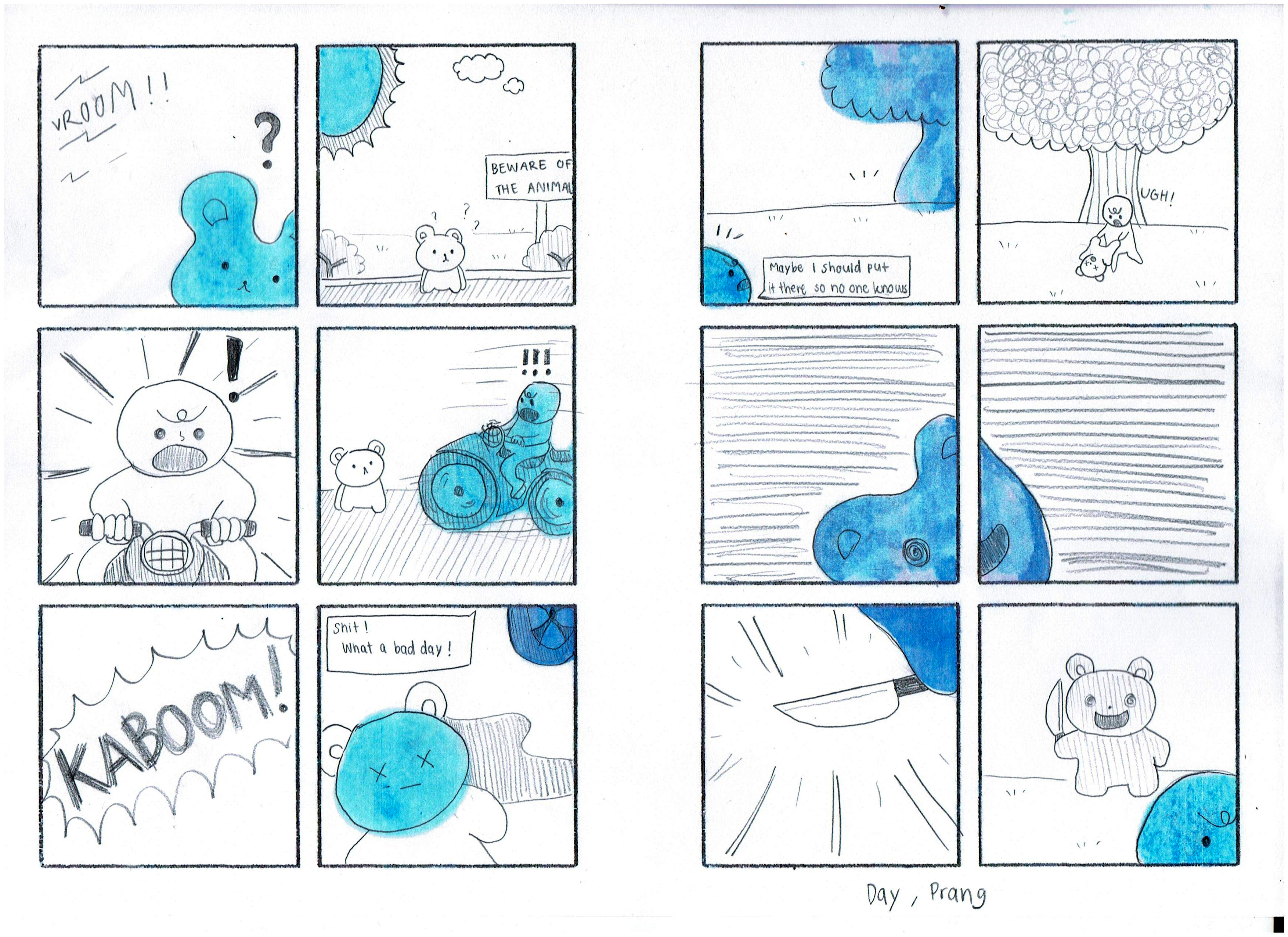
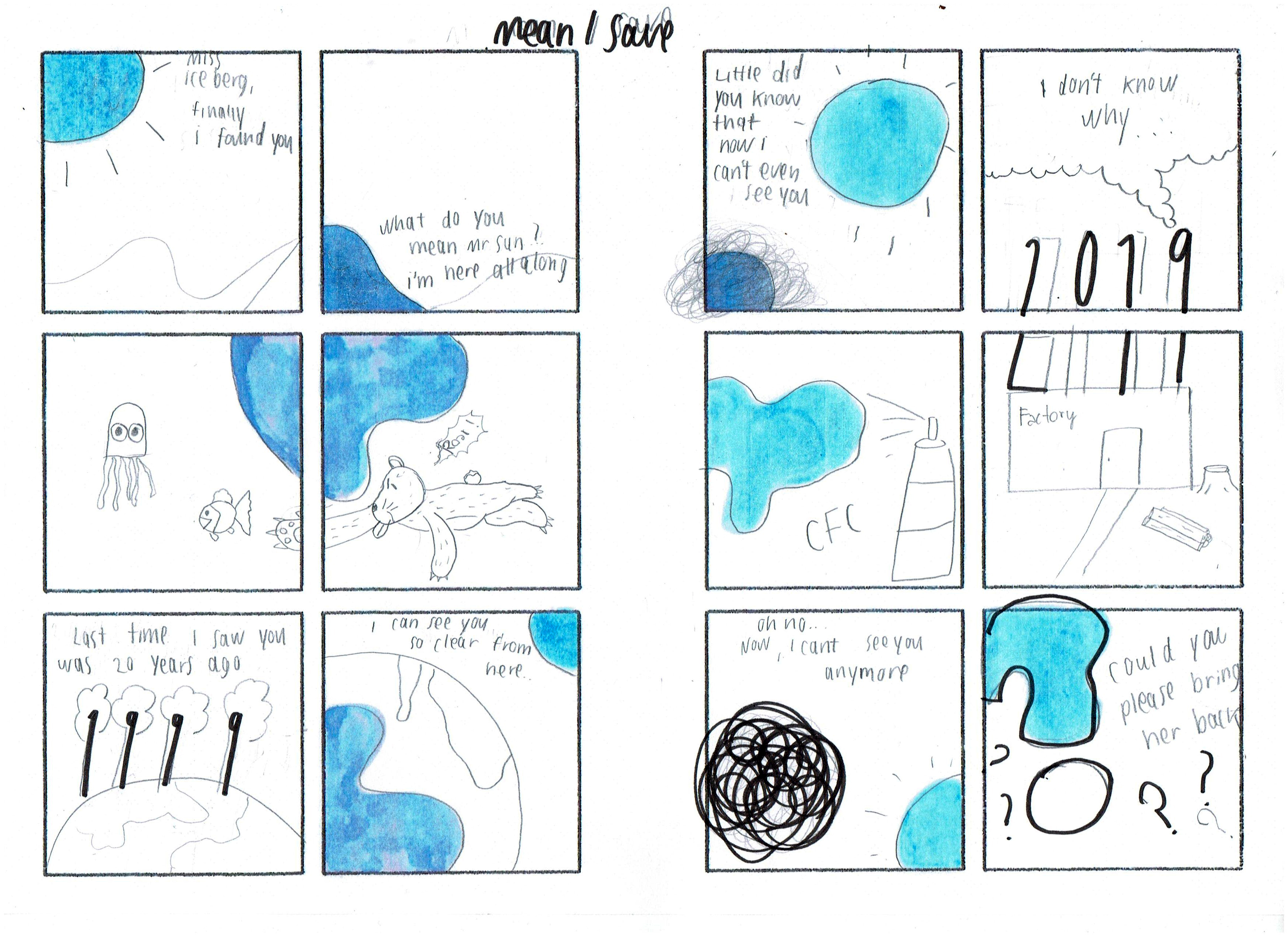
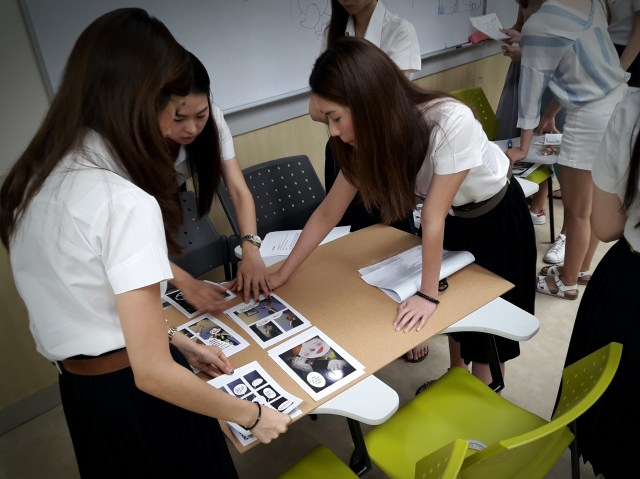
For this post, I wanted to display results by students who never pursued any drawing formation. The 3rd and 4th Year Performing Arts students of my “Imaginative Media” course accepted the challenge, and the results are again interesting and varied… and fun!
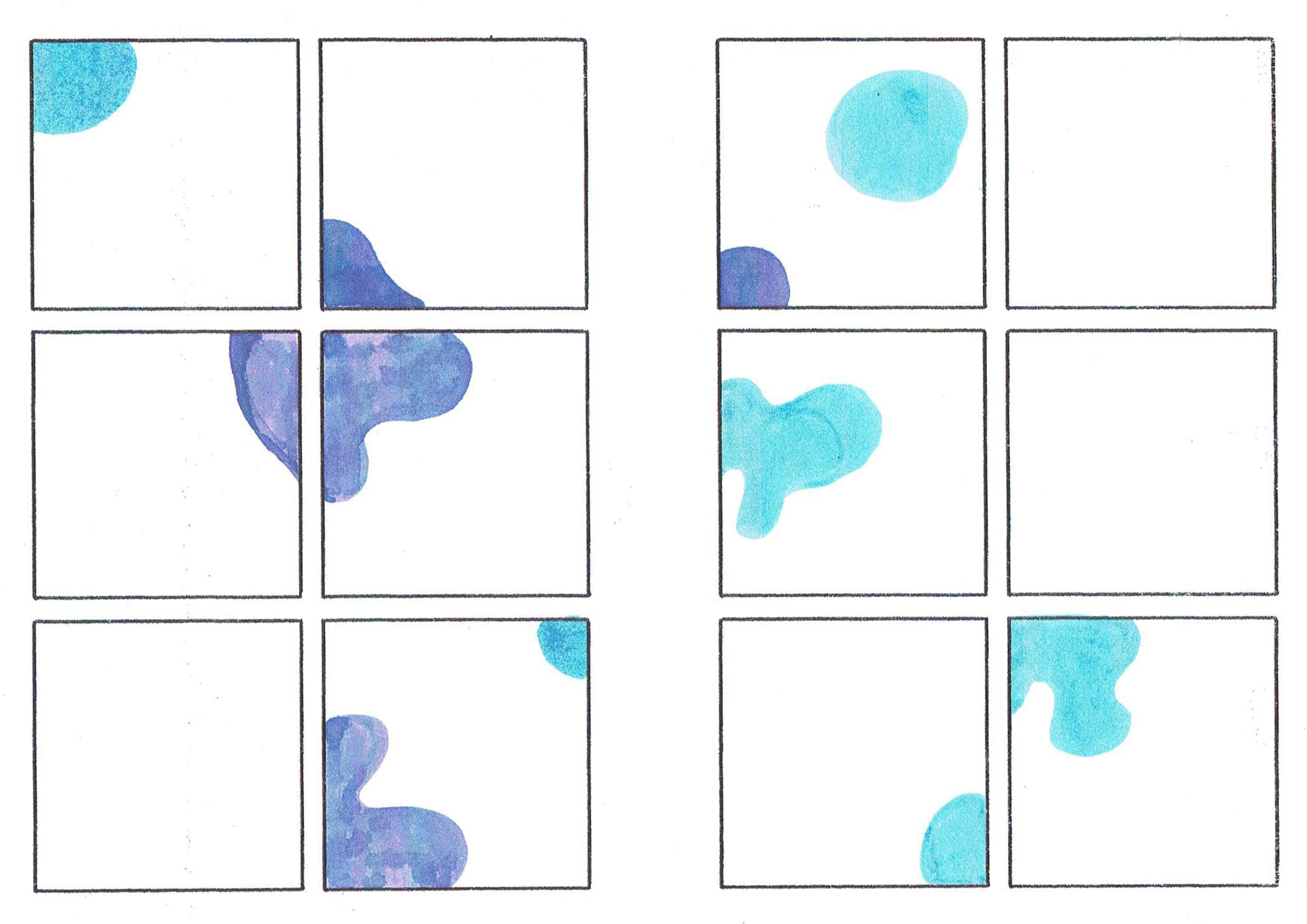
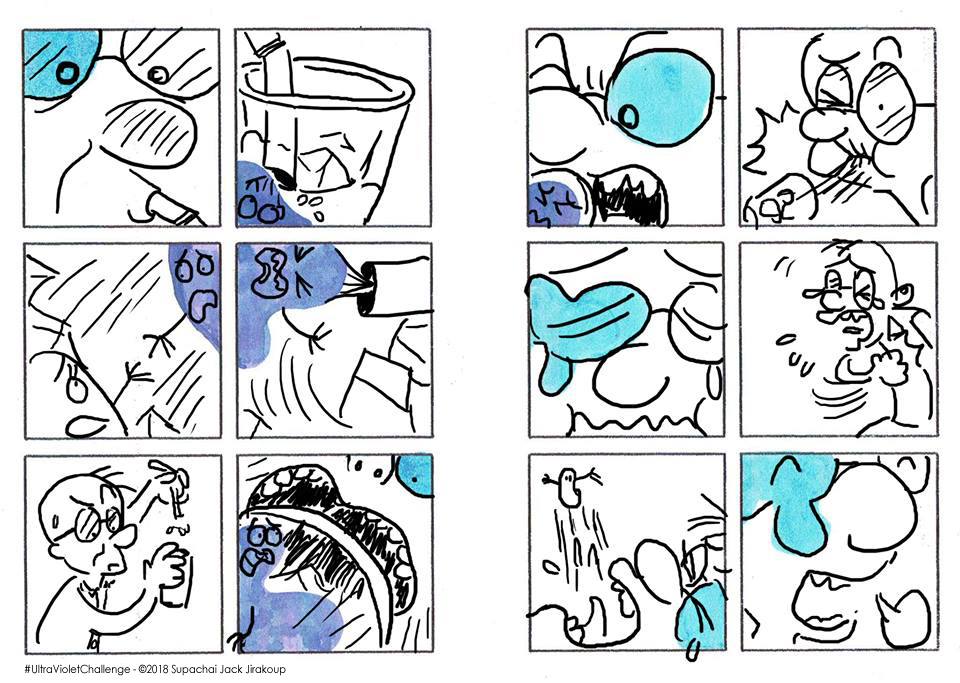
#UltraVioletChallenge: “Making Sense of Signs (and Fragments)” in-class creative assignment (“Imaginative Media” course, Thai Program, Faculty of Communication Arts, Chulalongkorn University); create a figurative comics based on an imposed abstract comics (duration: 90′). Based on a constrained comics exercise used atPierre Feuille Ciseaux international comics residency-lab.
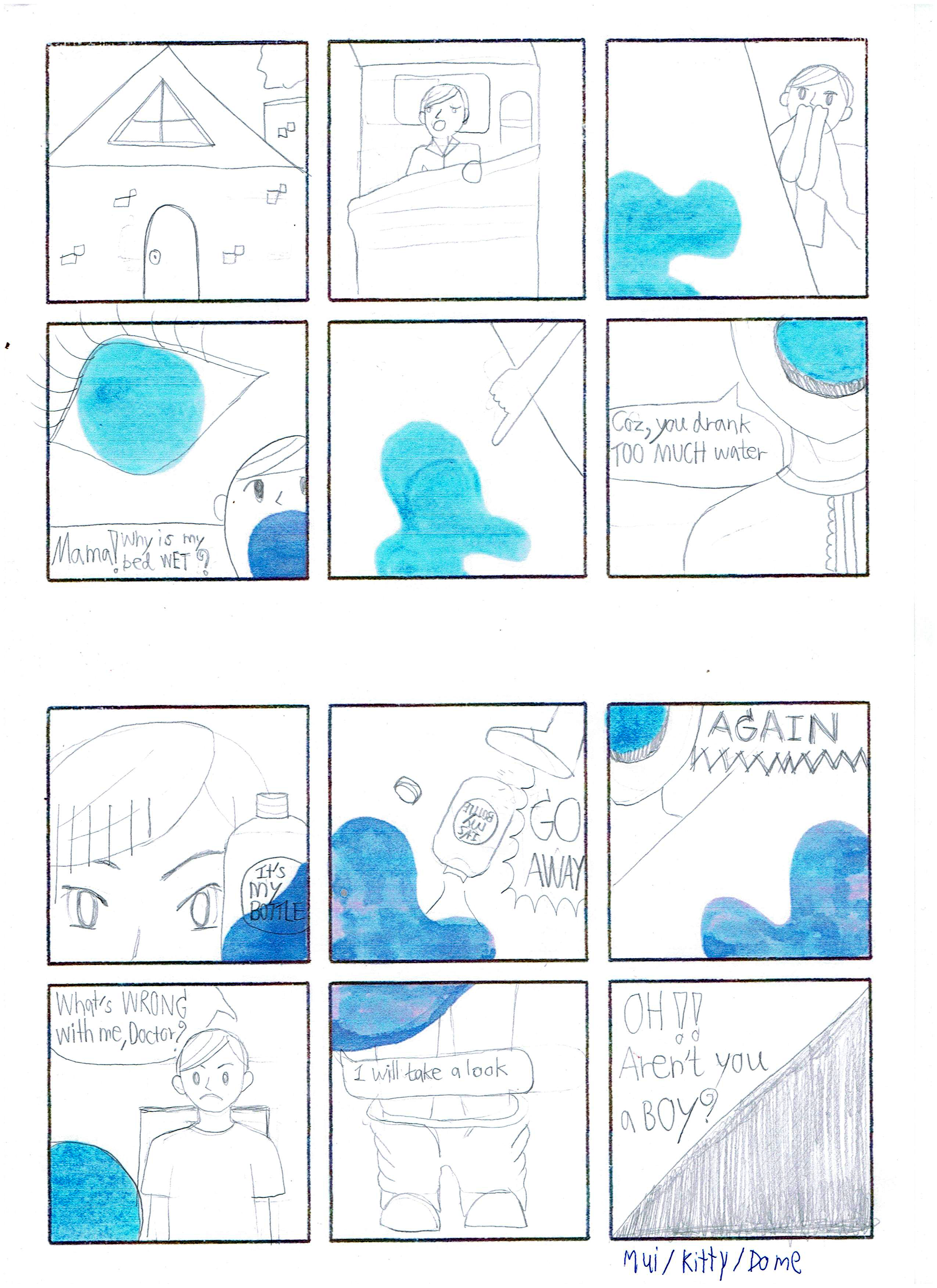
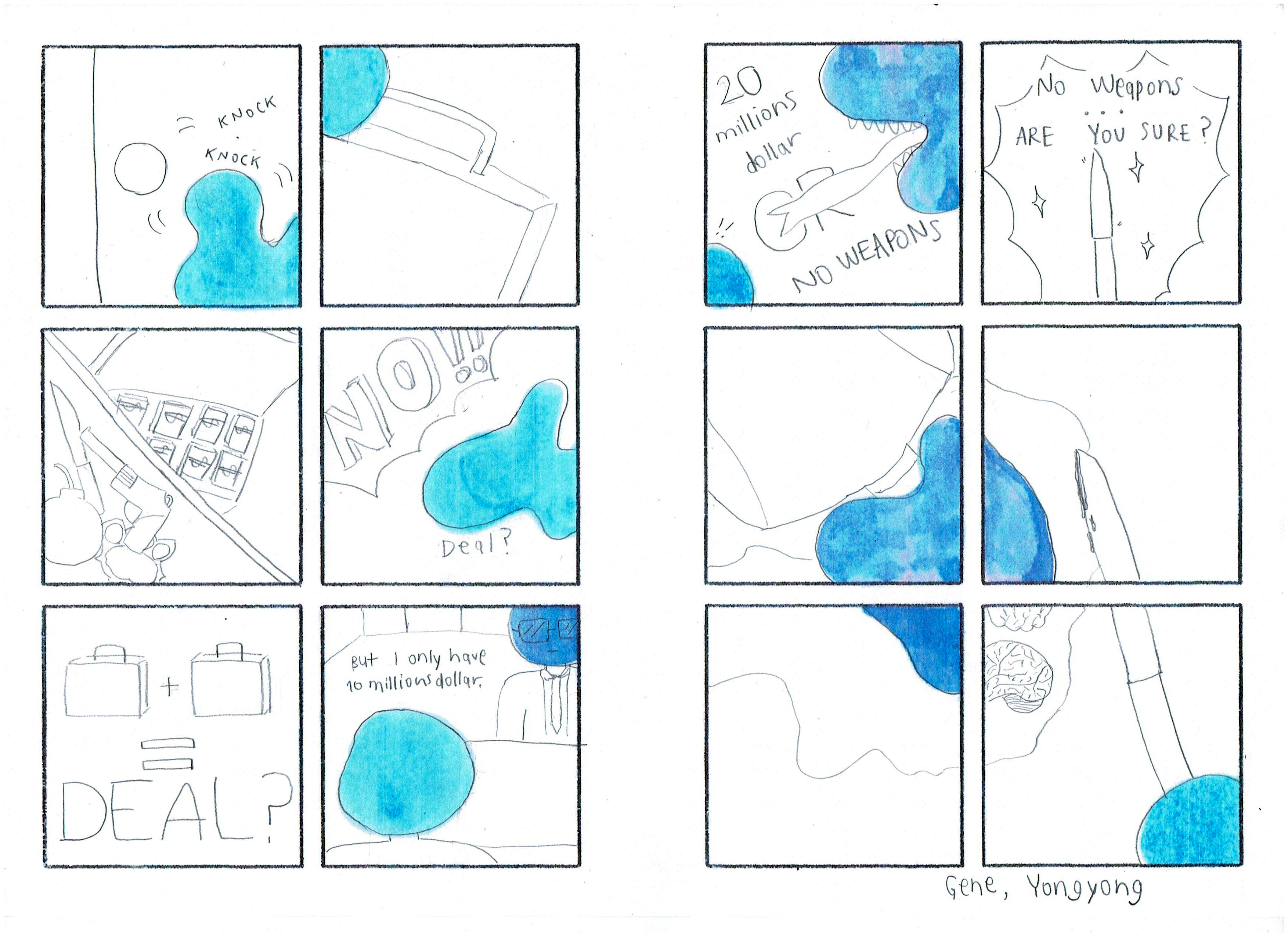
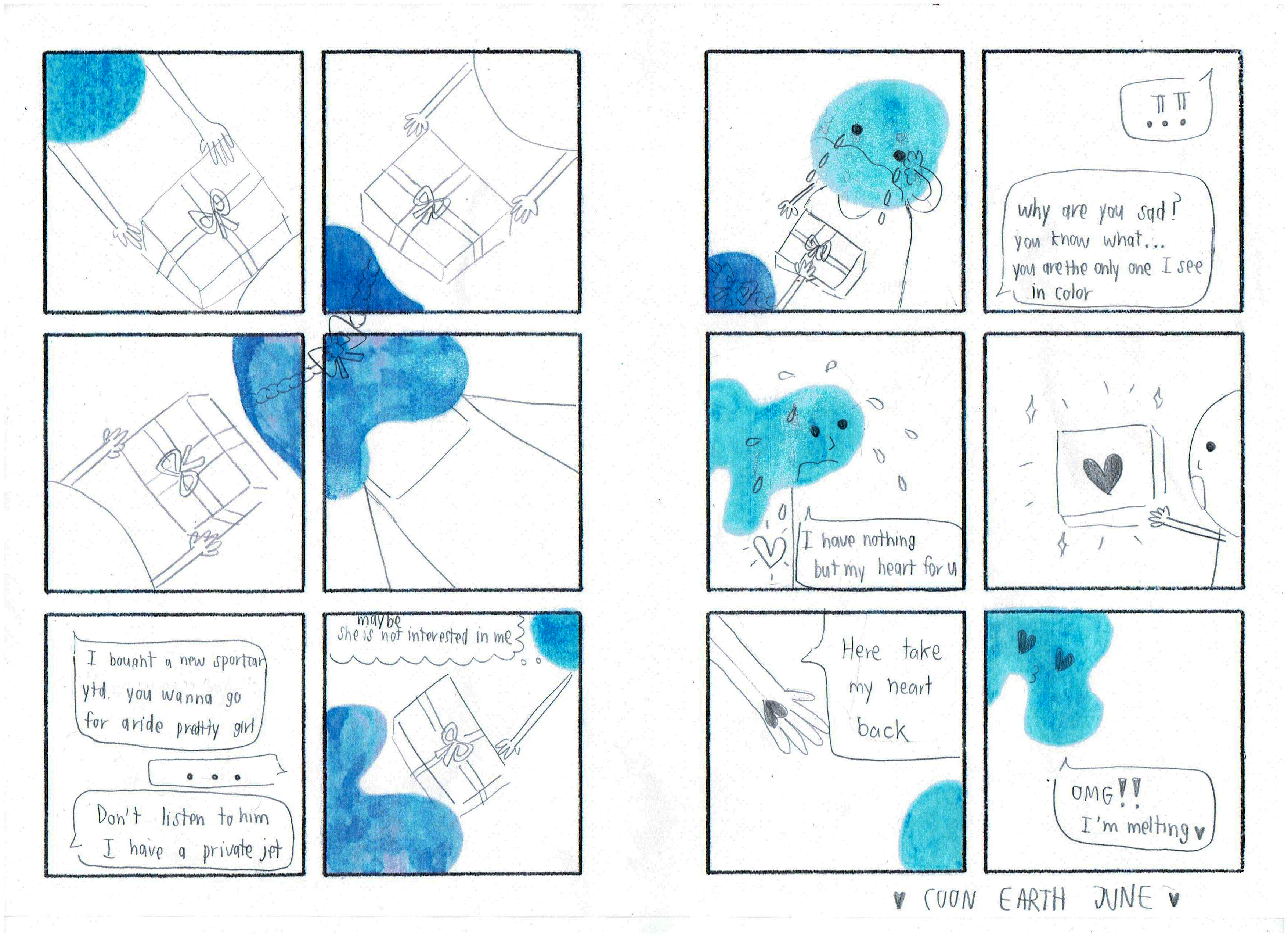
Imposed abstract comics page #UltraVioletChallenge#UltraVioletChallenge by Performing Arts students Day and Prang.#UltraVioletChallenge by Performing Arts students Mean and Save.#UltraVioletChallenge by Performing Arts students Mui, Kitty and Dome.#UltraVioletChallenge by Performing Arts students Kay and Mew.#UltraVioletChallenge by Performing Arts students Gene and Yongyong.#UltraVioletChallenge by Performing Arts students Coon, Earth and June.
“2018 not only celebrates 150 years of Thai-Belgian friendship, it is also the 60th anniversary of the Smurfs,” the small blue human-like creatures who were first introduced in the Belgian comics series titled Johan et Pirlouit (translated to English as Johan and Peewit) in 1958 by Peyo [Pierre Culliford; 1928-1992]. The Smurfs have been selected as the icon of the Thai-Belgian friendship celebration.
On the occasion of the 150th Anniversary of Friendship between Belgium and Thailand and after introducing the Belgo-Palombian character Marsupilami in graphic narratives to denounce a case of black panther poaching in Thailand (see students’ comics HERE), students were invited to revisit another famous -and much scrutinized- Belgian comics character: Smurfette(or Schtroumpfette in the original version)!
Thai (and foreign) Chulalongkorn students from the two courses mentioned above were asked to create short graphic narratives (2 to 4 pages) on imposed topics related to the Critical Tradition which challenges “the control of language to perpetuate power imbalances by exploring the way communication establishes, reinforces and maintains power structures in society” (see Denis McQuail, McQuail’s Reader in Mass Communication Theory, Sage Publishing, 2002). With a vast majority of Asian and female students in my courses, the Smurfette Principle and Whitewashing in Film topics seemed to be appropriate and meaningful choices. The latter topic addresses the under-representation of minorities in the media, and more specifically the Hollywoodian habit of casting white actors to play non-white characters while disregarding the -mostly comics- source material (see articles by Steve Rose and Keith Chow). Infamous recent examples include Tilda Swinton casted as a Himalayan mystic in Doctor Strange, Emma Stone casted as a Chinese-Hawaiian character in Aloha, Scarlett Johansson playing a Japanese cyborg in the live-action feature Ghost in the Shell, or British actor Ed Skrein who decided to step down from his (half-Japanese) Ben Daimio’s role in the upcoming reboot of Hellboy. Criticism on cultural appropriation and whitewashing has also been raised towards Wes Anderson’s latest feature Isle of Dogs (see here).
“In its original sense, ‘whitewashing’ meant covering or cleaning something up. In today’s cultural landscape, it is a stain that won’t rub off. Now, ‘whitewashing’ describes the habit of casting white actors to play non-white characters, often to shoehorn in a star, sometimes out of racial insensitivity, invariably to the detriment of people (and especially actors) of colour.” Steve Rose in ‘“The idea that it’s good business is a myth’ – why Hollywood whitewashing has become toxic”, The Guardian (source), 2017.
Illustration by Dadu Shin for “Why Won’t Hollywood Cast Asian Actors?”, The New York Times (source), 2016.
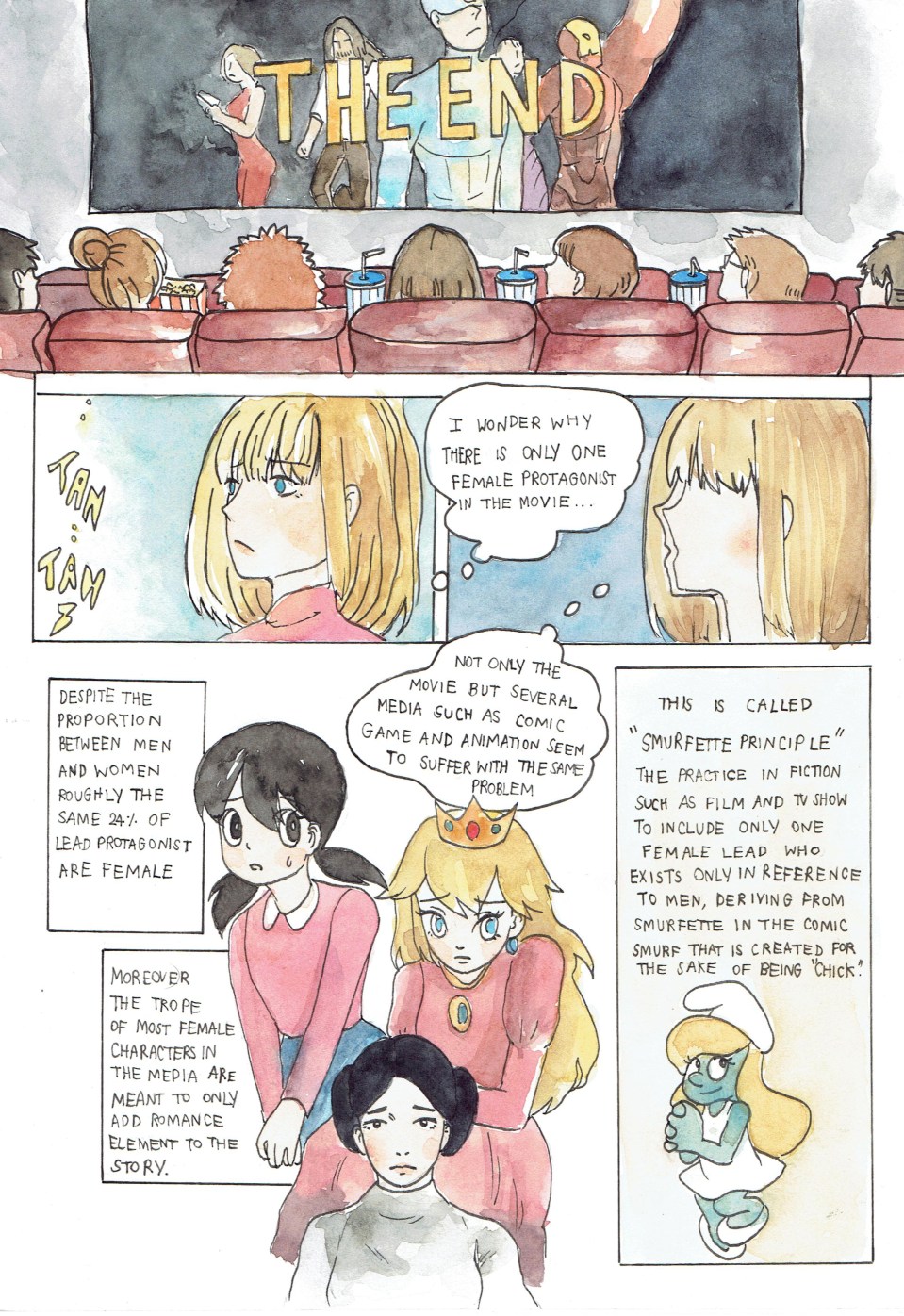
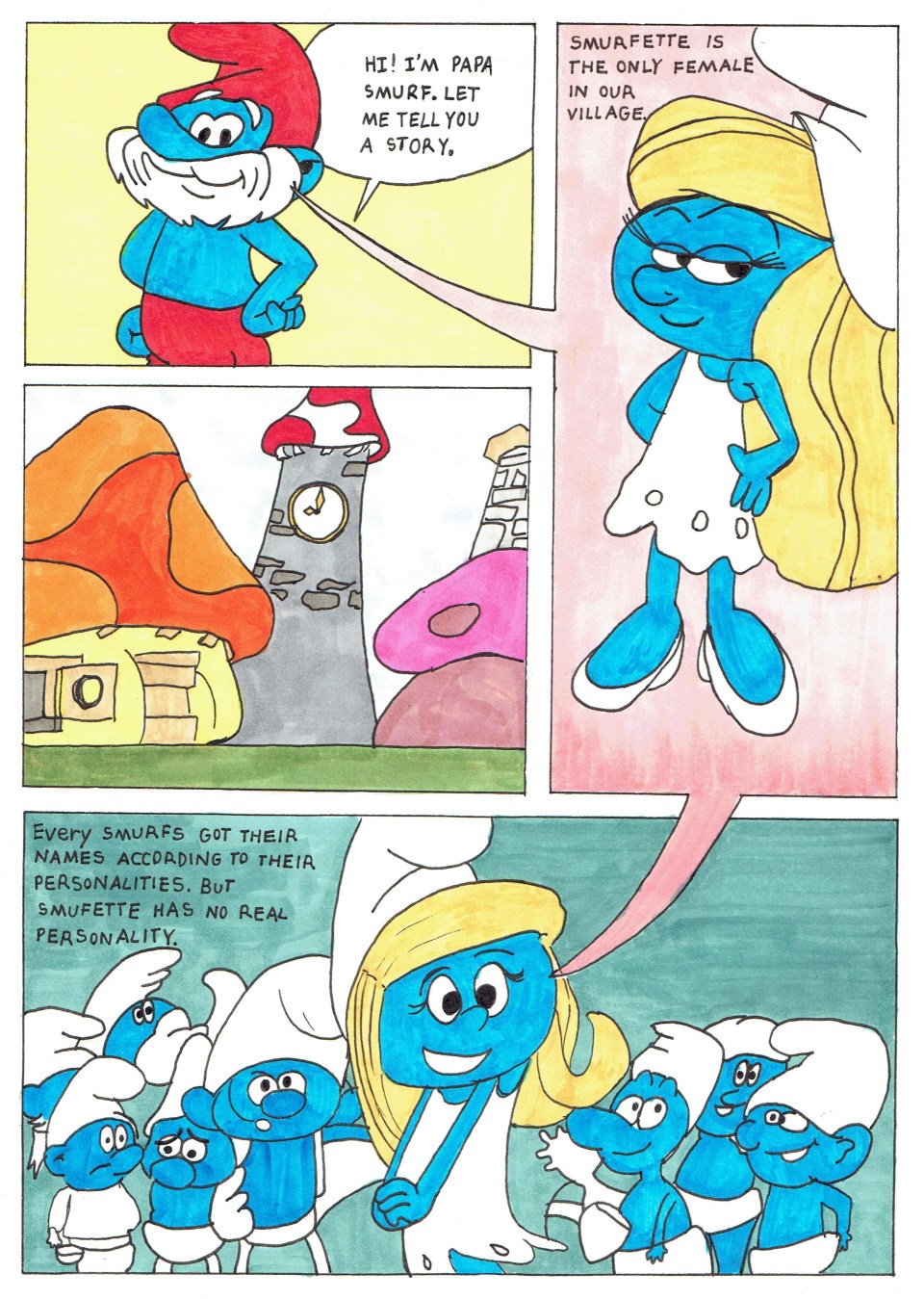
In line with the Feminist Critical Tradition which criticizes communication content and practices that perpetuate patriarchal hierarchies and ideologies, The Smurfette Principle was coined and defined by poet and essayist Katha Pollitt in 1991 in the New York Times as a practice in fiction to include only one stereotypicalfemale character in an otherwise all-male cast (see quote below).
“The message is clear. Boys are the norm, girls the variation; boys are central, girls peripheral; boys are individuals, girls types. Boys define the group, its story and its code of values. Girls exist only in relation to boys.” Katha Pollitt in “Hers; The Smurfette Principle”, The New York Times (source), 1991.
Original artwork attributed to Belgian cartoonist Peyo [Pierre Culliford; 1928-1992].
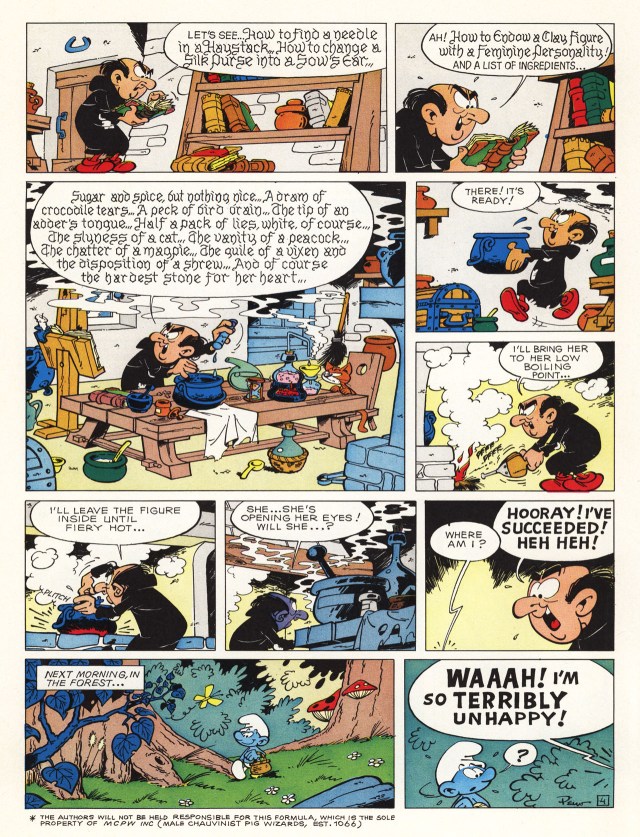
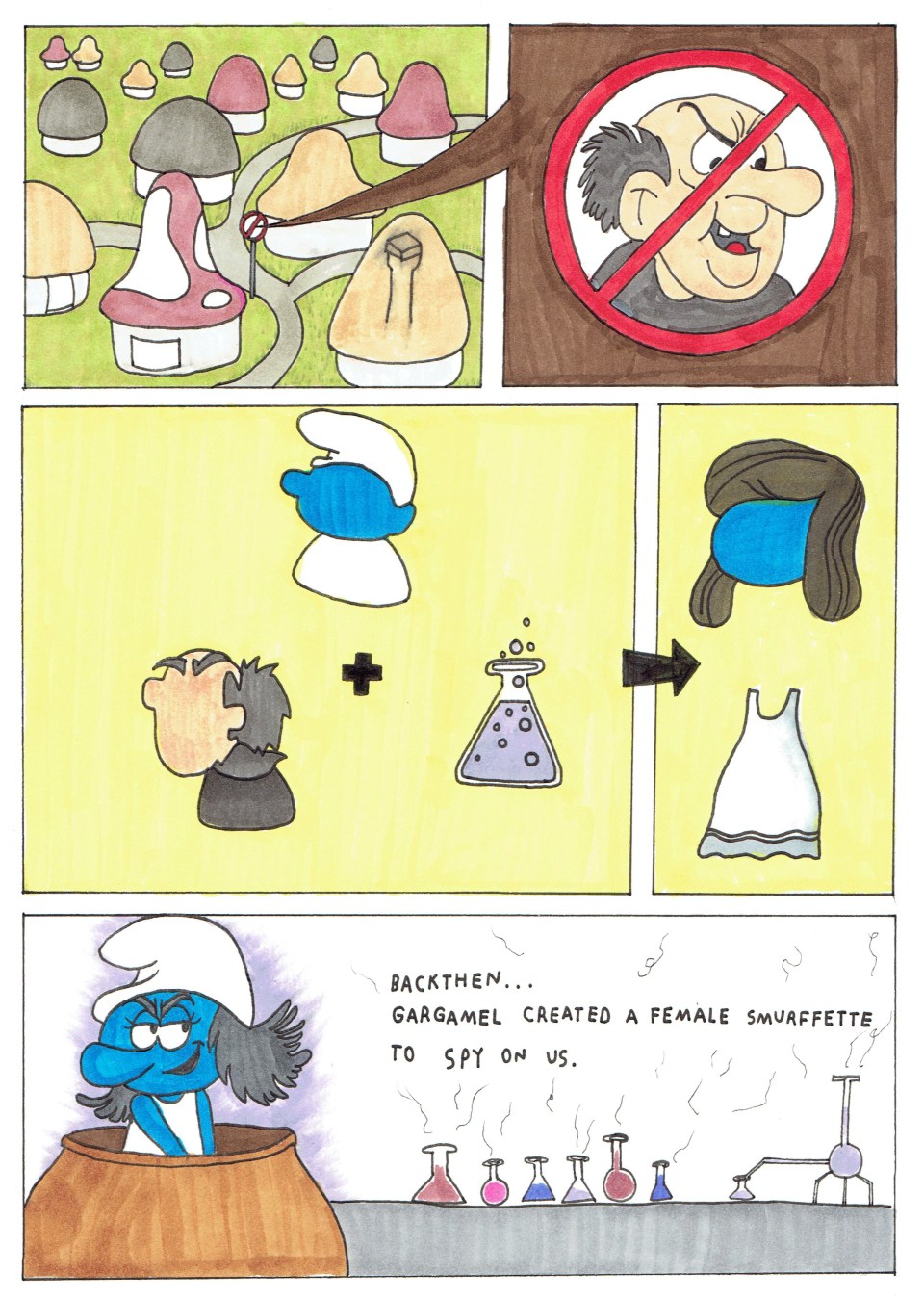
If Katha Pollitt bases her criticism on the Smurfs animated TV series, the Smurfette character was first introduced in Peyo’s A Smurf Adventure: The Smurfette serialized in Spirou magazine (Dupuis, Belgium) in 1966 and written by Yvan Delporte [1928-2007] and Peyo [Pierre Culliford; 1928-1992]. The Smurfette was created from clay by evil wizard Gargamel in order to launch a feud in the all-male Smurf village. The recipe’s ingredients (see Fig. 2; “Sugar and spice, but nothing nice… A dram of crocodile tears… A peck of bird brain…”, etc.) used by the wizard present themselves as an appalling and misogynistic list of personalilty traits. Let’s point here that the recipe is accompanied by an asterisk leading to a footnote (see Fig.1 ). In the French edition (but I don’t know if the footnote was already in the first serialized publication), the footnote reads “This text only represents the views of the author of the grimoire ‘Magicae Formulae’, Beelzebub Publishing” (my translation). The 1976 English further relieves Delporte and Peyo of any responsibilities which are rejected on the “Male Chauvinist Pig Wizards” Incorporation…
Figure 1. Footnotes accompanying the French and 1976 English editions of A Smurf Adventure: The Smurfette.
Nevertheless, the Smurfette’s origin story raises more criticism. Smurfette first appears with unruly black hair, a large nose, basic dress and slippers (see Fig. 3). Feeling miserable because of her physical appearance and lack of attractiveness, she undergoes an “operation of plastic smurfery ” [sic] at the hands of Papa Smurf to become a blonde Smurfette -inspired by French actress Brigitte Bardot- with shortened nose, curled eyelashes, gown and high heels; she is now “one of a kind, full of feminine grace and frivolous. She can also be very much a woman, playing with the feelings of her sweethearts” (from Smurfette’s official bio quoted in Jason Richards’ The Problem With Smurfette). Turned into an “object of desire” and with stereotypical feminine personality traits, Smurfette -and the male Smurfs themselves by competing for her attention- will bring even more trouble in the village soon to be flooded. Let’s add, to be fair, that Delporte and Peyo do not depict the male Smurfs from their best angle either; they do not save the day (except for the more tempered Papa Smurf) and are made laughable -and “identical”- by their hazardous and idiotic behaviour.
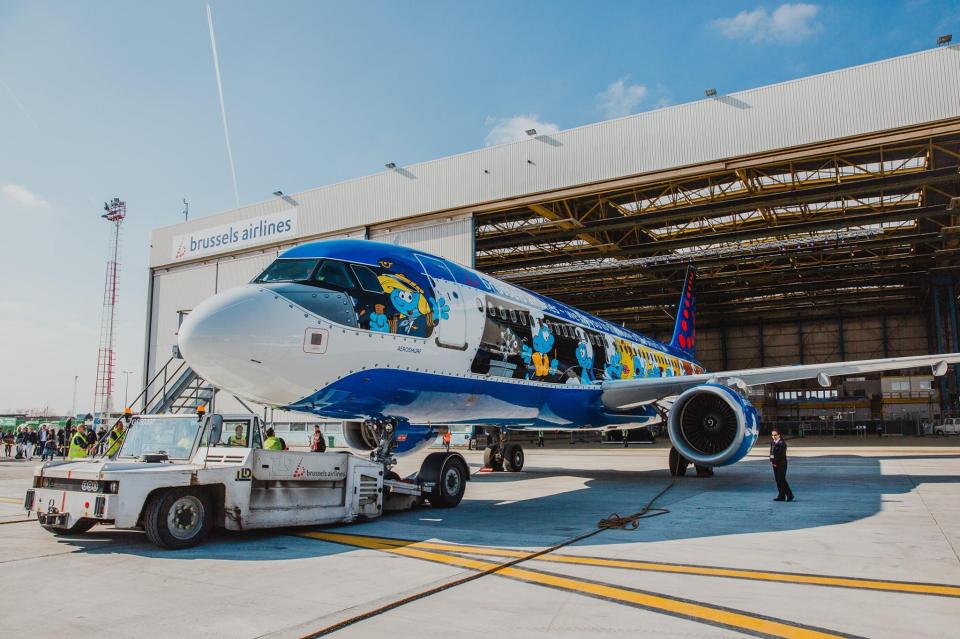
The character of Smurfette evolved positively -albeit quite slowly- over the past decade; becoming the leader of the Smurf village in the 2010 adventure La Grande Schtroumpfette, or an airplane pilot on the outside paint job of some Brussels Airlines’ Airbus A320.
Smurfette as an airplane pilot on a Brussels Airlines’ Airbus A320.
The imposed format was “knowledge (or educational) comics” in order to explore the ability of text/image (multimodal) narratives to condense and convey a large amount of information in a limited space of only a few pages. See quote below.
“Just like diagrams, info-graphics, and other forms of science visualizations, comics use words and pictures to convey information, however they also divide the information into panels [McCloud, 1994] which can facilitate the reading experience and highlight important information, such as parts and processes [Mayer and Gallini, 1990]. Furthermore, comics not only break down the information into more digestible units but can also reassemble them into meaningful compositions […]. As summarized by comic scholar and educator Nick Sousanis: “the spatial interplay of sequential and simultaneous, imbues comics with a dual nature — both tree-like, hierarchical and rhizomatic, interwoven in a single form” [Sousanis, 2015]. In other words, comics can be read linearly, panel by panel, but also lend themselves to non-linear explanations, encouraging the reader to constantly reassess earlier panels in the light of new information. Similarly, science often requires readers to make connections between multiple scales and domains of knowledge, not necessarily arranged in a hierarchical, linear order. In conclusion, while comics are often perceived as an easy and playful format, they may be exquisitely suited at presenting complex information in a rigorous yet accessible way.” Matteo Farinella, “The Potential of Comics in Science Communication”, in JCom Journal of Science Communication 17/1 (source), 2018.
Examples of “knowledge comics” provided to the students included the excellent series La Petite Bédéthèque des Savoirs (Le Lombard, Belgium) which presents itself as “pocket-sized hardcover educational books on subjects as varied as artificial intelligence, sharks, heavy metal, and the history of prostitution. Each volume in the series is written and drawn by a different writer and artist pair. Internationally-renowned experts in the fields work with comics luminaries for a unique alchemy every time” (source). Some volumes are available in English by IDW Publishing under the series title “The Little Book of Knowledge”. Other references were Nick Sousanis’ doctoral dissertation in comics form Unflattening, Scott McCloud’s Understanding Comics and Understanding Rhetoric: A Graphic Guide to Writing by Elizabeth Losh, Jonathan Alexander, Kevin Cannon, and Zander Cannon.
Page from “The Little Book of Knowledge: Tattoos” by Jérôme Pierrat (author) and Alfred (artist). IDW Publishing/Le Lombard.
Page from “The Little Book of Knowledge: Heavy Metal” by Jacques de Pierpont (author) and Hervé Bourhis (artist). IDW Publishing/Le Lombard.
Page from (upcoming in English) “The Little Book of Knowledge: Sharks” by Bernard Séret (author) and Julien Solé (artist). IDW Publishing/Le Lombard.
Page from “La Petite Bédéthèque des Savoirs #18: Le conflit israélo-palestinien” by Vladimir Grigorieff (author) and Abdel de Bruxelles (artist), Le Lombard.
The Smurfette Principle and Whitewashing in Film Knowledge Comics by Chula students
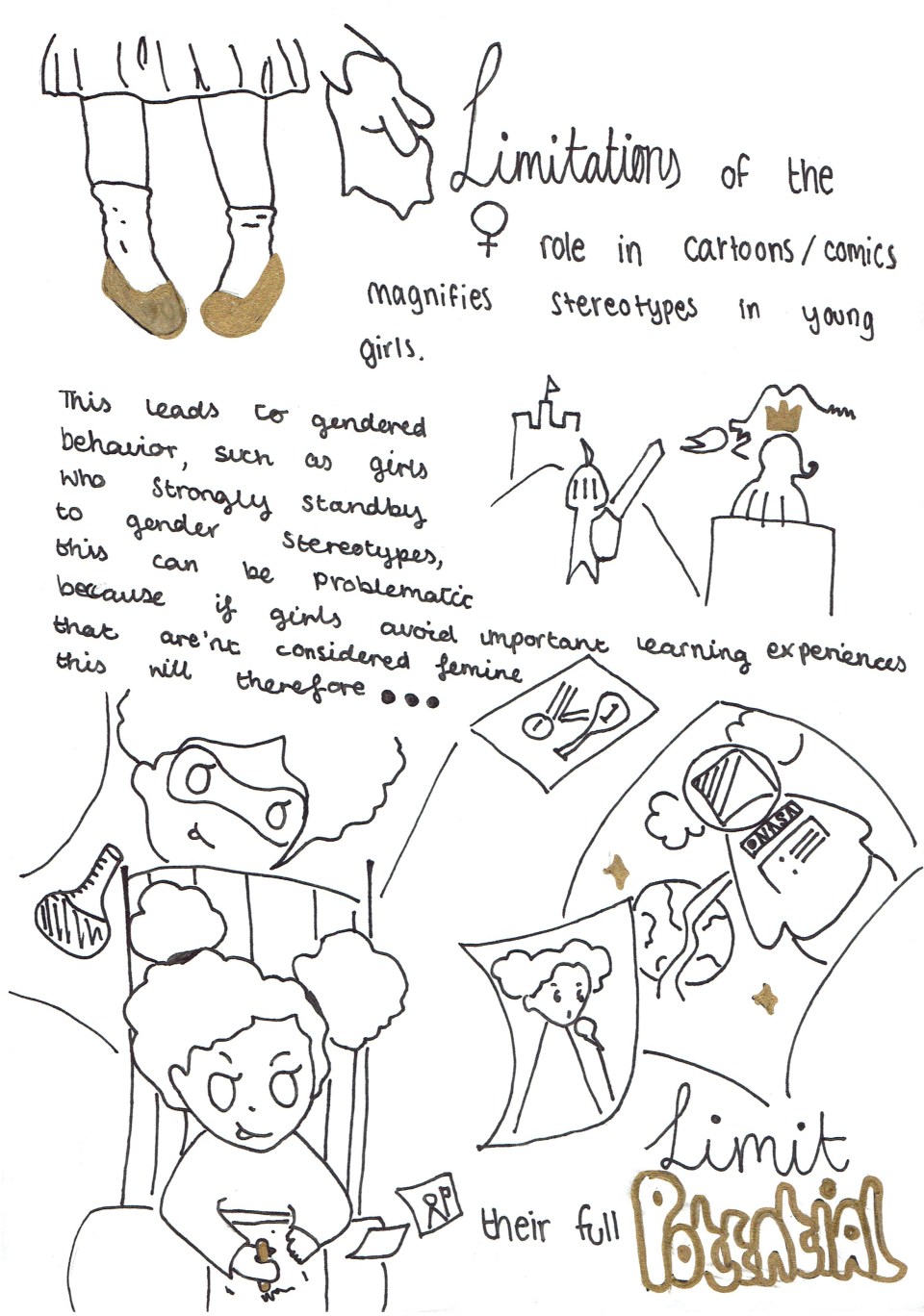
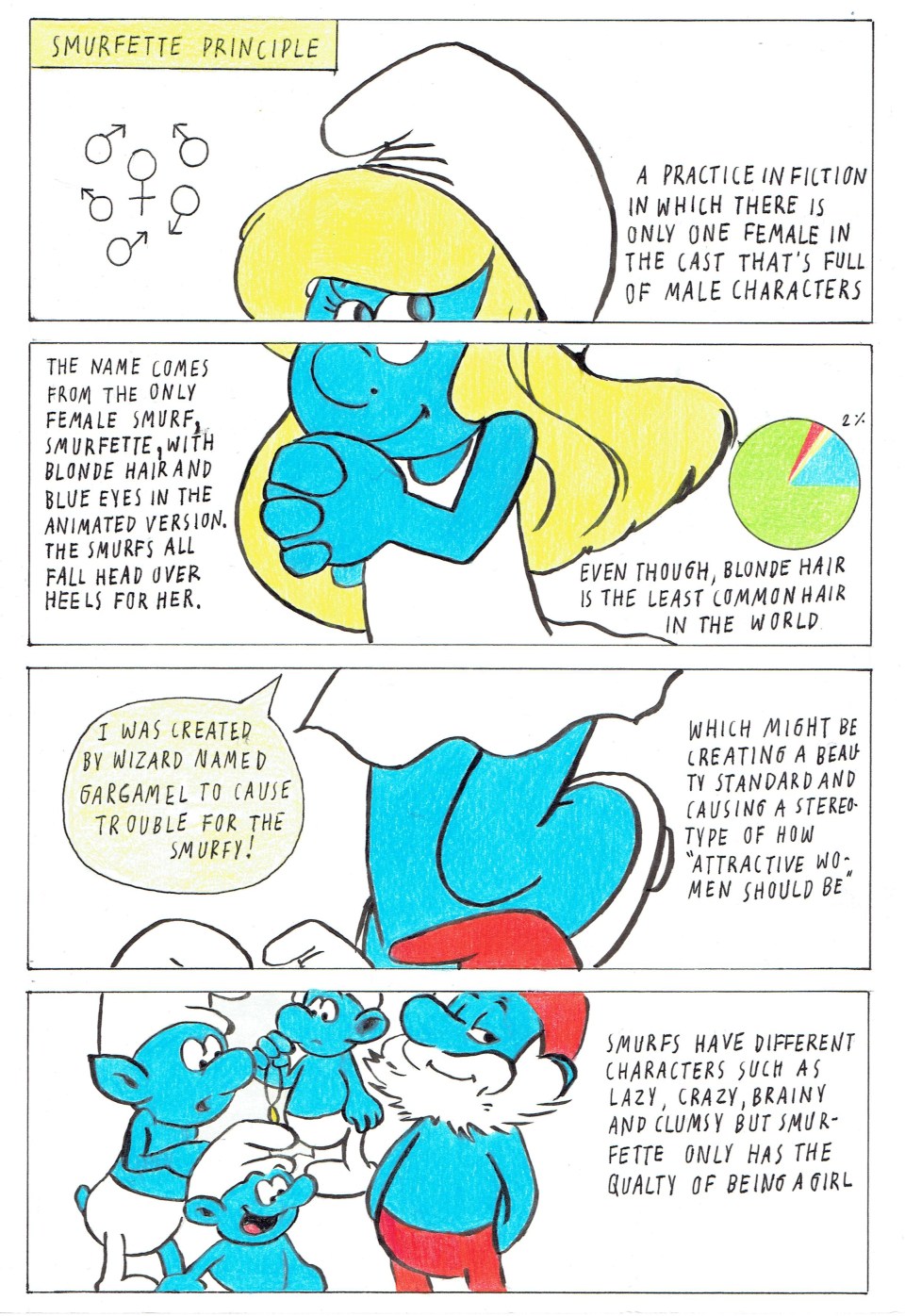
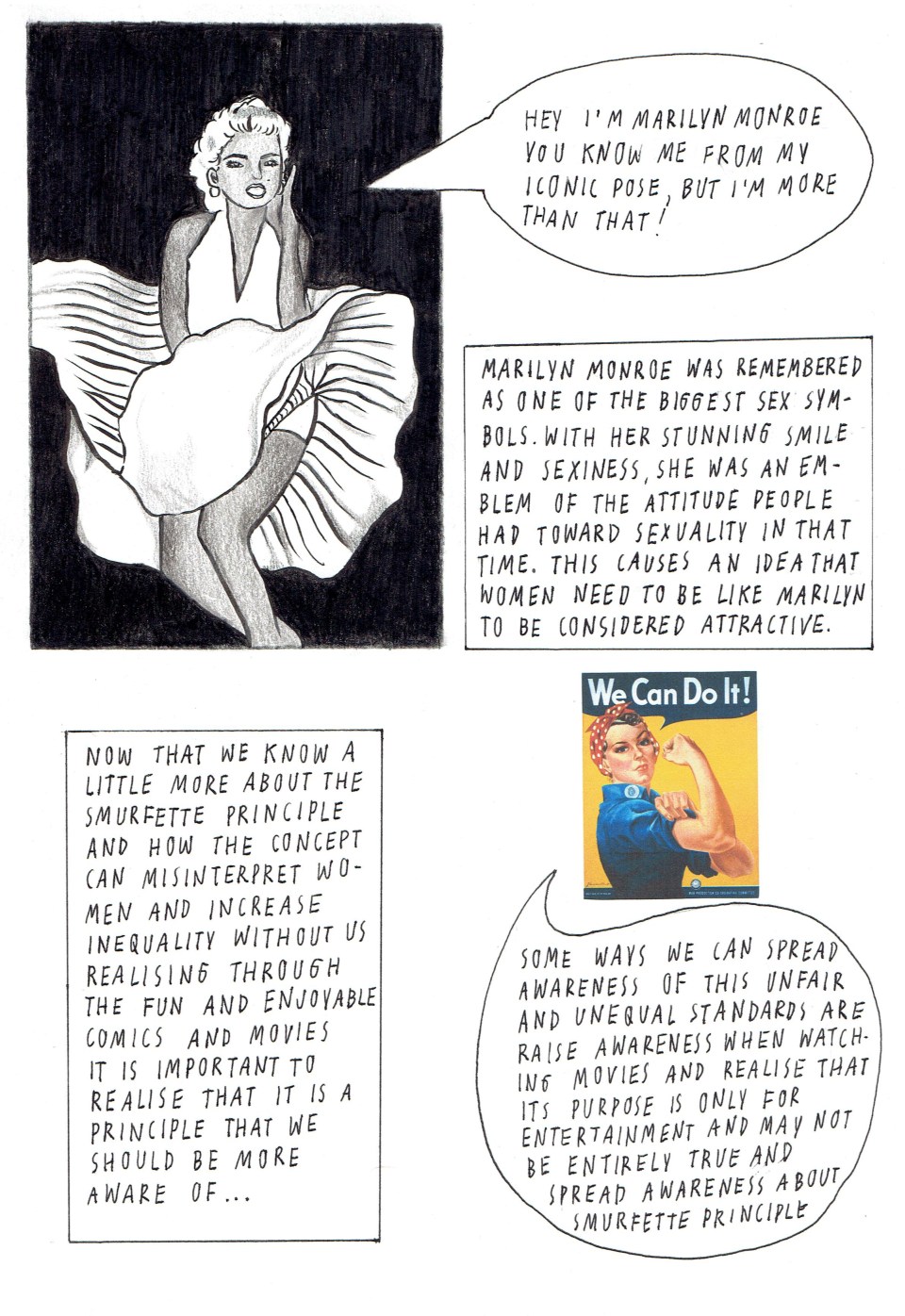
“The Smurfette Principle” Knowledge Comics (page 1/3) by 1st year CommDe students Grace, Chichi, Ping, Pang and Nene. March 2018. Based on the Smurfette character created by Peyo; and Katha Pollitt’s Smurfette Principle.“The Smurfette Principle” Knowledge Comics (page 2/3) by 1st year CommDe students Grace, Chichi, Ping, Pang and Nene. March 2018. Based on the Smurfette character created by Peyo; and Katha Pollitt’s Smurfette Principle.“The Smurfette Principle” Knowledge Comics (page 3/3) by 1st year CommDe students Grace, Chichi, Ping, Pang and Nene. March 2018. Based on the Smurfette character created by Peyo; and Katha Pollitt’s Smurfette Principle.“The Smurfette Principle” Knowledge Comics (page 1/3) by 1st year BALAC student Noey (BALAC: Program in Language and Culture, Faculty of Arts, Chulalongkorn University). November 2017. Based on the Smurfette character created by Peyo; and Katha Pollitt’s Smurfette Principle.“The Smurfette Principle” Knowledge Comics (page 2/3) by 1st year BALAC student Noey (BALAC: Program in Language and Culture, Faculty of Arts, Chulalongkorn University). November 2017. Based on the Smurfette character created by Peyo; and Katha Pollitt’s Smurfette Principle.“The Smurfette Principle” Knowledge Comics (page 3/3) by 1st year BALAC student Noey (BALAC: Program in Language and Culture, Faculty of Arts, Chulalongkorn University). November 2017. Based on the Smurfette character created by Peyo; and Katha Pollitt’s Smurfette Principle.“The Smurfette Principle” Knowledge Comics (page 1/2) by 4th year BALAC students Taew and Petch (BALAC: Program in Language and Culture, Faculty of Arts, Chulalongkorn University). November 2017. Based on the Smurfette character created by Peyo; and Katha Pollitt’s Smurfette Principle.“The Smurfette Principle” Knowledge Comics (page 2/2) by 4th year BALAC students Taew and Petch (BALAC: Program in Language and Culture, Faculty of Arts, Chulalongkorn University). November 2017. Based on the Smurfette character created by Peyo; and Katha Pollitt’s Smurfette Principle.
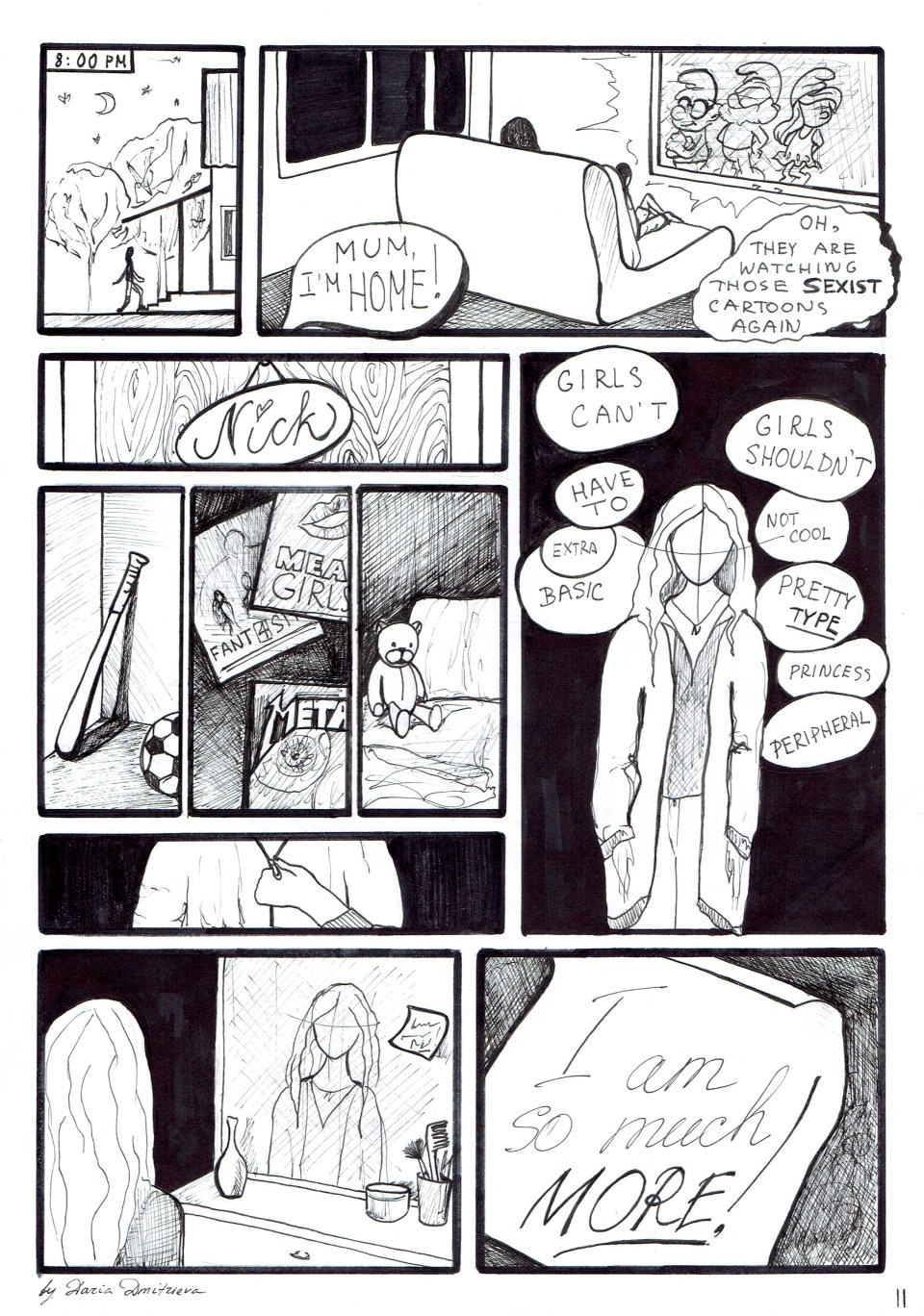
“The Smurfette Principle” comics (page 1/2) by 3rd year INDA student Daria Dmitrieva (INDA: International Program in Design and Architecture, Faculty of Arts, Chulalongkorn University). November 2017. Based on the Smurfette character created by Peyo; and Katha Pollitt’s Smurfette Principle.
“The Smurfette Principle” comics (page 1/2) by 3rd year INDA student Daria Dmitrieva (INDA: International Program in Design and Architecture, Faculty of Arts, Chulalongkorn University). November 2017. Based on the Smurfette character created by Peyo; and Katha Pollitt’s Smurfette Principle.
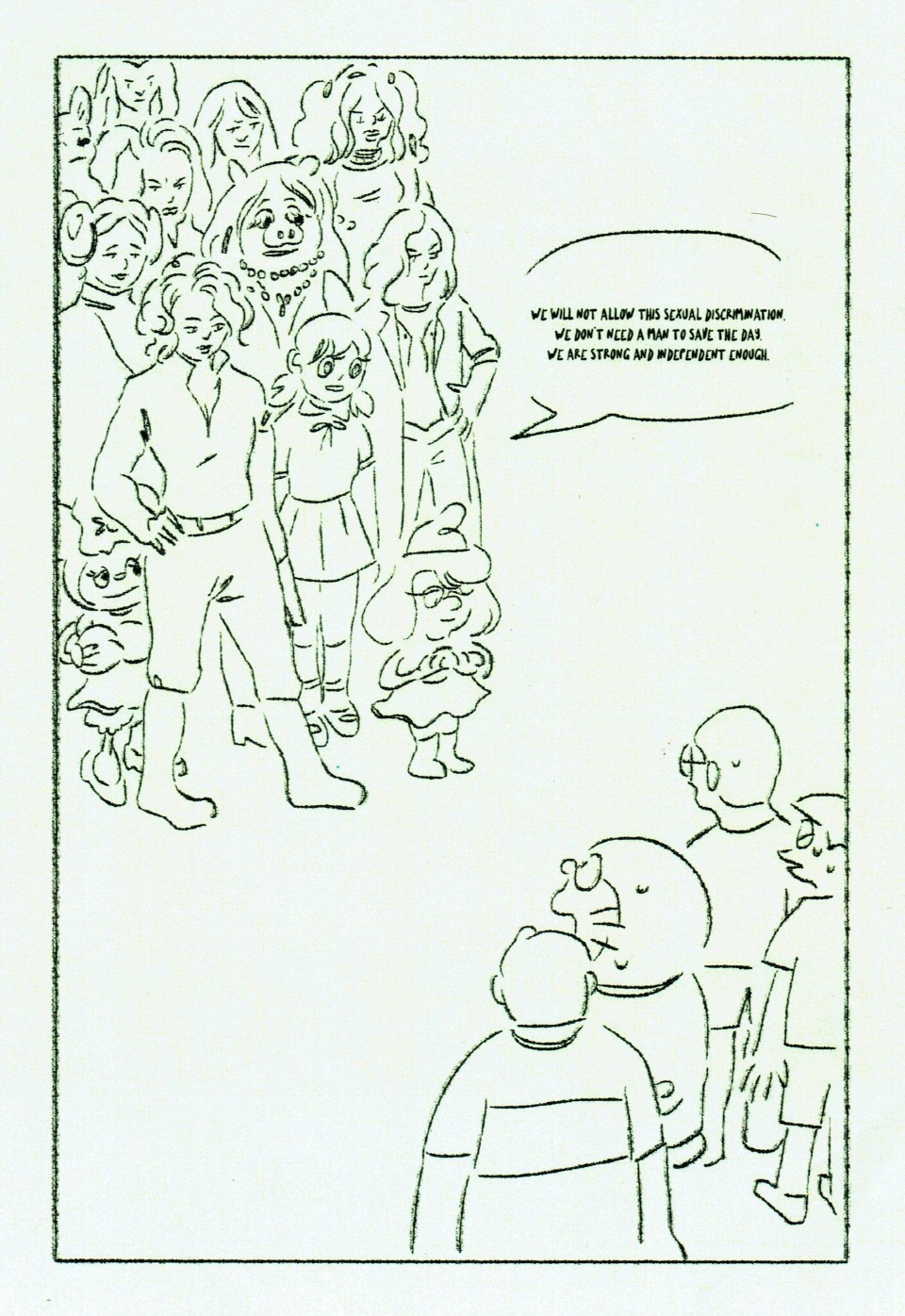
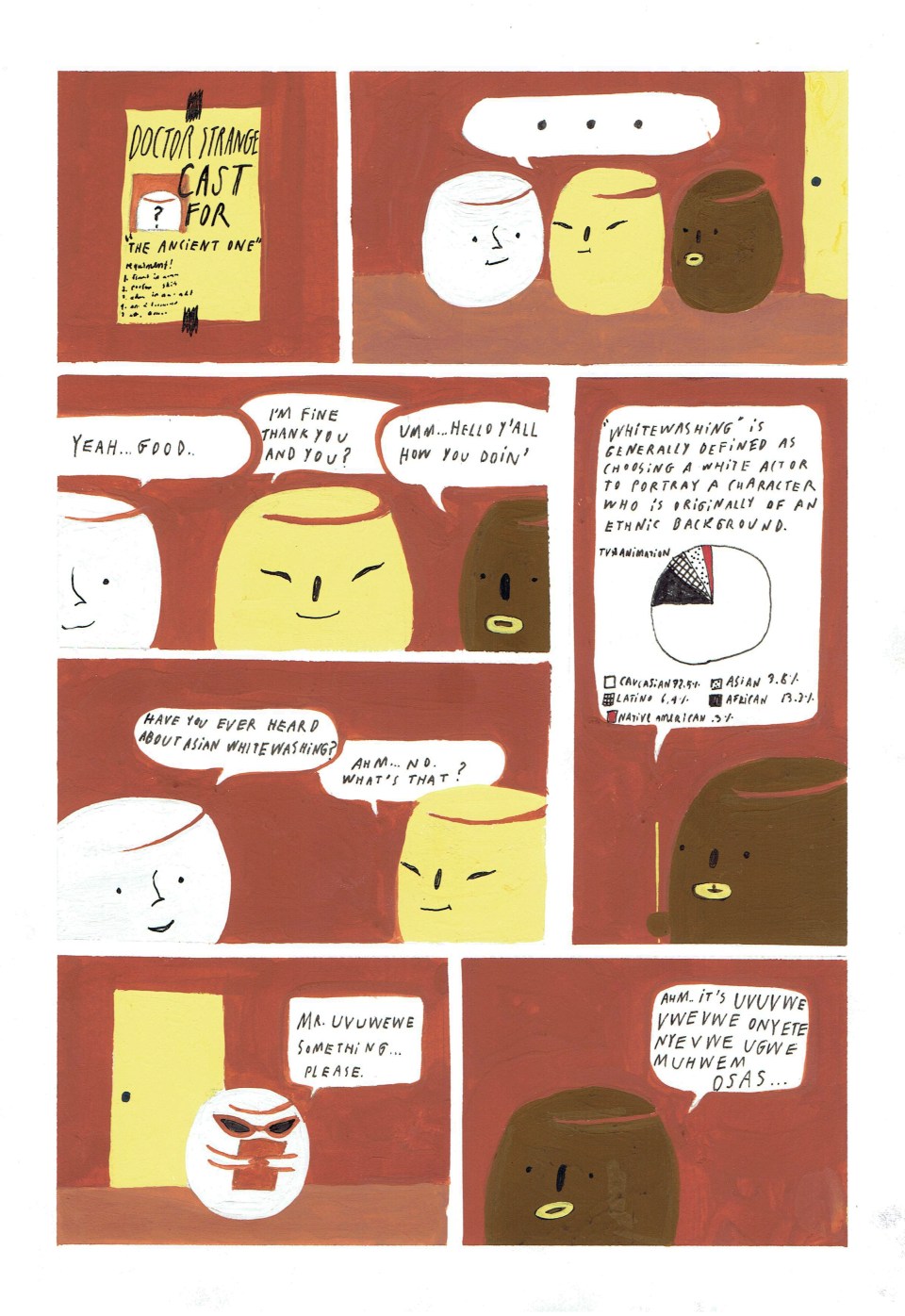
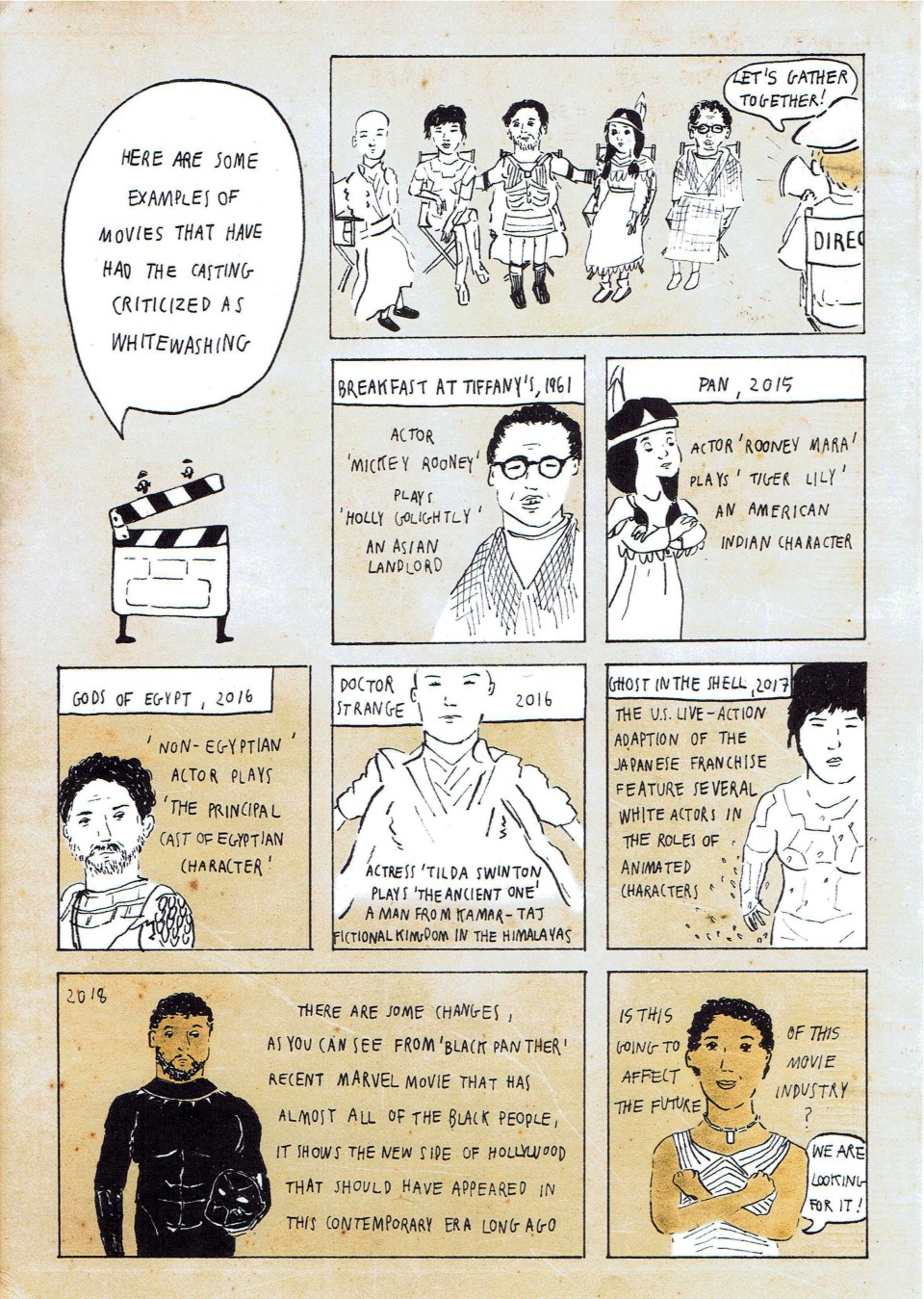
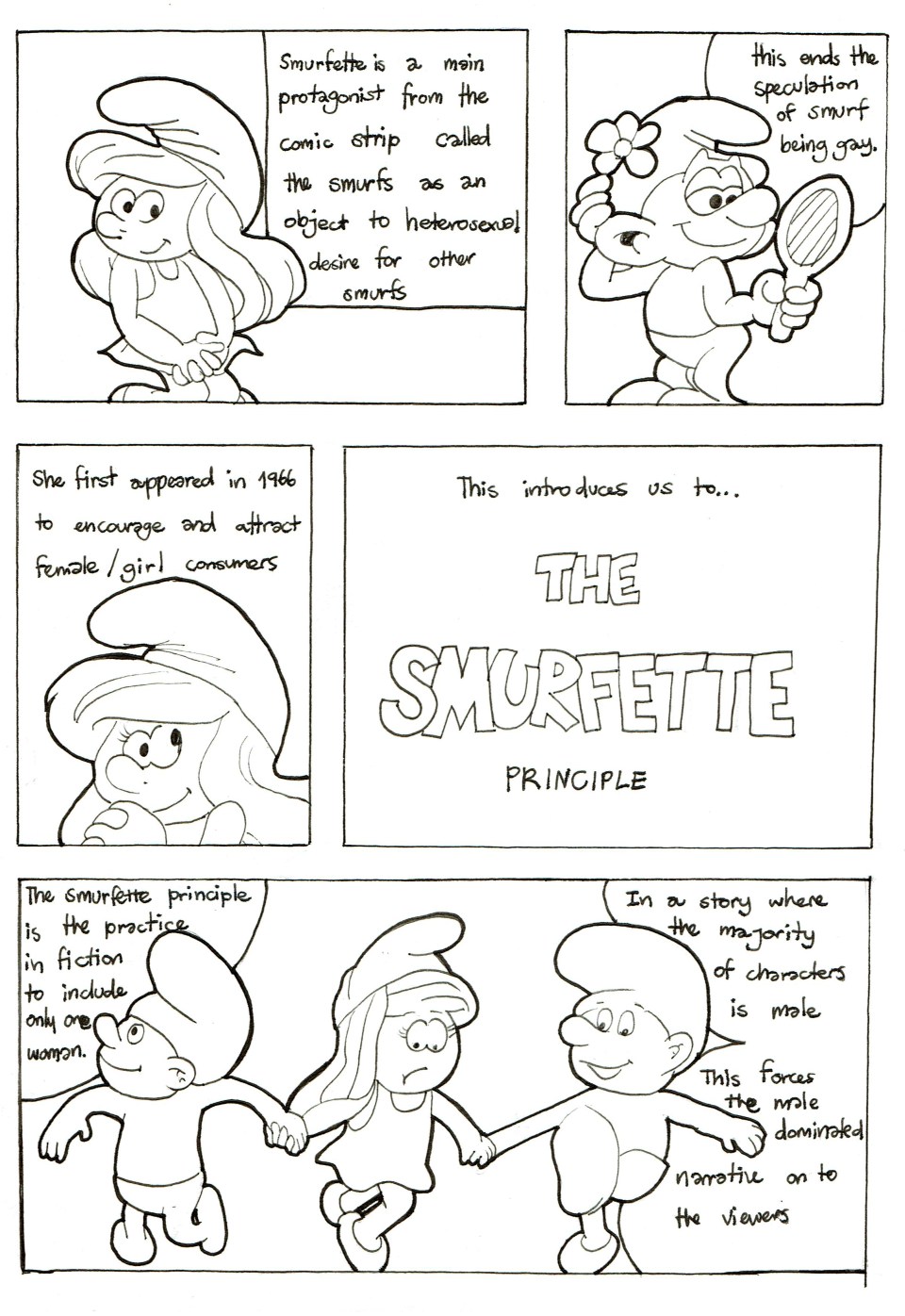
“The Smurfette Principle” comics (page 1/2) by 3rd year CommDe students Tung, Tee, Mint and Mean. November 2017. Based on the Smurfette character created by Peyo; and Katha Pollitt’s Smurfette Principle.“The Smurfette Principle” Knowledge Comics (page 2/2) by 3rd year CommDe students Tung, Tee, Mint and Mean. November 2017. Based on the Smurfette character created by Peyo; and Katha Pollitt’s Smurfette Principle.“Whitewashing in Film” Knowledge Comics (page 1/3) by 1st year CommDe students Fern, Pun, Oom, Bank and Lukpear. March 2018.“Whitewashing in Film” Knowledge Comics (page 2/3) by 1st year CommDe students Fern, Pun, Oom, Bank and Lukpear. March 2018.“Whitewashing in Film” Knowledge Comics (page 1/3) by 1st year CommDe students Fern, Pun, Oom, Bank and Lukpear. March 2018.“The Smurfette Principle” Knowledge Comics (page 1/3) by 1st year CommDe students Joy, Plye, Sunny and Nana. March 2018. Based on the Smurfette character created by Peyo; and Katha Pollitt’s Smurfette Principle.“The Smurfette Principle” Knowledge Comics (page 2/3) by 1st year CommDe students Joy, Plye, Sunny and Nana. March 2018. Based on the Smurfette character created by Peyo; and Katha Pollitt’s Smurfette Principle.“The Smurfette Principle” Knowledge Comics (page 3/3) by 1st year CommDe students Joy, Plye, Sunny and Nana. March 2018. Based on the Smurfette character created by Peyo; and Katha Pollitt’s Smurfette Principle.“Whitewashing in Film” Knowledge Comics (page 1/3) by 1st year CommDe students Aom (P), Ploy, Mim, Mind and Tang. March 2018.“Whitewashing in Film” Knowledge Comics (page 2/3) by 1st year CommDe students Aom (P), Ploy, Mim, Mind and Tang. March 2018.“Whitewashing in Film” Knowledge Comics (page 3/3) by 1st year CommDe students Aom (P), Ploy, Mim, Mind and Tang. March 2018.“The Smurfette Principle” Knowledge Comics (page 1/3) by 1st year CommDe students Shi, Kris, Aom, Wakako and Gem. March 2018. NOTE: Panels 1 and 2 refer to Jeffery P. Dennis’ 2003 essay Queertoons: The dynamics of same-sex desire in the animated cartoonwhere the author states that the Smurfette “was introduced specifically to provide an object for the Smurfs’ heterosexual desire and defuse conjectures that they might be ‘really’ gay”. This claim has been subjected to criticism. Based on the Smurfette character created by Peyo; and Katha Pollitt’s Smurfette Principle.“The Smurfette Principle” Knowledge Comics (page 2/3) by 1st year CommDe students Shi, Kris, Aom, Wakako and Gem. March 2018. Based on the Smurfette character created by Peyo; and Katha Pollitt’s Smurfette Principle.“The Smurfette Principle” Knowledge Comics (page 3/3) by 1st year CommDe students Shi, Kris, Aom, Wakako and Gem. March 2018. Based on the Smurfette character created by Peyo; and Katha Pollitt’s Smurfette Principle.
“The Smurfette Principle” Knowledge Comics (page 1/3) by 3rd year CommDe students Natt, Cartoon, Nich and Champ. November 2017. Based on the Smurfette character created by Peyo; and Katha Pollitt’s Smurfette Principle.“The Smurfette Principle” Knowledge Comics (page 2/3) by 3rd year CommDe students Natt, Cartoon, Nich and Champ. November 2017. Based on the Smurfette character created by Peyo; and Katha Pollitt’s Smurfette Principle.“The Smurfette Principle” Knowledge Comics (page 3/3) by 3rd year CommDe students Natt, Cartoon, Nich and Champ. November 2017. Based on the Smurfette character created by Peyo; and Katha Pollitt’s Smurfette Principle.
The Smurfette origin (exploring elements from the Semiotics lessons: symbol, icon, connotation…).
“The Smurfette Origin” Comics (exploring elements from the Semiotics lessons: symbol, icon, connotation; and with a nod to Ibn al Rabin’ silent comics), page 1/3, by 1st year CommDe students Prim, Proud, Pauline, Pop and Suang. March 2018. Based on characters created by Peyo.“The Smurfette Origin” Comics (exploring elements from the Semiotics lessons: symbol, icon, connotation; and with a nod to Ibn al Rabin’ silent comics), page 1/3, by 1st year CommDe students Prim, Proud, Pauline, Pop and Suang. March 2018. Based on characters created by Peyo.“The Smurfette Origin” Comics (exploring elements from the Semiotics lessons: symbol, icon, connotation; and with a nod to Ibn al Rabin’ silent comics), page 1/3, by 1st year CommDe students Prim, Proud, Pauline, Pop and Suang. March 2018. Based on characters created by Peyo.
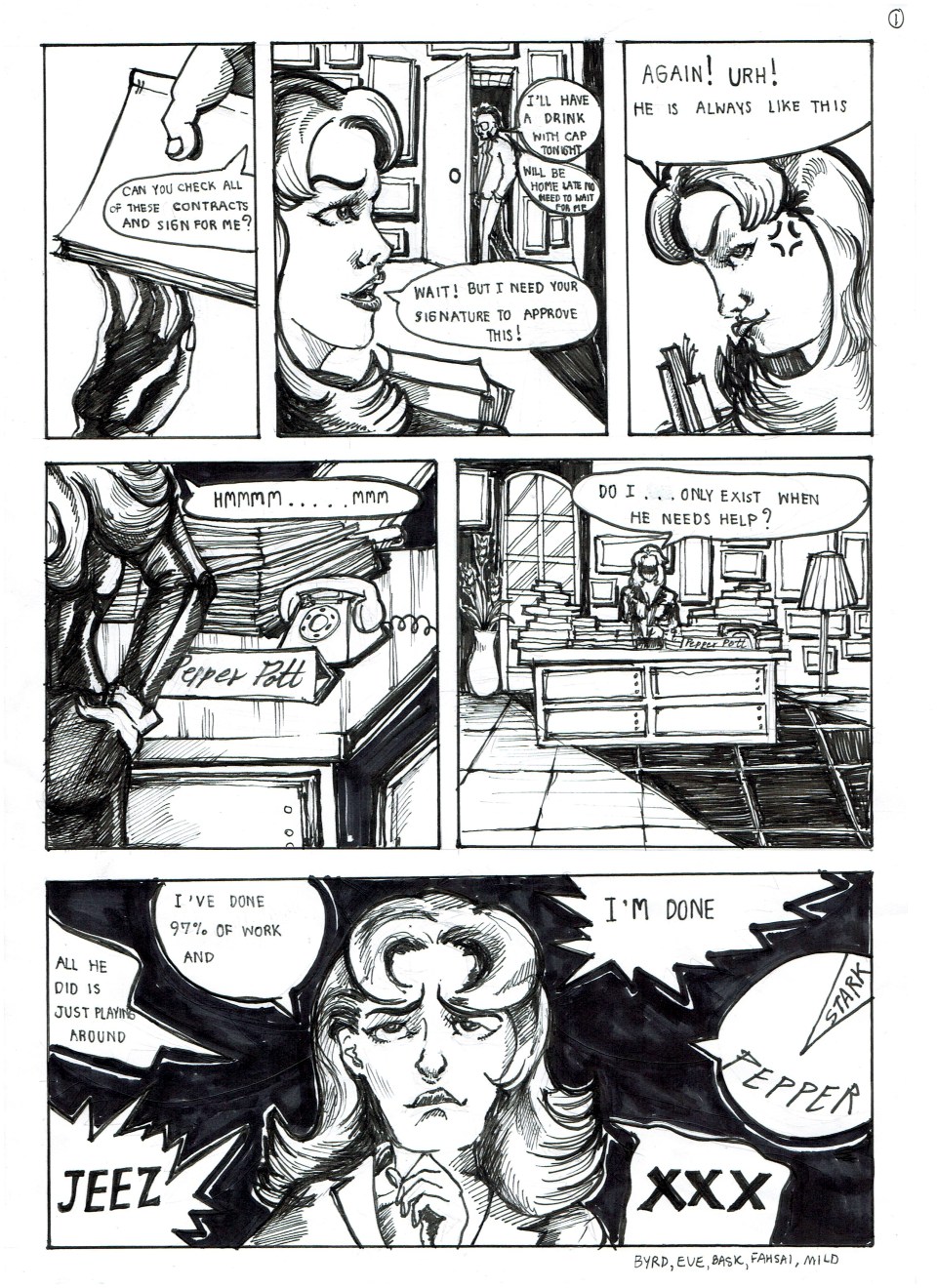
A satirical take on the Smurfette Principle starring Pepper Potts and Tony Stark (aka Iron Man).
“The Smurfette Principle” satirical comics (page 1/4) by 1st year CommDe students Byrd, Eve, Bask, Fahsai and Mild. March 2018. Based on the Tony Stark/Iron Man character created by Stan Lee, Larry Lieber, Don Heck and Jack Kirby, and on the Virginia “Pepper” Potts character created by Stan Lee and Don Heck.“The Smurfette Principle” satirical comics (page 2/4) by 1st year CommDe students Byrd, Eve, Bask, Fahsai and Mild. March 2018. Based on the Tony Stark/Iron Man character created by Stan Lee, Larry Lieber, Don Heck and Jack Kirby, and on the Virginia “Pepper” Potts character created by Stan Lee and Don Heck.“The Smurfette Principle” satirical comics (page 3/4) by 1st year CommDe students Byrd, Eve, Bask, Fahsai and Mild. March 2018. Based on the Tony Stark/Iron Man character created by Stan Lee, Larry Lieber, Don Heck and Jack Kirby, and on the Virginia “Pepper” Potts character created by Stan Lee and Don Heck.“The Smurfette Principle” satirical comics (page 4/4) by 1st year CommDe students Byrd, Eve, Bask, Fahsai and Mild. March 2018. Based on the Tony Stark/Iron Man character created by Stan Lee, Larry Lieber, Don Heck and Jack Kirby, and on the Virginia “Pepper” Potts character created by Stan Lee and Don Heck.
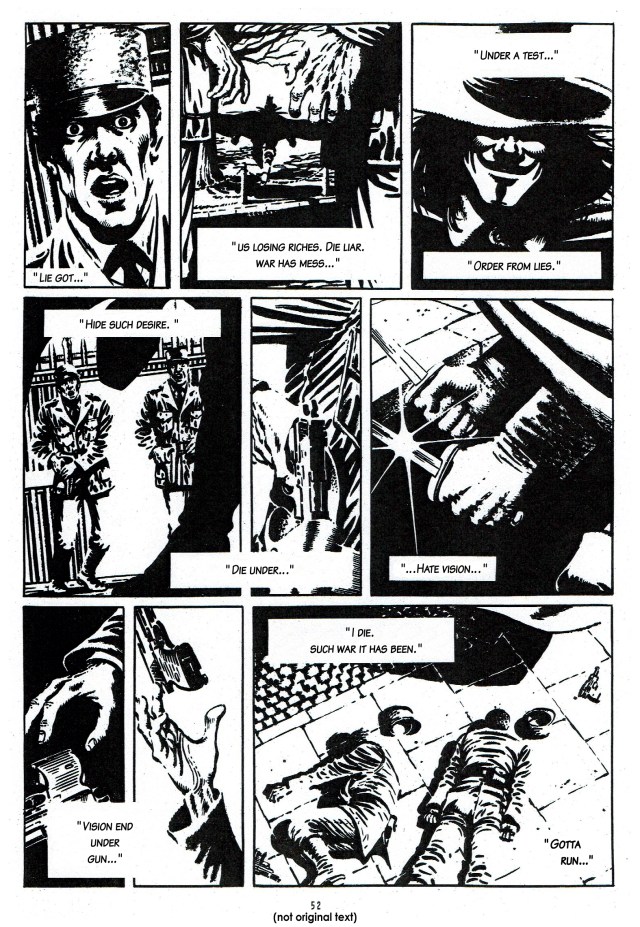
#VforVersion(s); alteration of imposed comics pages in foreign language -to the participants- (German edition of British creators Alan Moore and David Lloyd‘s V for Vendetta, and original edition of French cartoonist Lewis Trondheim‘s Psychanalyse) by partial deletion with white-out liquid of textual elements -such as sentences, words, letters or letter parts- to form a new text in English language which would be consistent with the unaltered pictorial sequence.
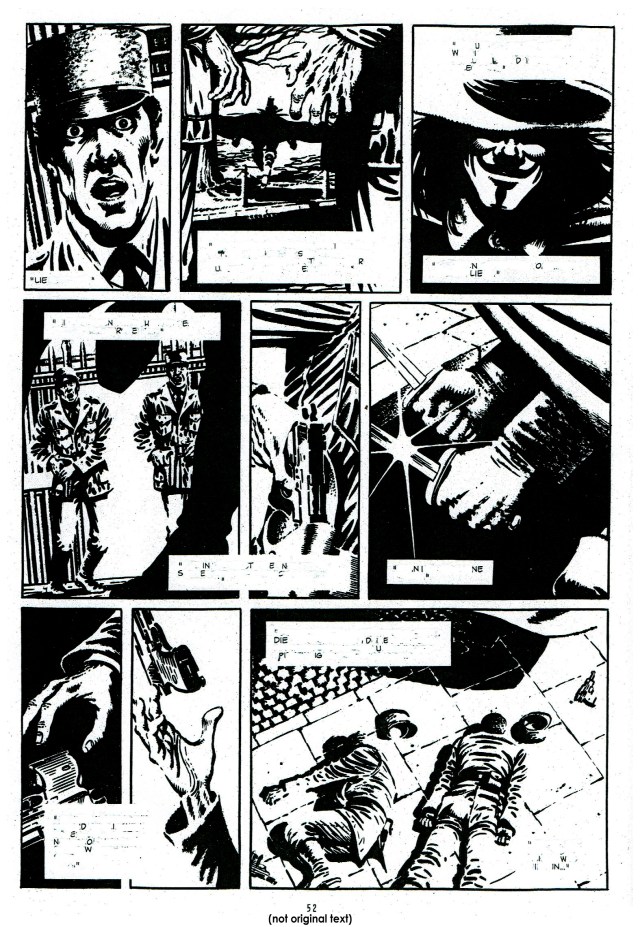
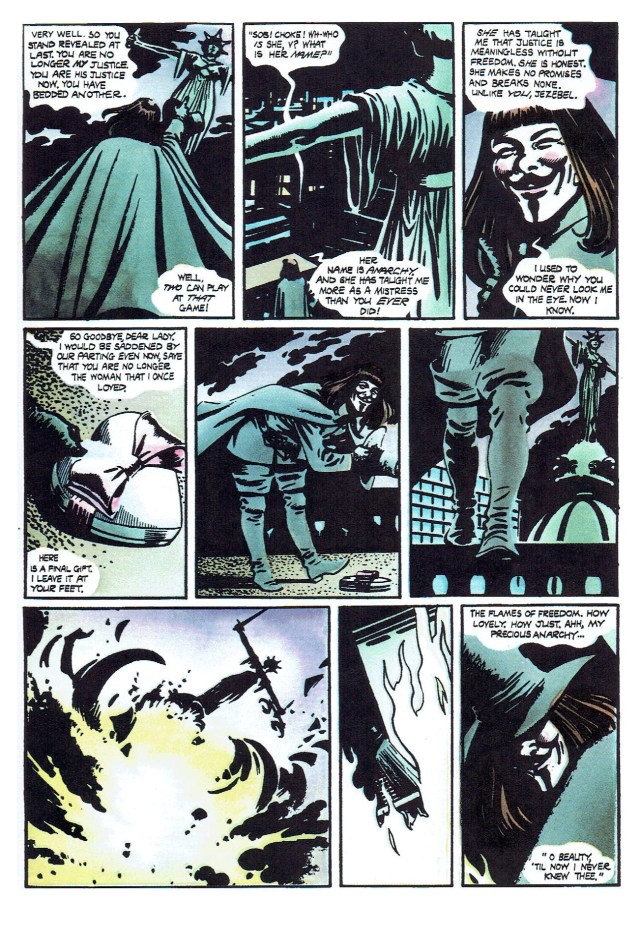
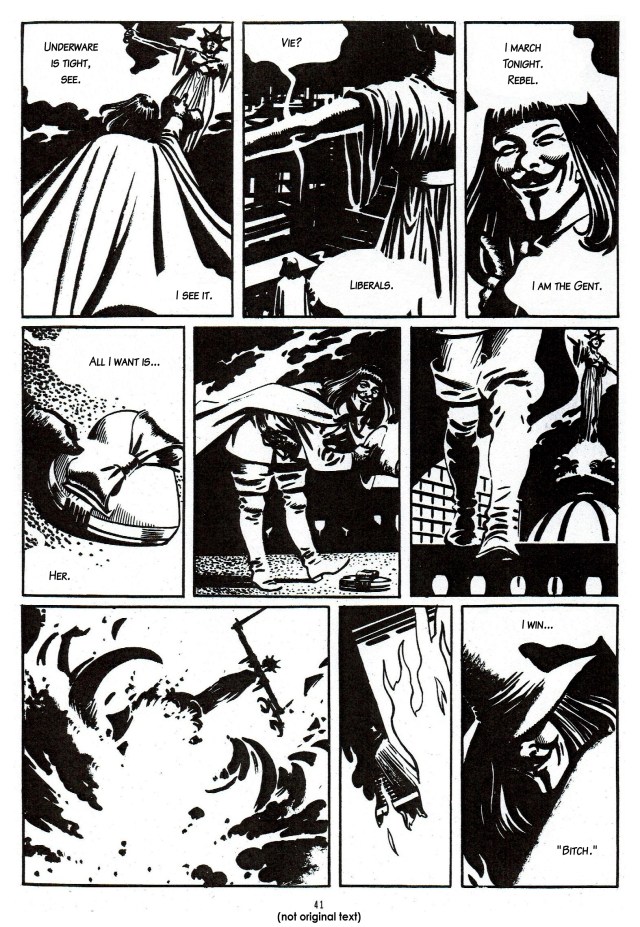
Fig 1. A. – Tier from the 1988 American color collected edition of V for Vendetta by DC Comics/Vertigo (original text). B. – Tier from the 2003 German edition of V for Vendetta (V wie Vendetta) by Speed Comics, with black and white pages as serialized in the 1982 original British edition. C. – Same tier of the German edition but with partial alteration (elements of the text are whited out) by Thai student Mon to form English words and sentences. D. – Same tier as before but with Mon’s selected letters and words reassembled for ease of reading. Credits:V for Vendetta, co-created by Alan Moore (script) and David Lloyd (art) with colors by Steve Whitaker, Siobhan Doods and David Lloyd.
1. Introduction
April 2018. The 62 students of the Creative Writing for Printed Matter course (sections 10 and 11; “Graphic Writing”) at the International Program (BA) in Communication Management (Faculty of Communication Arts, Chulalongkorn University, Bangkok , Thailand) were provided with a series of imposed comics pages excerpted from the 2003 German edition of V for Vendetta (1 to 3 pages depending on section), of the 1996 edition of Lewis Trondheim‘s Psychanalyse (2 consecutive pages in French language), and of the American edition of the ongoing manga series Sunny by Japanese cartoonist Taiyō Matsumoto (2 consecutive pages).
“Ajarn [teacher], where do you find all the ideas you torture us with every week?”
Student Gam during the in-class assignment. Answer: Oupus series, OuBapo FB page, and my tortuous mind.
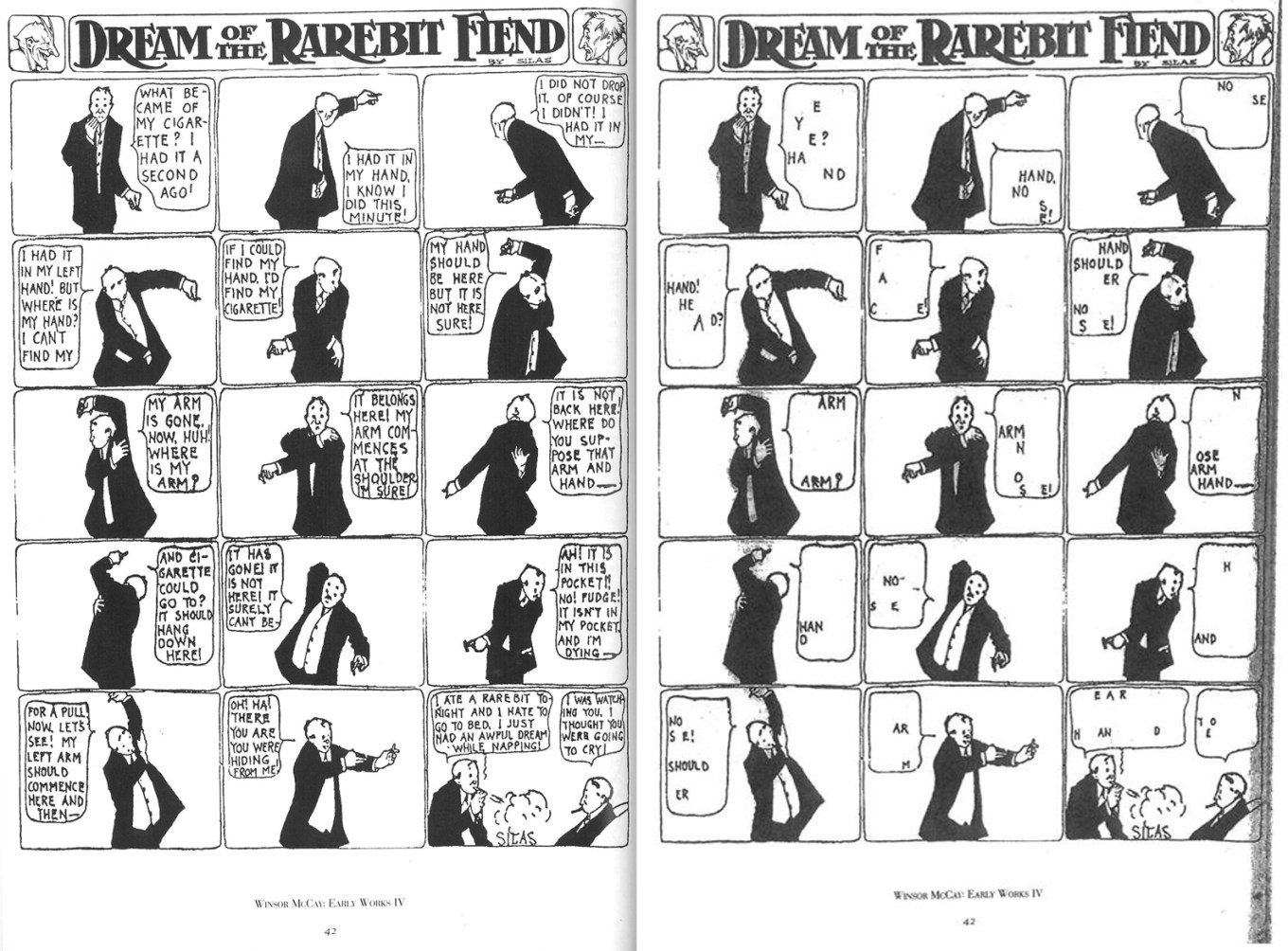
A remarkable example of white-out text alteration by Melissa Eddings Mancuso for Matt Madden’s online course about constraints for The Pennsylvania Academy of the Fine Arts. In a comic strip from the series Dream of the Rarebit Fiend (launched in 1904) by Silas (aka Winsor McCay), Melissa “looked for names of body parts in the original dialogue and then simply whited out the other letters,” providing us with instant poetry.
Under a “transformative constraint (which alter existing works)” students -in teams of 2 to 5 participants- were asked to do a partial alteration of the written texts, by erasing/covering with white-out liquid some textual element in order to form new sentences which would be consistent with the unaltered pictorial sequence. Additionally, students had to compose English (words and) sentences by respecting the order of appearance of the selected letters (or groups of letters). The most painstaking -if not painful- aspect of the exercise was related to the pages in German and French languages, two foreign languages that participating Thai and exchange students do not speak. If text alteration constraints aren’t new in Literature or Comics Art (see Lettrism, Tom Phillips, blackout poetry, cut-up technique, TNT en Amérique by Jochen Gerner [Fig 2], OuBaPo), the use of texts written in a language not spoken by the participant(s) seems to me less usual (as far as I know). The inability to understand the content of the foreign text and the constraint to propose an altered text in a mastered language (here English) are indeed quite a radical restrictions.
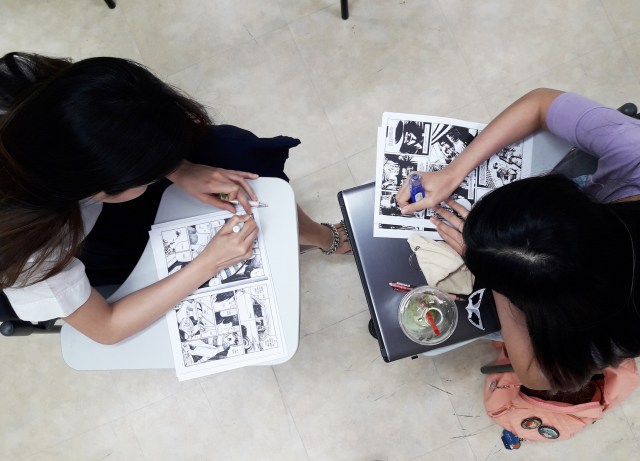
Students Pat and Nymph whiting out fragments of text from imposed pages of Taiyō Matsumoto’s Sunny and Alan Moore and David Lloyd’s V for Vendetta to create new narratives.
Even if German, French and English languages share the same Roman script (with sometimes additional letters) and if they share numerous cognates (or words with a common etymological origin) as neighboring Indo-European languages, these cognates have taken different forms (such as “colleague” in English, “collègue” in French and “Kollege” in German). Unable to use cognates (or false cognates or false friends) unless sharing identical spellings, participants are thus forced to compose English words (and sentences) with smallest units of writings like graphemes or syllables (or digraphs or larger groups of successive letters). In the first illustration (Fig 1), student Mon was forced to the radical alteration of the German sentence “Den Zorn, der Feuer vom Himmel regnen liess.“(Fig 1B; That Wrath which did rain fire from the Heavens) to compose the English clause “No lie” (Fig 1 C, D). Participants also came to appreciate (sigh) the different ratios of vowels and consonants, as well as the different frequencies of letters and syllables, in German, French and English languages… Students noted the low frequency of the vowel ⟨o⟩ in German (2.594%) compared to French (5.796%) and English (7.507%). Consequently, the newly formed English sentences tended to be quite short. Using V’s theatrical tirades (and Alan Moore’s verbose writing) was truly convenient in this regard. Let’s note here that the high frequency of the vowel ⟨e⟩ and ⟨d⟩, ⟨o⟩, ⟨t⟩) in French language will be put to good use by students Por and Jean in their hilarious story “DOT” altering pages of Lewis Trondheim’s Psychanalyse (see Fig 5). Accidentally and to the delight of the French speakers, the two students ended their narrative on an English-French false friend word (and within the purest Lewis Trondheim tradition). Quite a revealing slip of the pen, would have said Freud and Lacan.
Students Belle, Fame and Prim whiting out fragments of text from imposed pages of Lewis Trondheim’s Psychanalyse, Taiyō Matsumoto’s Sunny and Alan Moore and David Lloyd’s V for Vendetta to create new narratives.
The two main objectives of this exercise under radical restriction were: first, to prevent the participants from relying to much on familiar words and clauses that could be used without much alteration; second: to ensure that the altered text would be a complete creation with a new set of meanings, not influenced by the original content of the written text (as its meaning isn’t understood by the participants who don’t speak the language in which it is written) but mostly by their own interpretation of the visual sequences they are imposed with. The accompanying visual sequence is an additional productive constraint which led to the selection of possible themes and story-lines. The alteration of the comics pages excerpted from Lewis Trondheim’s Psychanalyse -a proto-OuBaPian comics itself using the constraint of iconic iteration applied to only two different panels (see below)- was in this respect less productive; the minimal visual “context” complicated the selection of a theme or concept (within the allocated time). However, it led to the brilliant “DOT” story by students Por and Jean (see Fig 5). The challenge was, as I said, painstaking -if not painful at times (sorry, kiddos!)- but the resulting pages were worth the effort, filled with comics poetry -if not Poetic Justice- and concert tickets for AC/DC (see Fig 20)…
Students Noinae, Paan and Boss whiting out together fragments of text from Lewis Trondheim’s “Psychanalyse”, to finish their assignment on time.
Student French Fries whitening out fragments of text from the German edition of “V for Vendetta”.
Text alteration on the German edition of “V for Vendetta”.
A Circle of Inferno in Dante’s “Divine Comedy”. CommArts students at work.
Text alteration on Taiyo Matsumoto’s “Sunny”.
Additional comments on the constraints:
The choice of V for Vendetta pages was made for several reasons: first, as a nod to the Master Class held two years ago during this course by V for Vendetta‘s co-creator and artist David Lloyd; second, the pleasure to enjoy his starck chiaroscuro technique with masterful use of negative spaces, third; to make the use of Alan Moore’s verbose script in the process of extended deletion of text; fourth, because the graphic novel V for Vendetta is sadly as relevant now than it was then, moreover in current Thai context.
Time limit for the in-class assignment was 3 hours for section 10’s teams (with all three V for Vendetta pages to be altered) and 2 hours for section 11’s teams (with only one V for Vendettapage to be altered).
As mentioned earlier, many letters are not as frequent in German or in French as in English. To alleviate their suffering, students were allowed to tamper with some letterforms but only by reduction (deletion/erasing). The leg of ⟨K⟩ could be white out to form a ⟨Y⟩; same goes for ⟨R⟩ turned into a ⟨P⟩ (or even a ⟨D⟩). The diagonal stroke of ⟨Z⟩ was turned in a typographical slash (to form the slash in AC/DC). ⟨E⟩ could become ⟨I⟩ or ⟨L⟩ or ⟨F⟩; ⟨N⟩ turned into ⟨V⟩; or “NV” into ⟨W⟩ with erasure of the first stroke and some stretch of closure. Digraphs could be transformed into punctuation marks, such as “TR” into an ellipsis (“…”).
Fig 2. Left: page from Tintin en Amérique (Tintin in America) by Hergé. Right: radical reduction (with only fragments of the original text remaining) of the Tintin page by Jochen Gerner for TNT en Amérique“.
“The main interest for me of the comic strip is the infinite possible links between text and image : a system of representation continually confronting , in a kind of alchemy, text and picture . This is the field I endeavour to explore on my own or with OuBaPo (Ouvroir de Bande dessinée Potentielle).
The idea ‘TNT en Amérique’ sprang from these remarks with OuBaPo, from exercises, experiments. I try to find new reading perspectives. I dismantle a given material to make something else of it.” Jochen Gerner (source).
The use of logograms was also allowed. With ⟨N’⟩ for “and”, ⟨C⟩ for “see”, ⟨U⟩ for “you”, ⟨R⟩ for “are”, etc. Usage of slang was permitted too. The slang shortnening “Da” for “the” was accepted as well as “De” for “the” as it remained consistent with the accent of a German character (see Fig 3: A.B. Frost‘s comics, #VforVomans!).
Lewis Trondheim’s handwriting in Psychanalyse tended to complicate the browsing of the text to find usable graphemes and words. However, some ambiguous handwritten letterforms were put at good use with some ⟨O⟩ used as ⟨D⟩ (orconversely), ⟨U⟩ as ⟨V⟩, or ⟨L⟩ as ⟨C⟩.
WARNING: GRAPHIC LANGUAGE [sic]. We do apologize for the use of graphic language in the resulting pages, but the high frequency of the letters ⟨F⟩, ⟨U⟩, ⟨K⟩, ⟨C⟩ or ⟨B⟩, ⟨I⟩, ⟨T⟩, ⟨H⟩ in German language led to the formation of some English swear words; that’s explanation I’ve decided to provide anyway… And yes, “underwear” was spelled “underware” (see Fig 22), because it’s how I pronounce it with my French accent, I guess… #PoeticLicense #PardonMyFrench #Sic
Fig 3. #VforVomans! American cartoonist A. B. Frost’s first comic: a German attempts to pronounce English-language “th” phoneme. “De man, dis horse, dose vomans!” In: Harper’s News Monthly, December 1879.
2. Results for Psychanalyse
Note on Psychanalyse. In the pages of his minicomic series ACCI H3319self-published between 1988 and 1990, then-debuting French cartoonist Lewis Trondheim produced comic strips and single-page comics narratives relying only on the repetition of a photocopied single panel or a highly limited set of different panels. For instance, in the series of strips collected under the title Psychanalyse [Psychoanalysis] (by Le Lézard Noir, and later by L’Association), each comics page is built only with 4 different panels -but duplicated and arranged following the constraint of “iconic iteration”- presenting, in close-up, the minimalist depiction of a patient discussing with his psychiatrist (kept off-panel). Our transformative constrained exercise is thus applied to comics pages built themselves on proto-OuBaPian productive constraints.
Fig 4. CLICK ON THE PIC TO ENLARGE. Two imposed consecutive pages (in French language) of Lewis Trondheim’s Psychanalyse.Fig 5. CLICK ON THE PIC TO ENLARGE. Same pages of Lewis Trondheim’s Psychanalyse but with partial alteration (elements of the text are whited out) by Thai students Por and Jean to form English words and sentences. Their “DOT” comics, accidentally and to the delight of the French speakers, ends on an English-French false friend word (and within the purest Lewis Trondheim tradition). “Bite” usually defines the “use the teeth to cut into something” in English, but can be a (vulgar) synonym of “penis” in French language. Quite a revealing slip of the pen, would say Freud and Lacan.Fig 6. CLICK ON THE PIC TO ENLARGE. Same pages of Lewis Trondheim’s Psychanalyse but with partial alteration (elements of the text are whited out) by Thai students Erin, Misha, PingPing, Tanya and PunPun to form English words and sentences.
“[V trying to get tickets for] an AC/DC concert: believable. Convincing scenario is essential in any storytelling…”
David Lloyd, V for Vendetta co-creator and artist, commenting on the previous page altered by student French Fries.
Fig 21. Same V for Vendetta page from the German edition, altered by Thai student Mon (and his teammates Tap, Ik, Golf and X). With selected letters and words reassembled for ease of reading. Based on V for Vendetta, co-created by Alan Moore (script) and David Lloyd (artist), DC Comics/Vertigo.Fig 22. Same V for Vendetta page from the German edition, altered by Thai students Noinae, Paan and Boss. With selected letters and words reassembled for ease of reading. Based on V for Vendetta, co-created by Alan Moore (script) and David Lloyd (artist), DC Comics/Vertigo.
Fig 26. Same V for Vendetta page from the German edition, altered by Thai student Mon (and his teammates Tap, Ik, Golf and X). With selected letters and words reassembled for ease of reading. Based on V for Vendetta, co-created by Alan Moore (script) and David Lloyd (artist), DC Comics/Vertigo.
Fig 33. V for Vendetta page from the German edition (see original above), altered by Thai students Art, Mark, Junior and Book. With selected letters and words reassembled for ease of reading. Based on V for Vendetta, co-created by Alan Moore (script) and David Lloyd (artist), DC Comics/Vertigo.Fig 34. V for Vendetta page from the German edition (see original above), altered by Thai students Erin, Misha, PunPun, Earn, Tanya and PingPing. With selected letters and words reassembled for ease of reading. Based on V for Vendetta, co-created by Alan Moore (script) and David Lloyd (artist), DC Comics/Vertigo.Fig 35. V for Vendetta page from the German edition (see original above), altered by Thai students Gam, Mint (Si), Tip and Golf. With selected letters and words reassembled for ease of reading. Based on V for Vendetta, co-created by Alan Moore (script) and David Lloyd (artist), DC Comics/Vertigo.Fig 36. V for Vendetta page from the German edition (see original above), altered by Thai students Lukkaew, Prim, Fame and Belle. With selected letters and words reassembled for ease of reading. Based on V for Vendetta, co-created by Alan Moore (script) and David Lloyd (artist), DC Comics/Vertigo.
“I’m gonna die. I’m gonna die. This is too complicated, Ajarn [teacher]. I’m gonna die.”
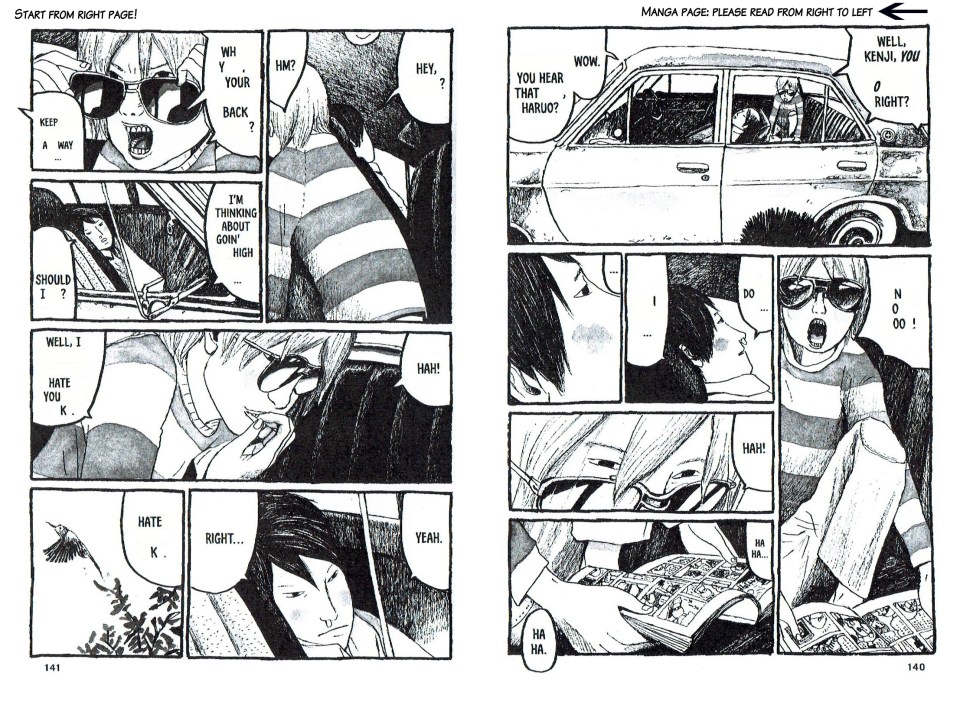
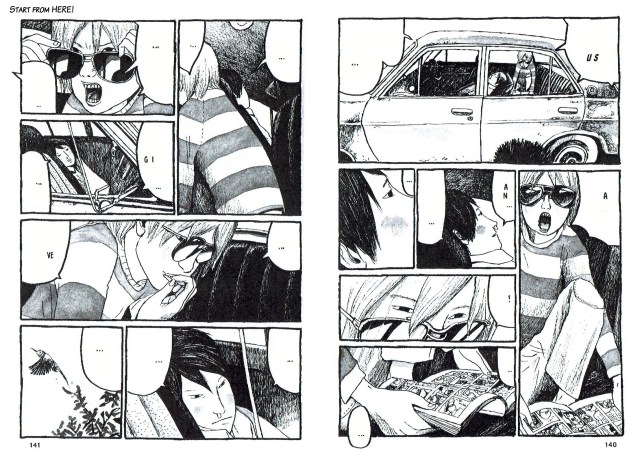
#LetMeSeeYourEyes; substituting the dialogue of a comics/manga page with imposed lines excerpted from Norwegian cartoonist Jason‘s Why Are You Doing This? (Fantagraphics, 2005; Editions Carabas, 2004, for original French version).
BLURB!
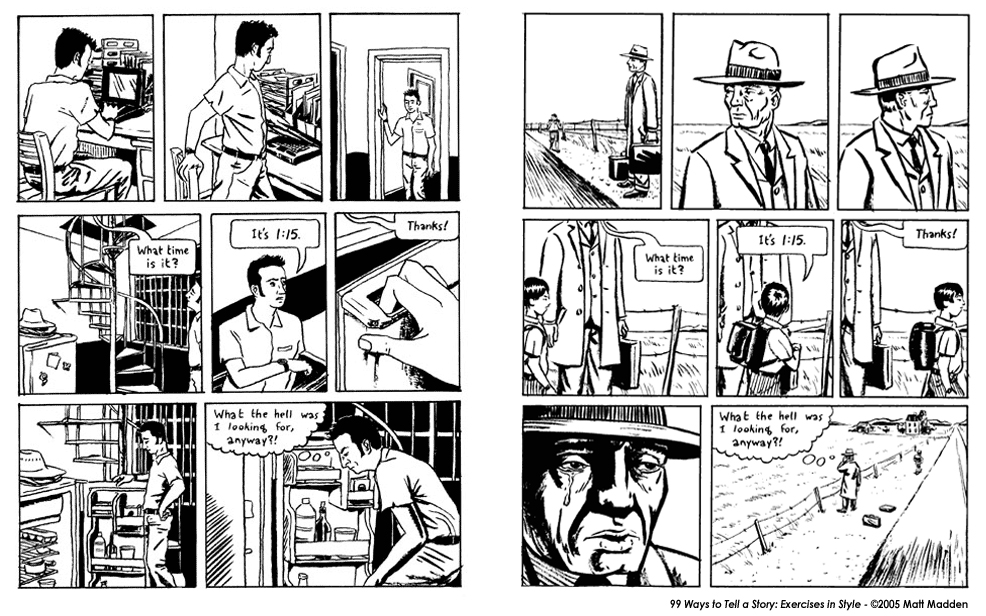
“Great idea for an exercise (the source is impeccable, of course!). The examples work really well, and the Peanuts page shows how this principle can be expanded on and could even be used for a book-length work made up of quotes, borrowed page layouts, mash-ups, etc.” Matt Madden(February 17, 2018), cartoonist and teacher best known for his book 99 Ways to Tell a Story: Exercises in Style (Penguin), as well as a member of Oubapo (Workshop for Potential Comics), and later a French knight in the Order of Arts and Letters.
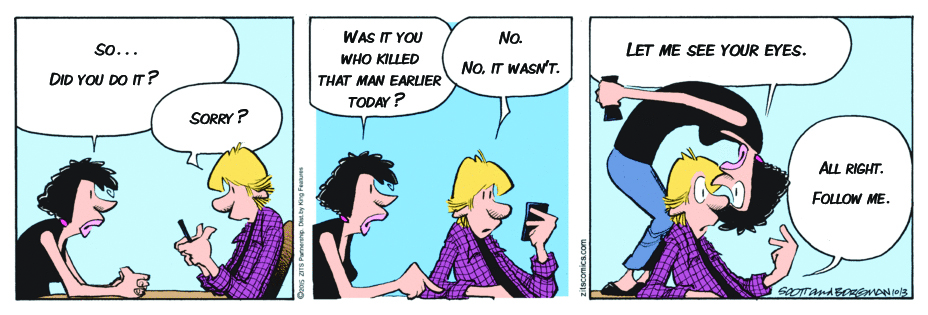
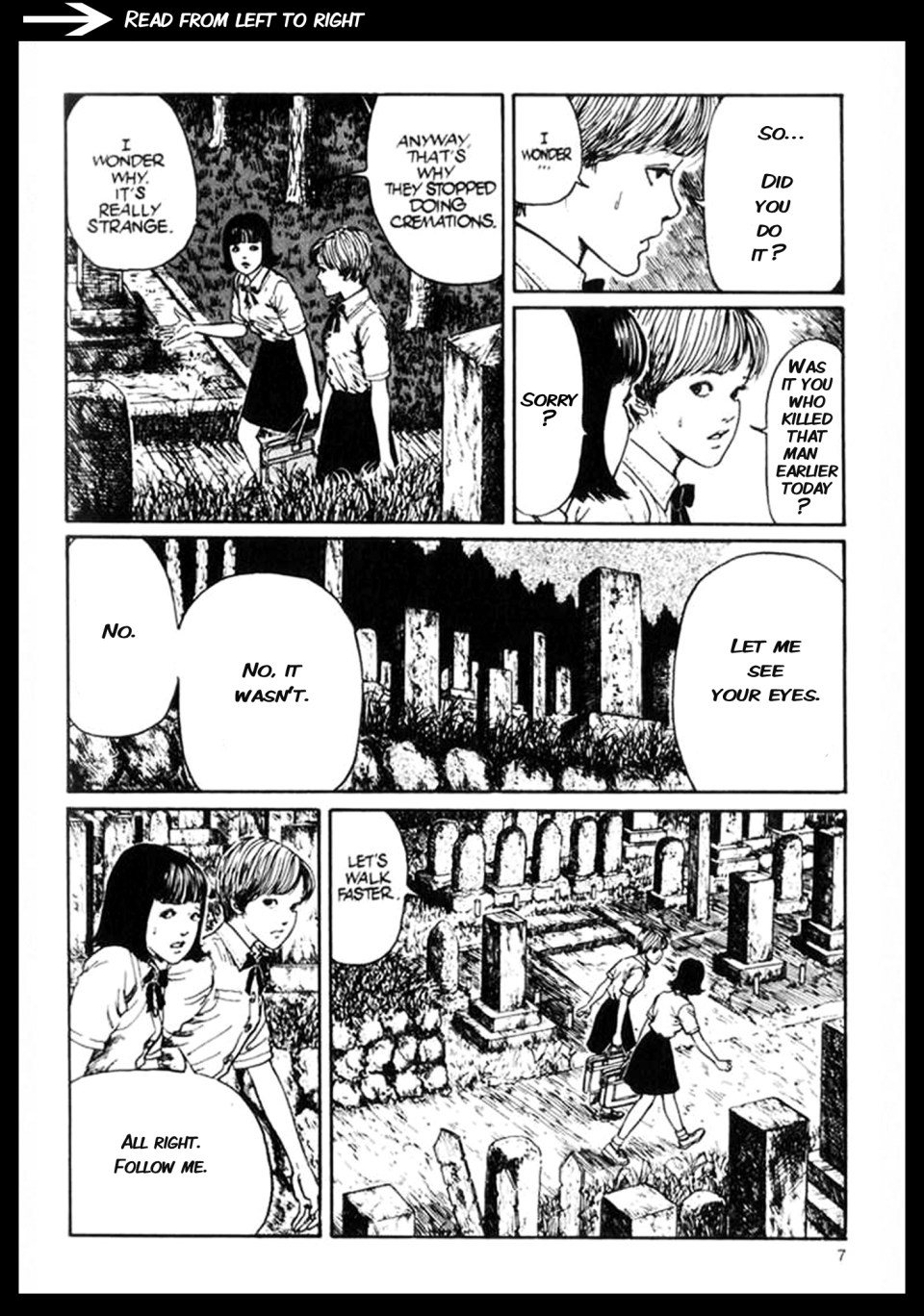
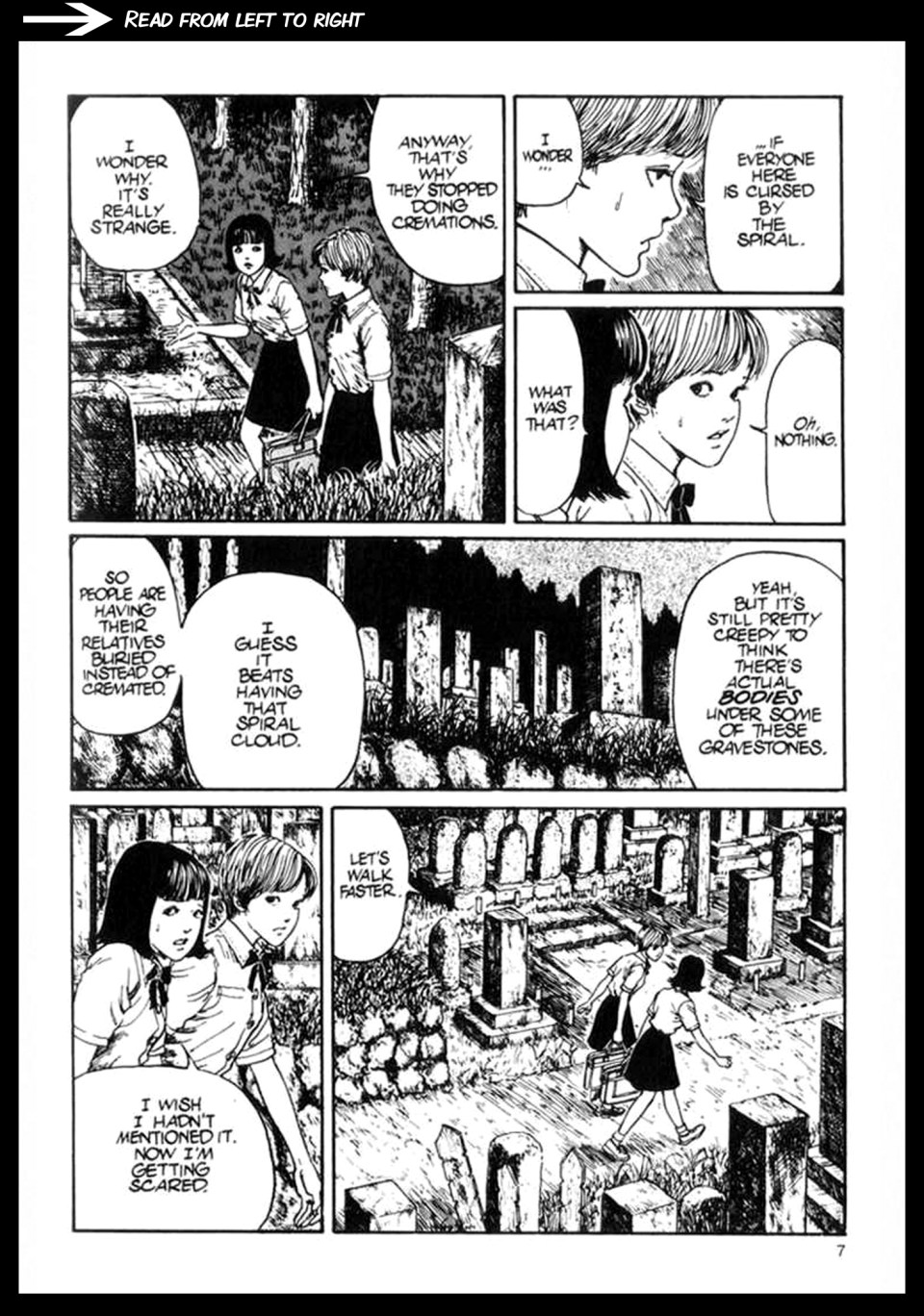
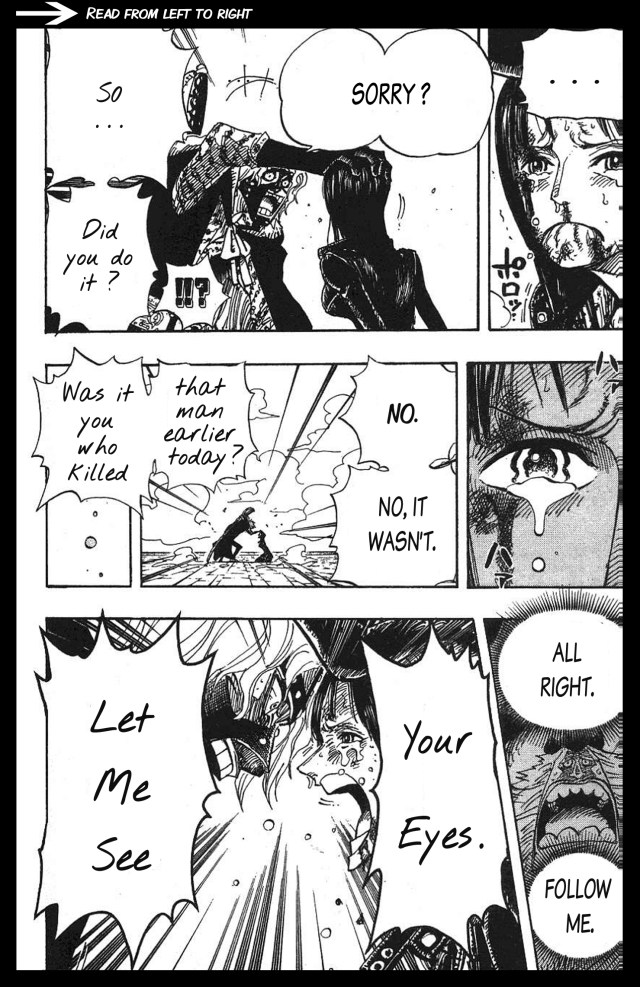
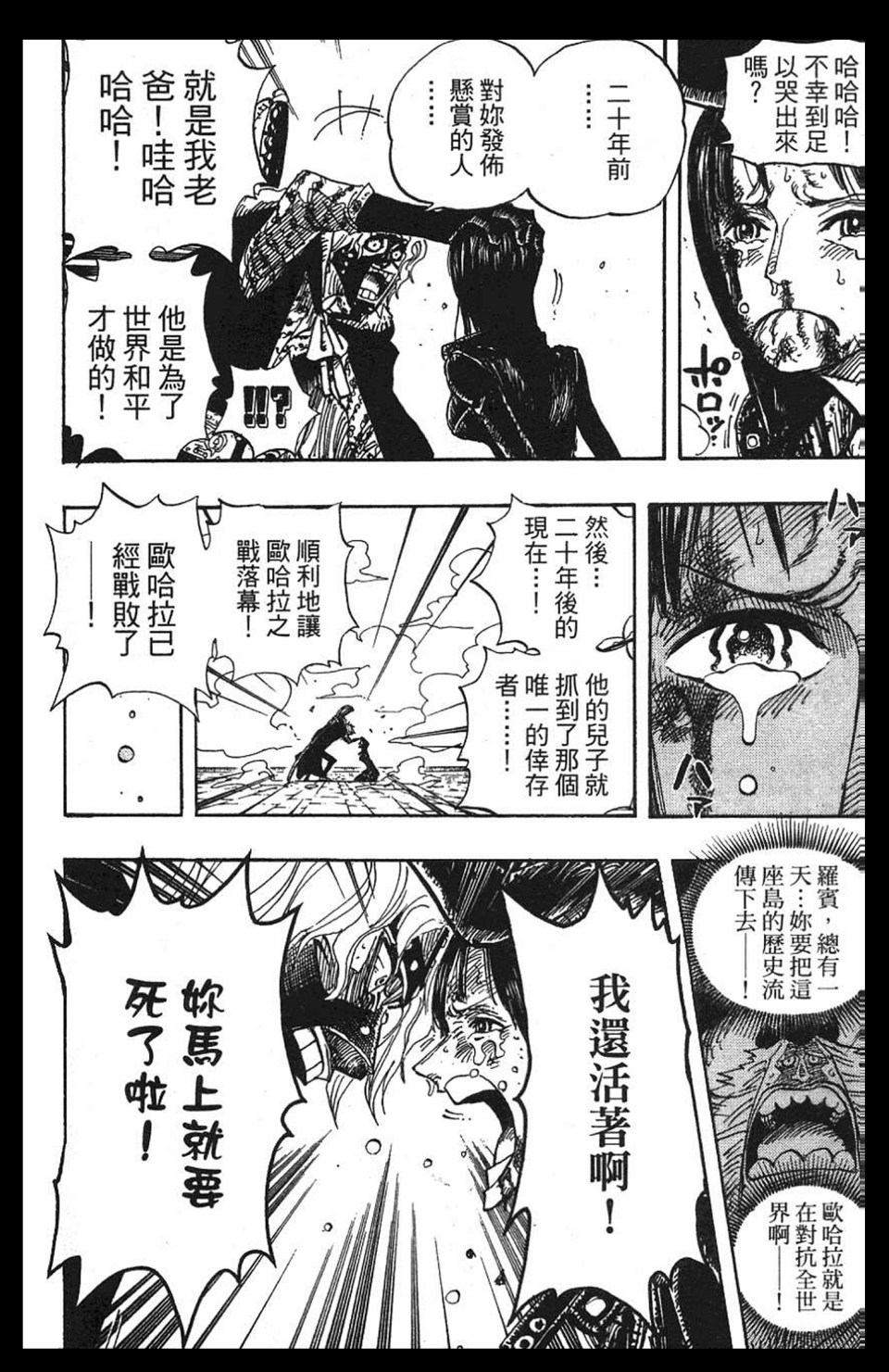
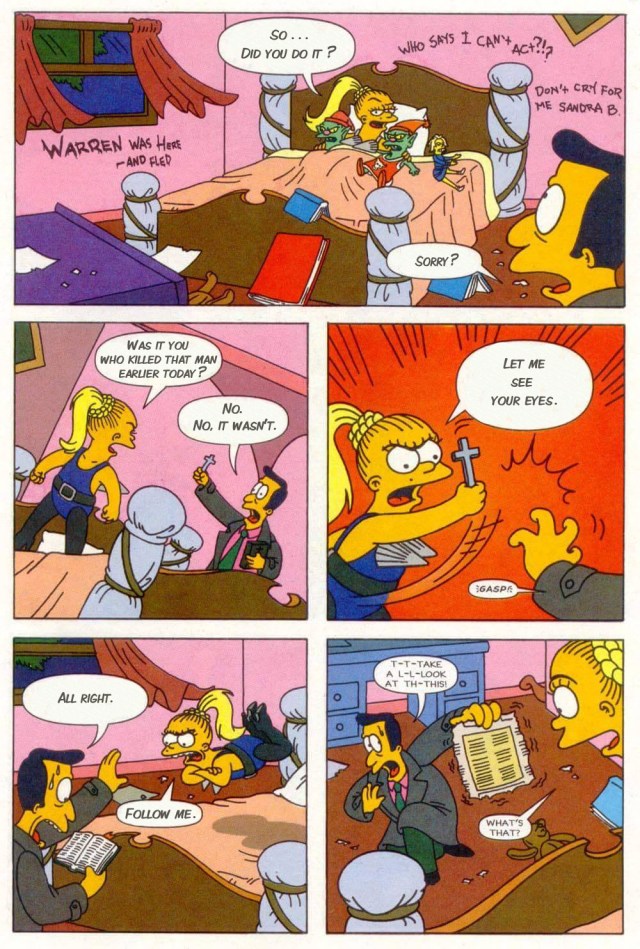
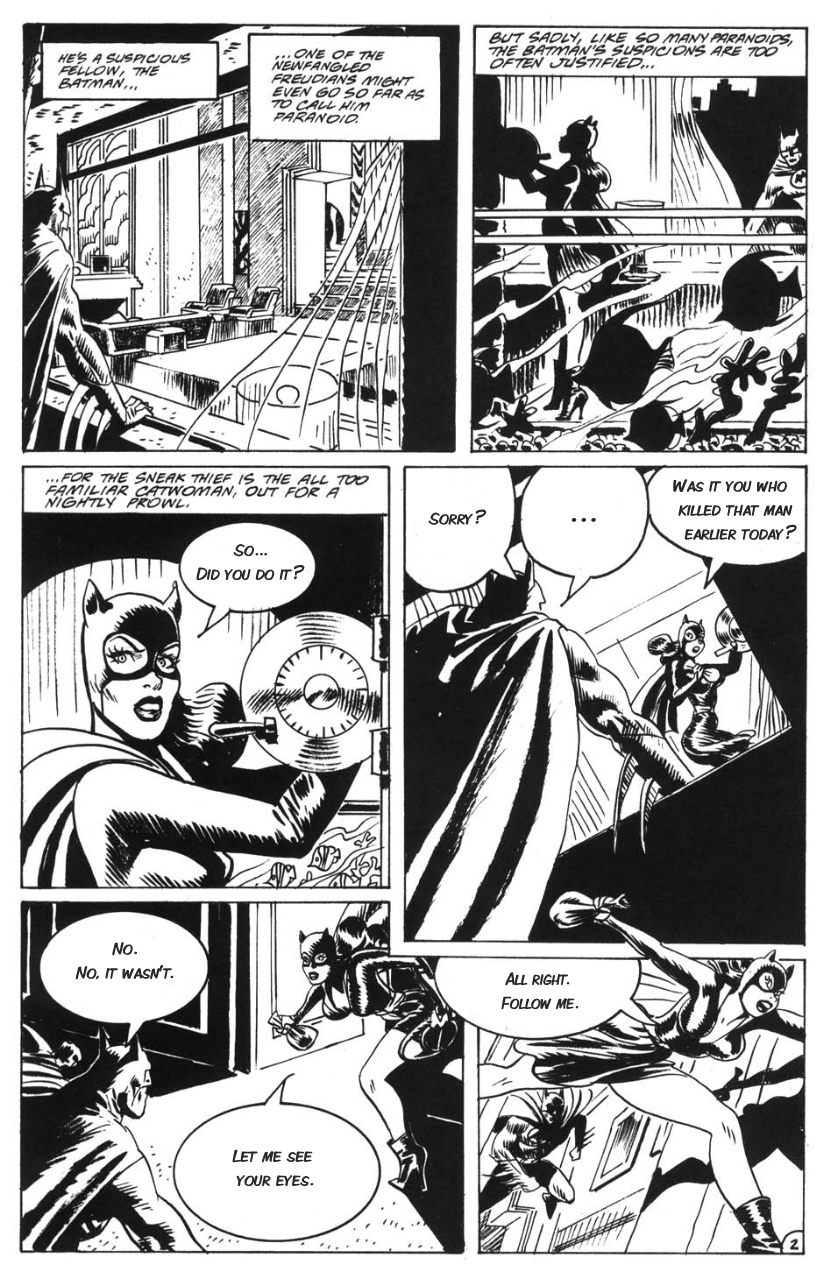
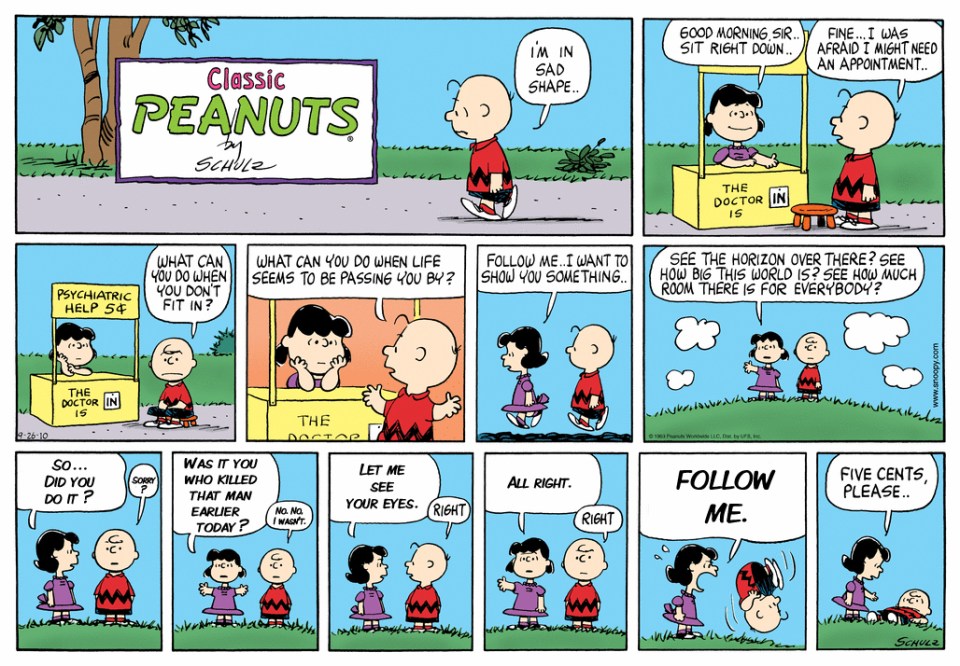
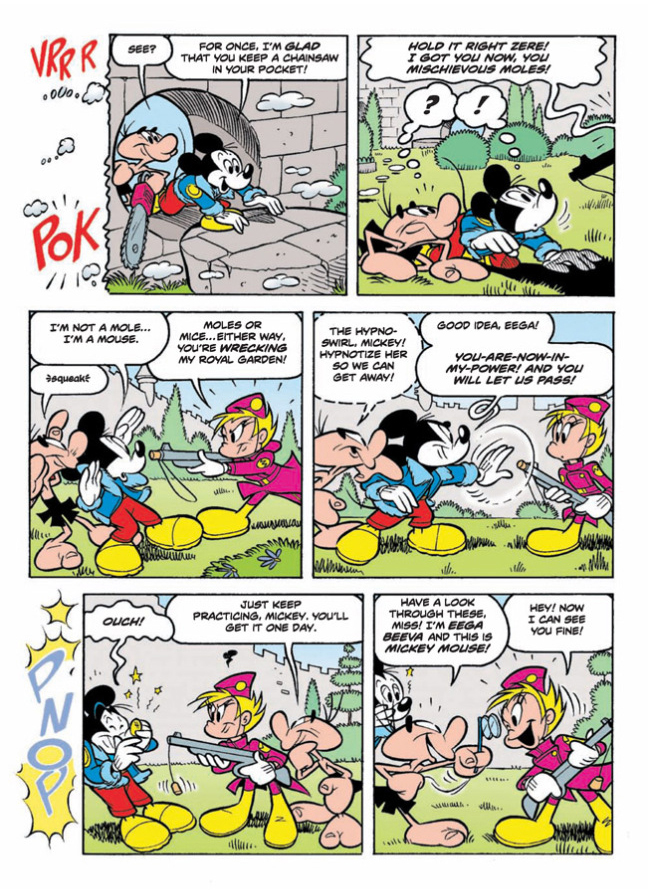
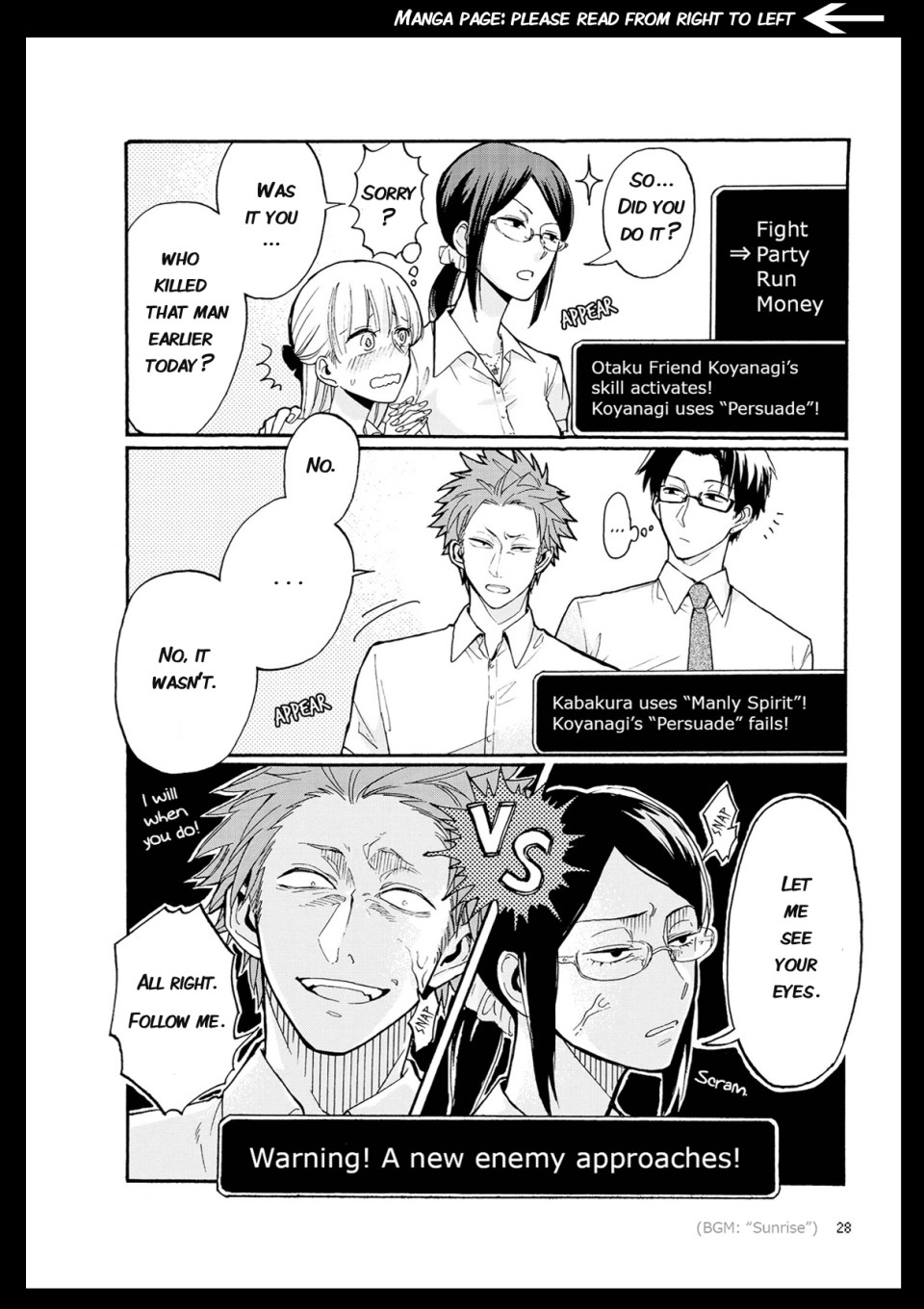
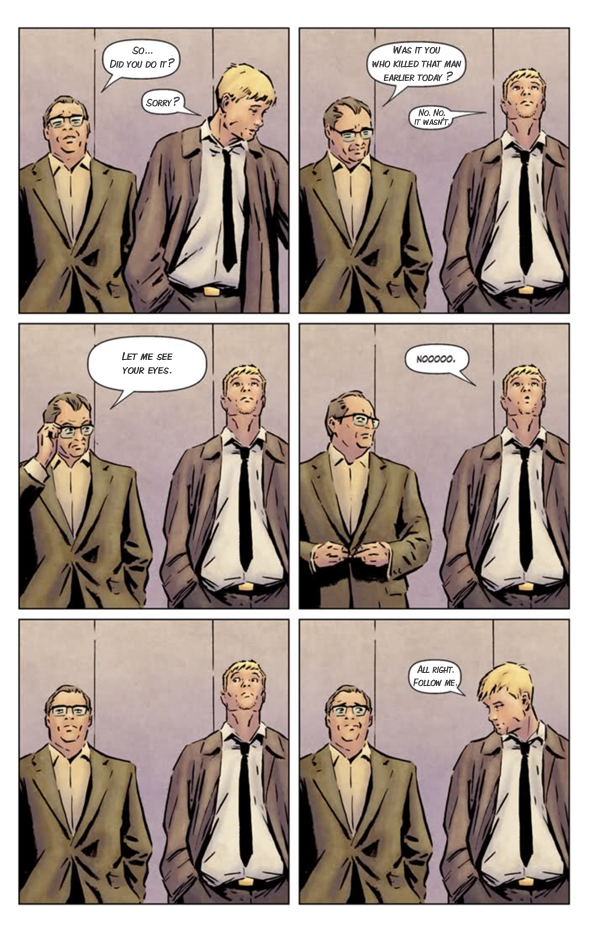
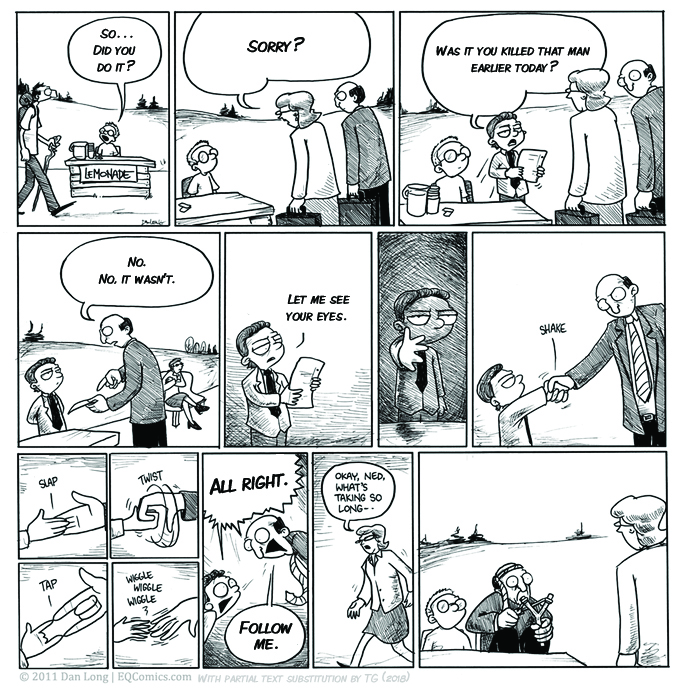
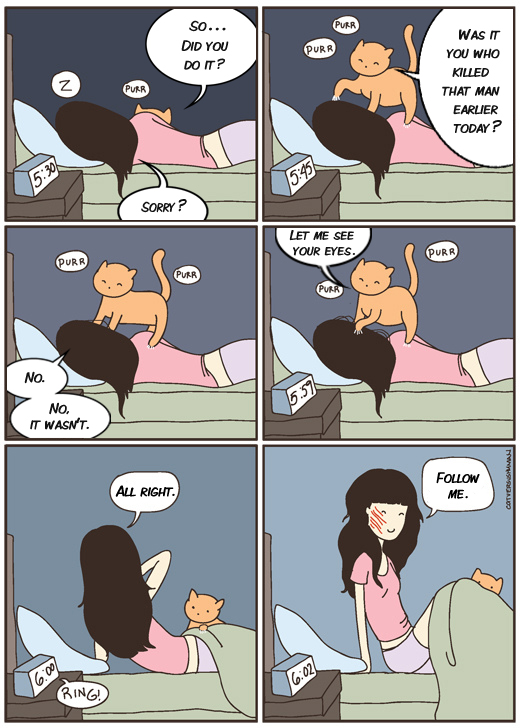
January 2018. The sixty-two (3rd and 4th year) students in the Creative Writing for Printed Matter course (sections 10 and 11; “Graphic Writing”) at the International Program (BA) in Communication Management (Faculty of Communication Arts, Chulalongkorn University, Bangkok , Thailand) were provided with a series of imposed lines excerpted from Jason’s comics Why Are You Doing This?: “So… Did you do it? / Sorry? / Was it you who killed that man earlier today? / No. No, it wasn’t. / Let me see your eyes. / All right. Follow me.” After being shown an example (Tintin in Tibet; see below) and as a home assignment, students were given one week to find a comics/manga page in which the dialogue might fit -with the least possible alteration- by substitution.
“The function of relay is less common (at least as far as the fixed image is concerned); it can be seen particularly in cartoons and comic strips. Here text (most often a snatch of dialogue) and image stand in a complementary relationship; the words, in the same way as the images, are fragments of a more general syntagm [sequence of linguistic units] and the unity of the message is realized at a higher level, that of the story, the anecdote, the diegesis […].” Roland Barthes, Rhetoric of the Image (translation S. Heath), in: Image, Music, Text, 1977.
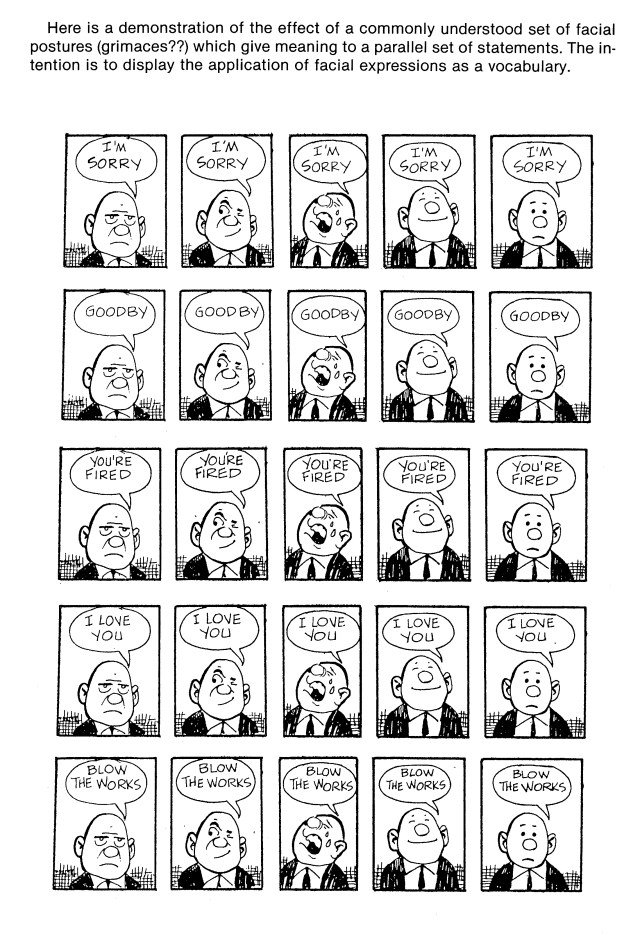
Goals of this warm-up exercise; production of new comics pages by students without any particular artistic training; browsing of dozens of comics pages, and development of the “image reading” skill by focusing students’ attention on visual motifs in pictures and sequences; development of multimodal literacy through the combination/confrontation of visual (drawings), aural (speech, tone), linguistic (delivery of both “written and spoken” text), gestural (facial expressions/body language/postures) and spatial (spatialisation of text & sequences of adjacent panels) modes; exploration of text/image relationship (anchorage/relay); to stress out the importance of eye contact in drama.
“[Comics] doesn’t blend the visual and the verbal – or use one simply to illustrate the other – but is rather prone to present the two non-synchronously; a reader of comics not only fills in the gaps between panels but also works with the often disjunctive back-and-forth of reading and looking for meaning.” Hillary Chute, “Comics as Literature? Reading Graphic Narrative”, in: PMLA, 123(2), 2008
Page from Jason’s comics Why Are You Doing This?(Fantagraphics, 2005). Imposed lines for the exercise were excerpted from panels 6 to 12.Example provided to the students: original (half-) page of Tintin in Tibetby Hergé; before text substitution.Example provided to the students: (half-) page of Tintin in Tibet by Hergé after text substitution (by yours truly) of the imposed lines excerpted from Jason’s Why Are You Doing This?.
Commenting on Gunther Kress’s Multimodality, Jacobs notes that linguistic, visual, audio, gestural, and spatial elements combine in comics narratives and that, “[taken] together, these elements form a multimodal system of meaning making.” (“More than Words: Comics as a Means of Teaching Multiple Literacies”, in: The English Journal, 96(3), 2007.
1. Text substitutions by CommArts students; without any order/speech balloon alteration (except for an additional ellipsis, or “…”, in a couple of pages)
Text substitution by CommArts student Mint (Sirivadee) in a page from the manga adaptation (Titan Comics) by mangaka Jay of the TV series Sherlock.Original page (before text substitution).Text substitution by CommArts student Golf (Sorasak) in a page from the manga Pokémon Adventuresv.34 (VIZ Media) by mangaka Hidenori Kusaka (script) and Satoshi Yamamoto (art).Original page (before text substitution).Text substitution by CommArts student Ben in a Zits comic strip by Jerry Scott and Jim Borgman.Original page (before text substitution).Text substitution by CommArts student Prim in a page from the manga Case Closed(or Detective Conan; VIZ Media) by mangaka Gosho Aoyama.Original page (before text substitution).Text substitution by CommArts student Erin in a page from the Disney fan comic, or doujinshi, Disney High School (featuring Rapunzel and Quasimodo as siblings) by Morloth88.Original page.Text substitution by CommArts student WIN in a page from the manga Uzumaki (VIZ Media) by mangaka Junji Ito.Original page (before text substitution).Text substitution by CommArts (Taiwanese exchange) student Edd in a page from the manga One Piece (VIZ Media) by mangaka Eiichiro Oda.Scanlated page (before text substitution).Text substitution by CommArts student Plawan in a page from the comics series Bart Simpson’s Treehouse of Horror(Bongo Comics).Original page (before text substitution).Text substitution by CommArts student Yaiyaa (Creative Writing, 2016) in a page from the comics Batman: Blackout (“1940’s Catwoman”, DC Comics, 2000) by Howard Chaykin (script) and Jordi Bernet (pencils).Original page (before text substitution).Text substitution by CommArts student Mark in a strip from the webcomic Cyanide and Happiness (written and illustrated by Rob Den Bleyker, Kris Wilson, Dave McElfatrick and formerly Matt Melvin).Original strip (before text substitution).
2. Text substitutions by CommArts students; respecting the order of the imposed lines but not their strict succession (distribution of the imposed lines before and after text retained from the original comics page).
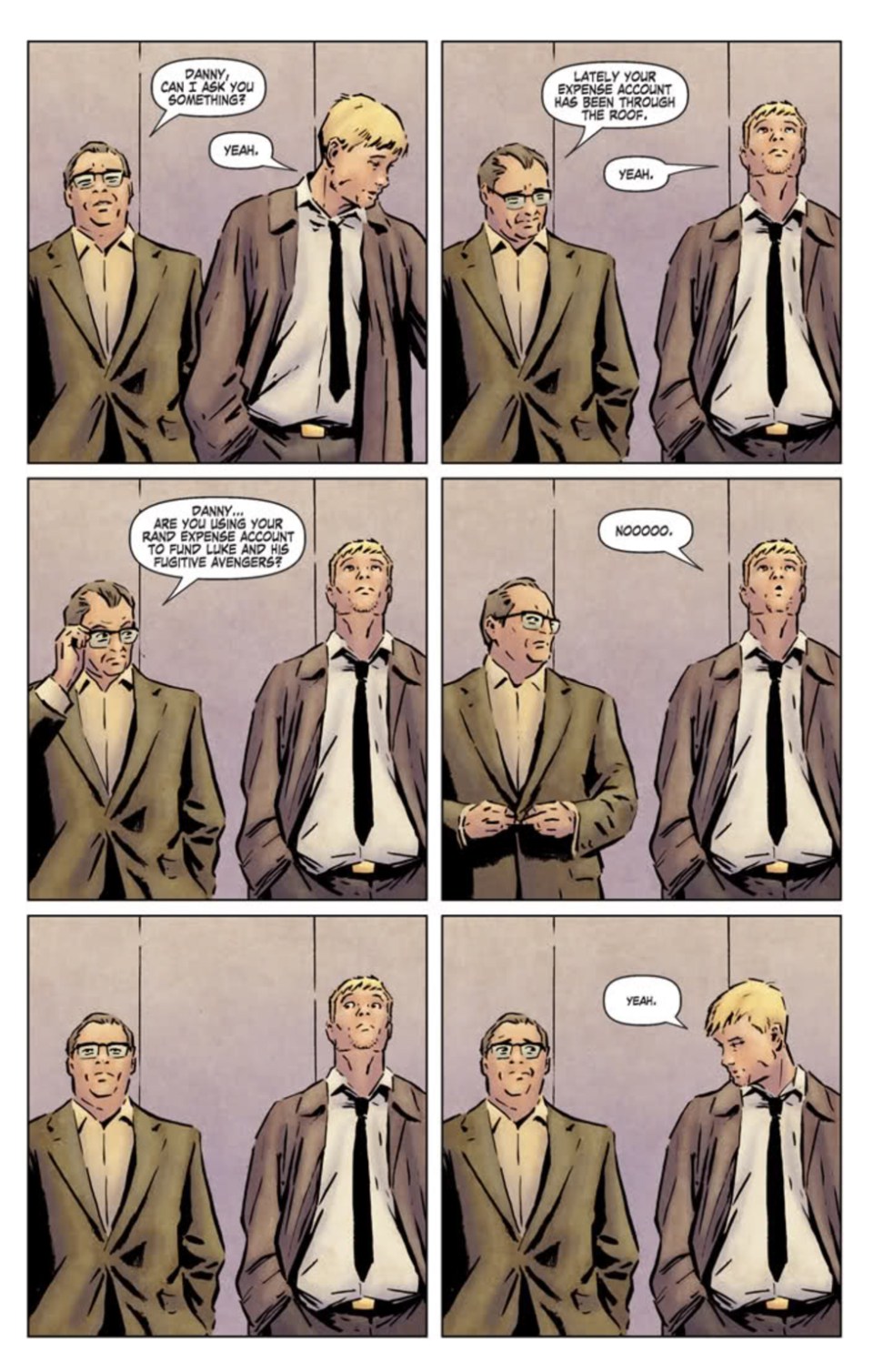
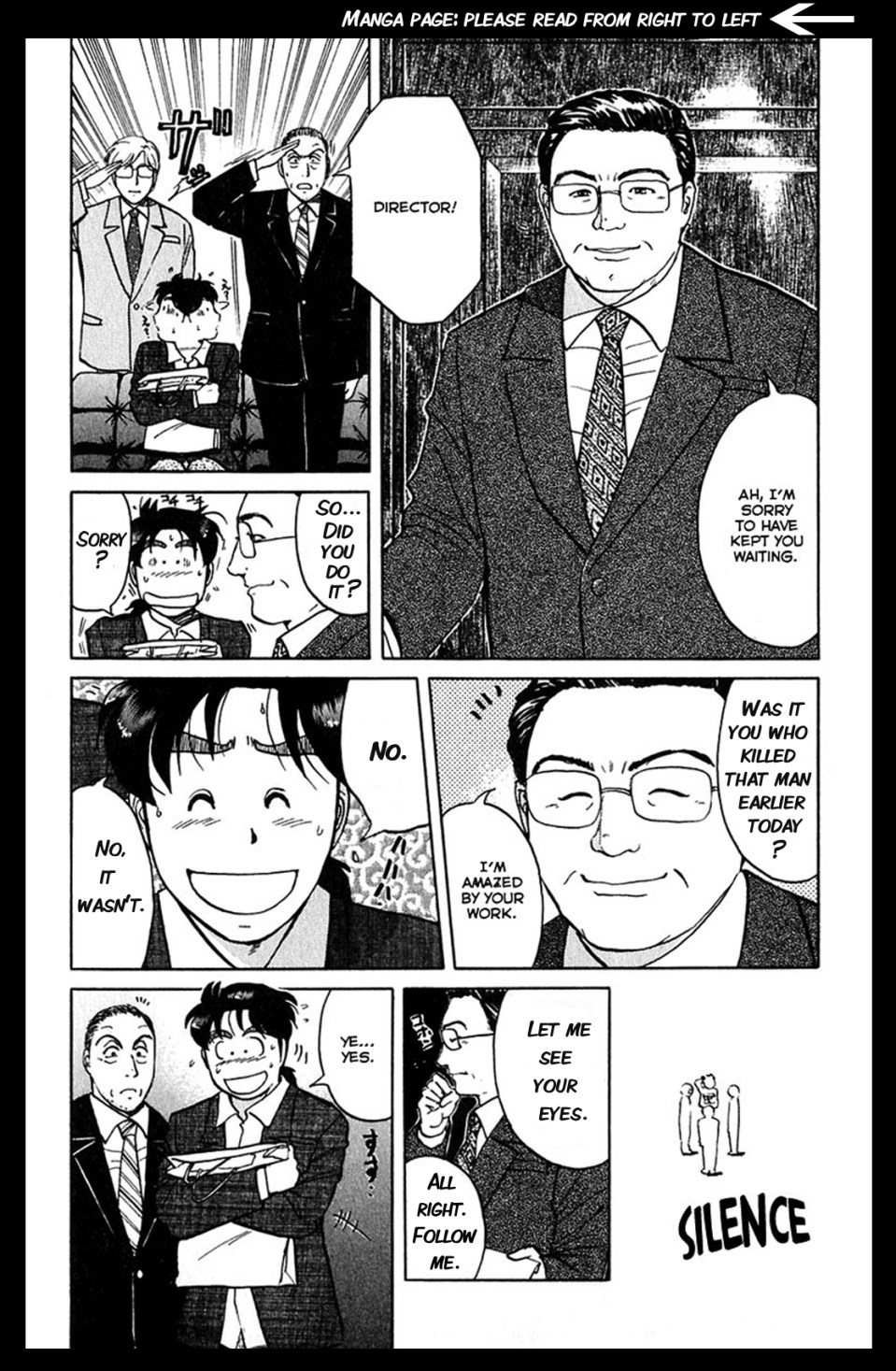
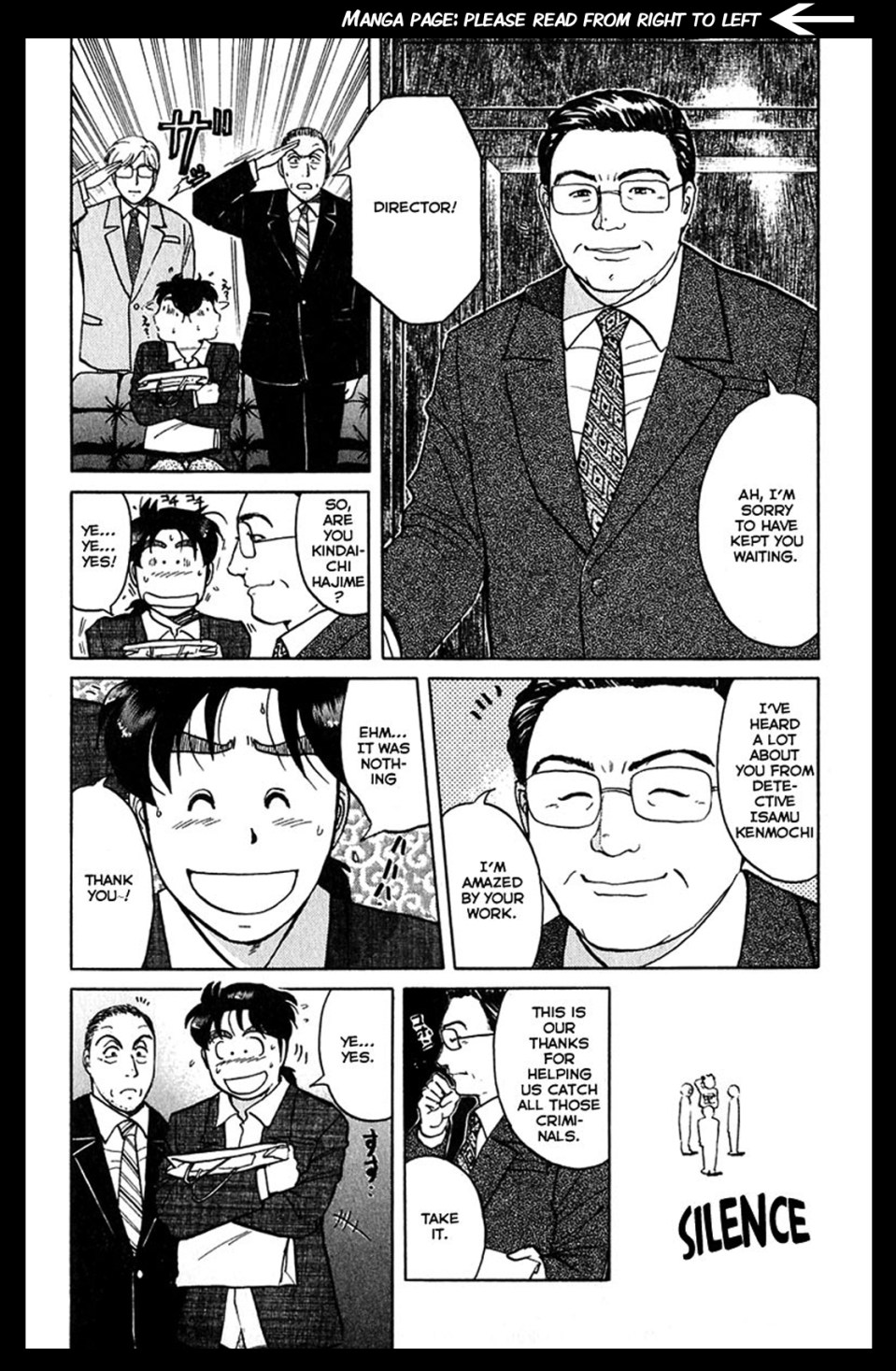
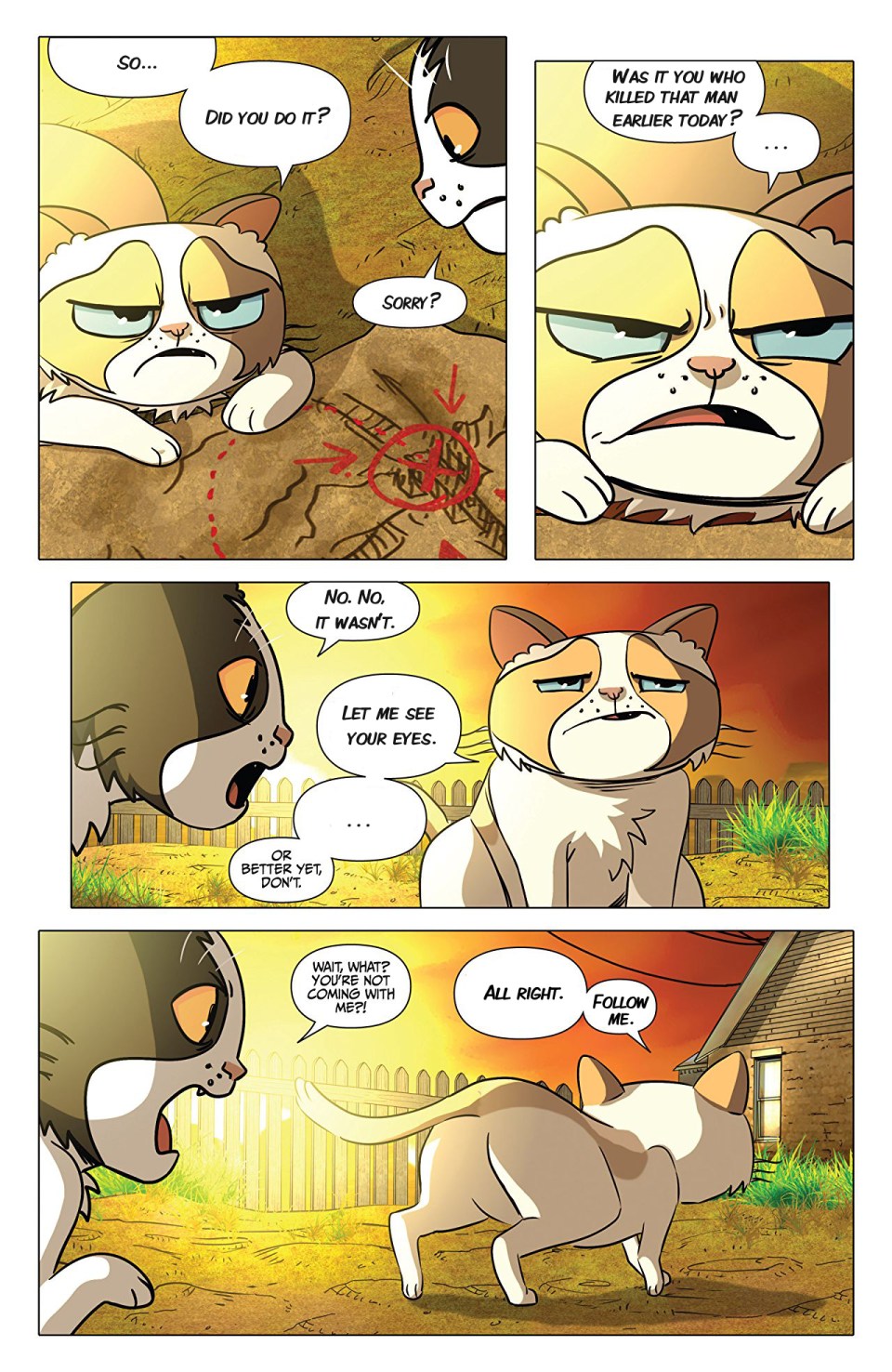
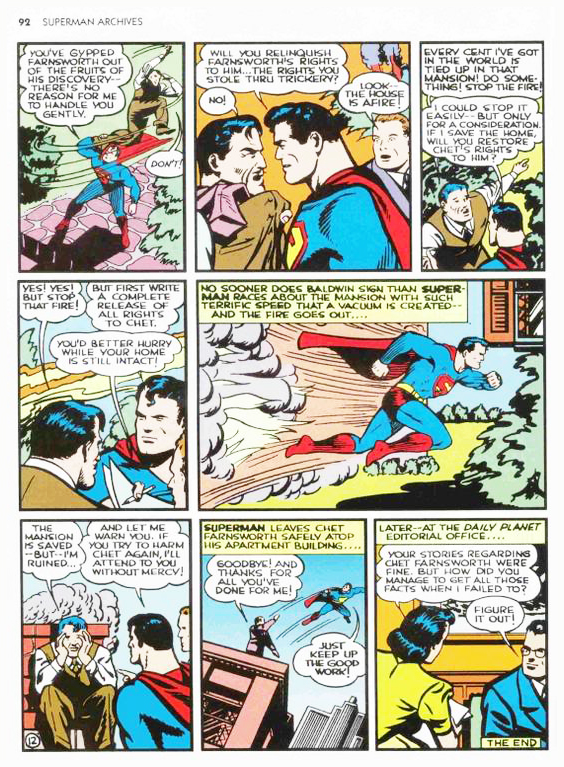
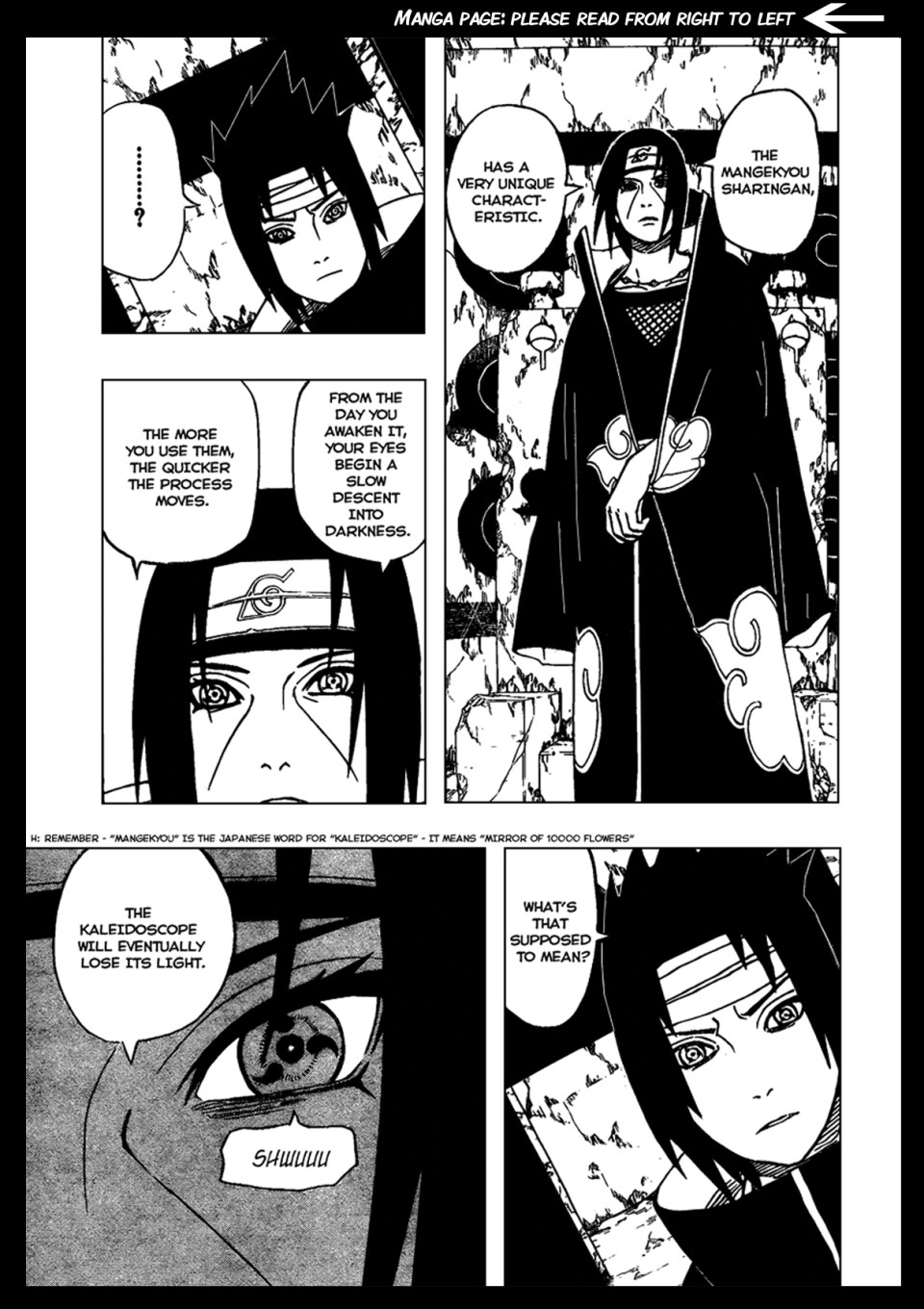
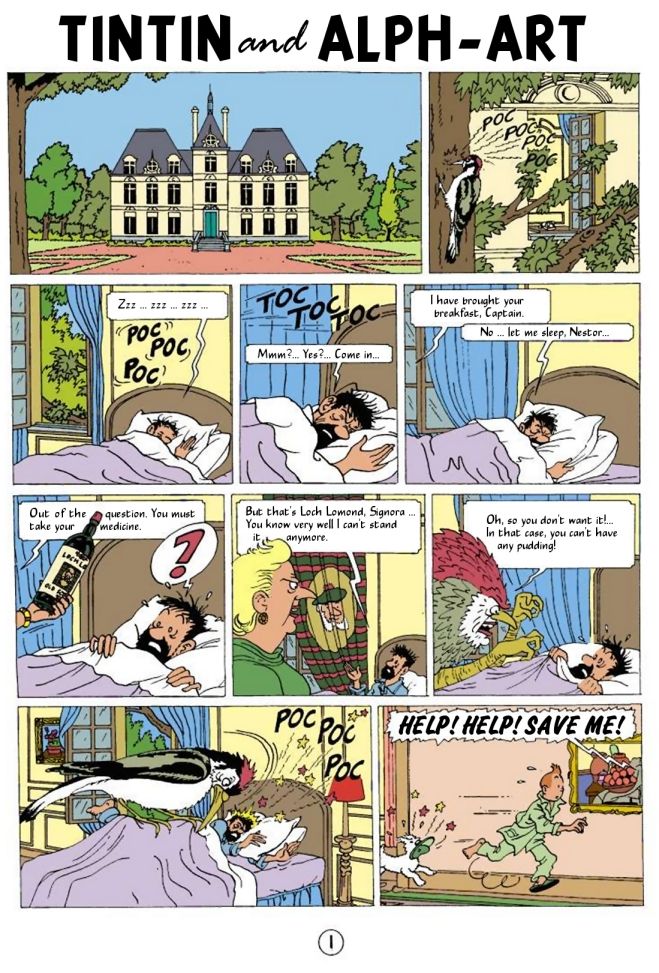
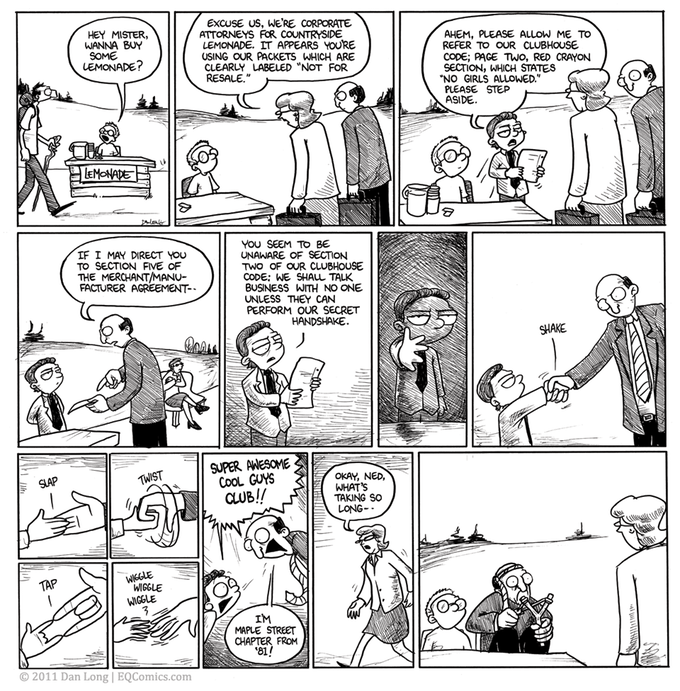
Text substitution by CommArts student Por in a Peanutscomic strip by Charles M. Schulz. Retaining the two original speech ballons “Right” in panels 9 and 10.Original page (before text substitution).Text substitution by CommArts student Sean in a page from the manga Bonbonzaka Koukou Engekibu (1992) by mangaka Takahashi Yutaka. Retaining the two original speech ballons “Damn” and “Da…” in panel 3.Original scanlation (before text substitution).Text substitution by a CommArts student (Graphic Writing, 2015) in a page from Mickey Mouse and the World to Come: The Sinking of Illusitania (Boom! Kids, 2010) by Andrea Castellan (aka Casty). Retaining various two original speech balloons.Original page (before text substitution).Text substitution by CommArts student Nymph in a page from the manga Wotaku ni Koi ha Muzukashii(It’s Difficult to Love an Otaku) by mangaka Fujita. Retaining various speech ballons, and adding an ellipsis (“…”).Original scanlation (before text substitution).Text substitution by CommArts student Pat in a page from the webcomic Saturday Morning Breakfast Cereal by Zach Weinersmith. Retaining various speech ballons.Original strip (before text substitution).Text substitution by CommArts student Boss in a page from the comics Immortal Iron First issue 16 (Marvel Comics) by Matt Fraction (writer) and David Aja (penciller). Retaining the original speech ballon “Noooooo” in panel 4.Original page (before text substitution).Text substitution by CommArts student Poon K. in a page from the manga The Kindaichi Case Files (Tokyopop) by mangaka Yōzaburō Kanari and Seimaru Amagi (writers) and Fumiya Satō (art). Retaining the original speech ballon “I’m amazed by your work” in panel 4.Original page (before text substitution).Text substitution by CommArts student Tip in a page from GRUMPY CAT AND POKEY(Dynamite; writers Ben Fisher, Derek Fridolfs, Ilias Kyriazi; and artists Ken Haeser, Ilias Kyriazis, Steve Uy). Retaining various speech balloons, and with additional ellipsis (“…”).Original page (before text substitution).Text substitution by CommArts student Mos (Creative Writing, 2016)in a page from Superman #14 (The Invention Thief, DC Comics, 1942), by Jerry Siegel & Joe Shuster, and Leo Nowak. Retaining various original speech balloons.Original page (before text substitution).Text substitution by CommArts student Mon in a page from the manga Naruto (VIE Media) by mangaka Masashi Kishimoto. Retaining the original sound effect “SHWUUU” in panel 5.Original scanlation (before text substitution).Text substitution by CommArts student Mo (Creative Writing, 2016)in a page from Tintin and Alph-Art, inked and colorized by Yves Rodier based on (unfinished) pencilled page by Hergé. Retaining the original speech balloon (“?”) in panel 6.Original scanlation (before text substitution).Text substitution by CommArts student TG in a page from Edmund Finney’s Quest to Find the Meaning of Life – Volume 2 (EQ Comics) by Dan Long. Retaining various original speech balloons.Original strip (before text substitution).
3. Text substitutions by CommArts students; without order alteration, but with additional bubbles.
Text substitution by CommArts student Note in a page from Cat versus Human by Surovec Yasmine. Retaining various original speech balloons, and with additional bubbles.Original page (before text substitution).Text substitution by CommArts student Pitchii in a page from the webcomics Saphie the One Eyed Cat by Joho. Retaining various onomatopoeiae, and with additional bubbles.Click on the page to reach the original webcomics.
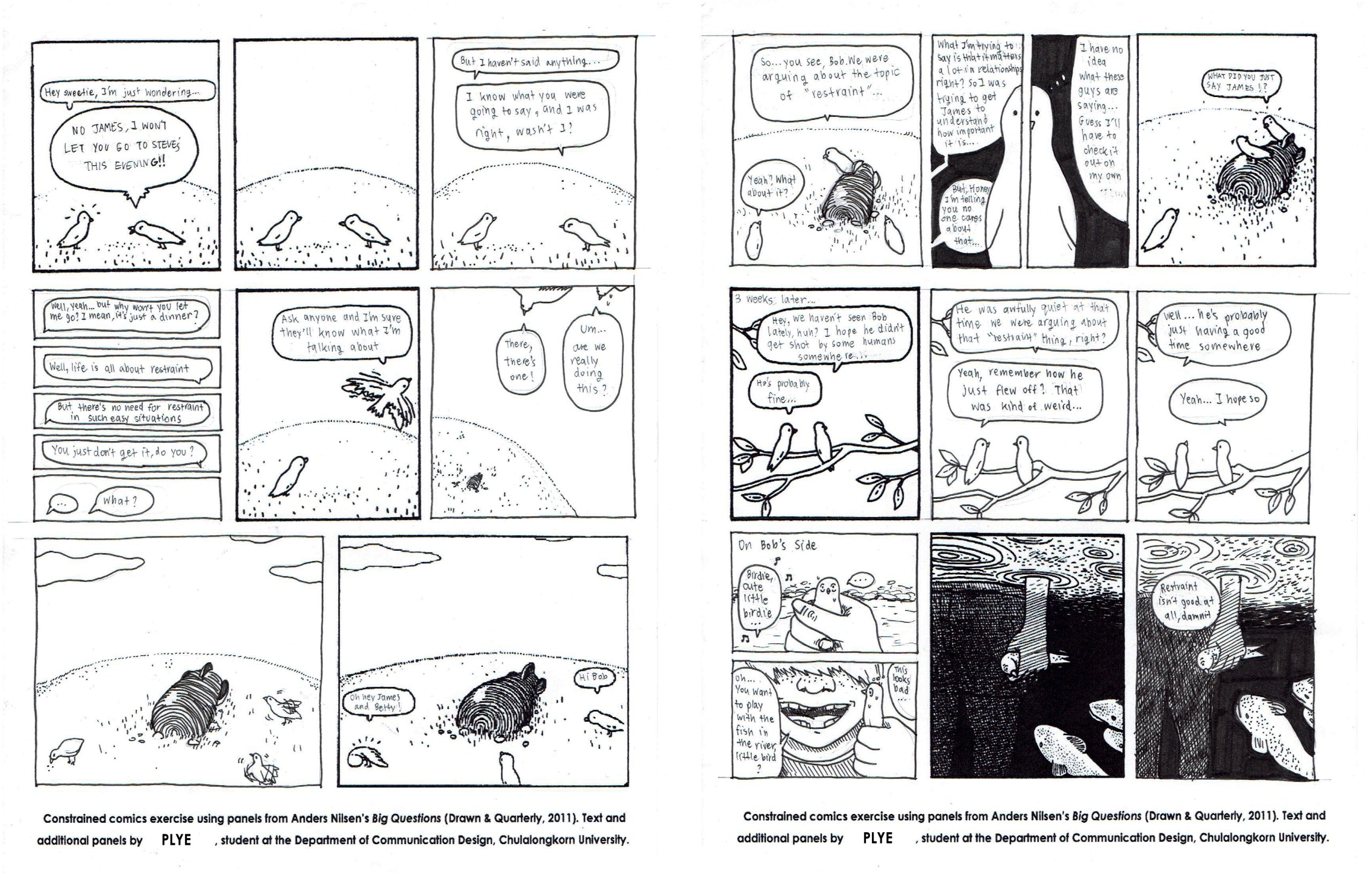
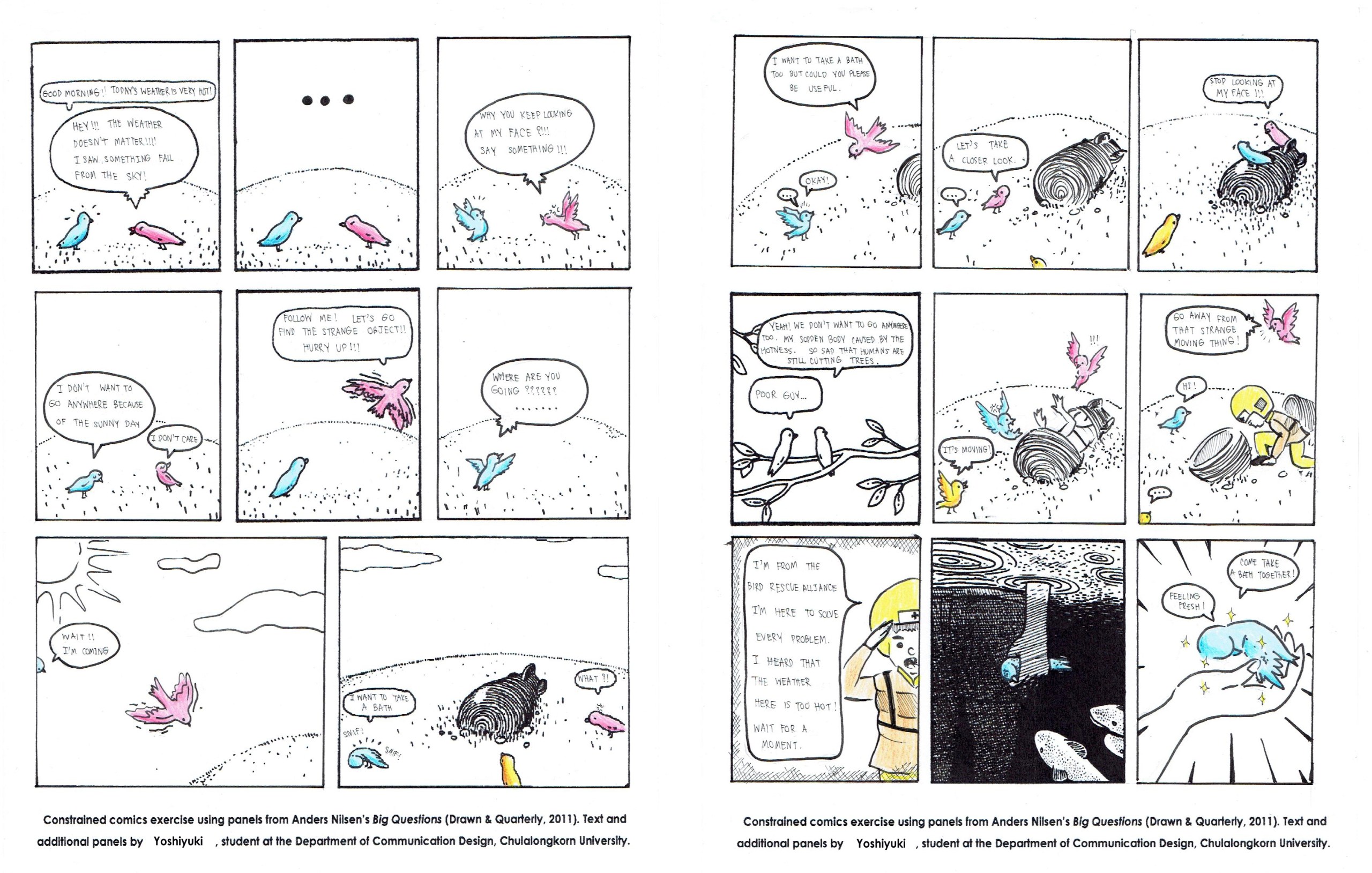
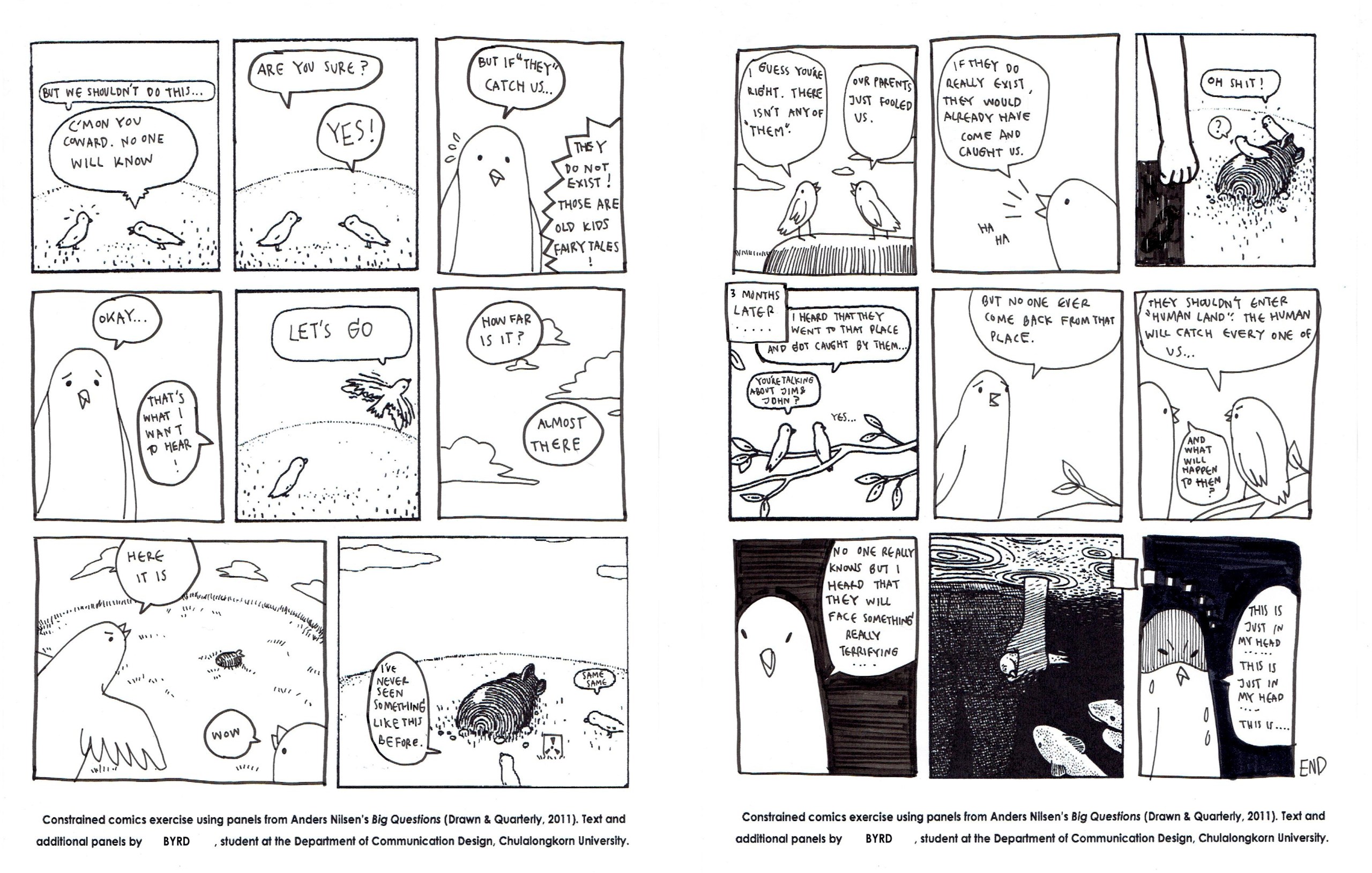
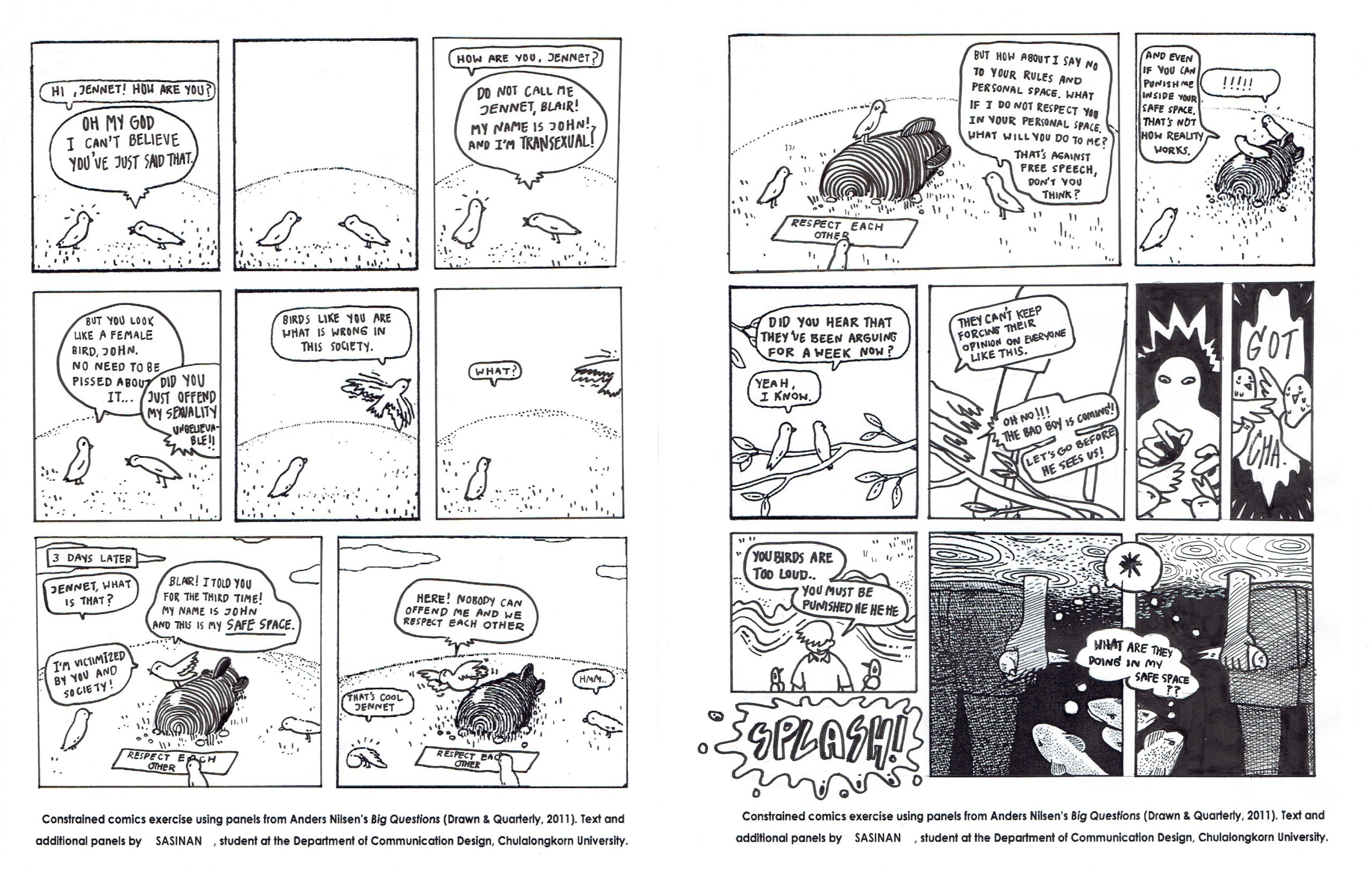
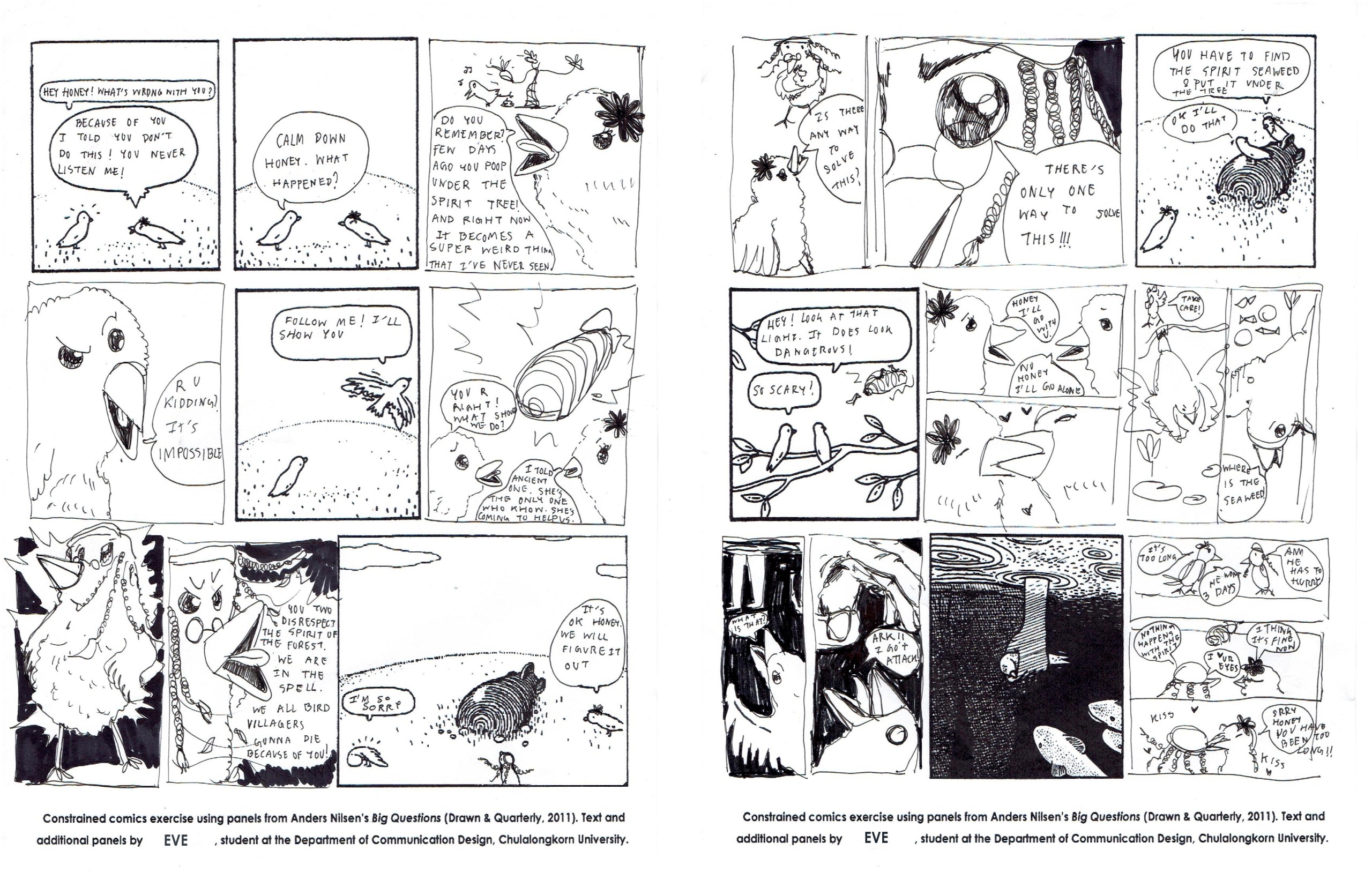
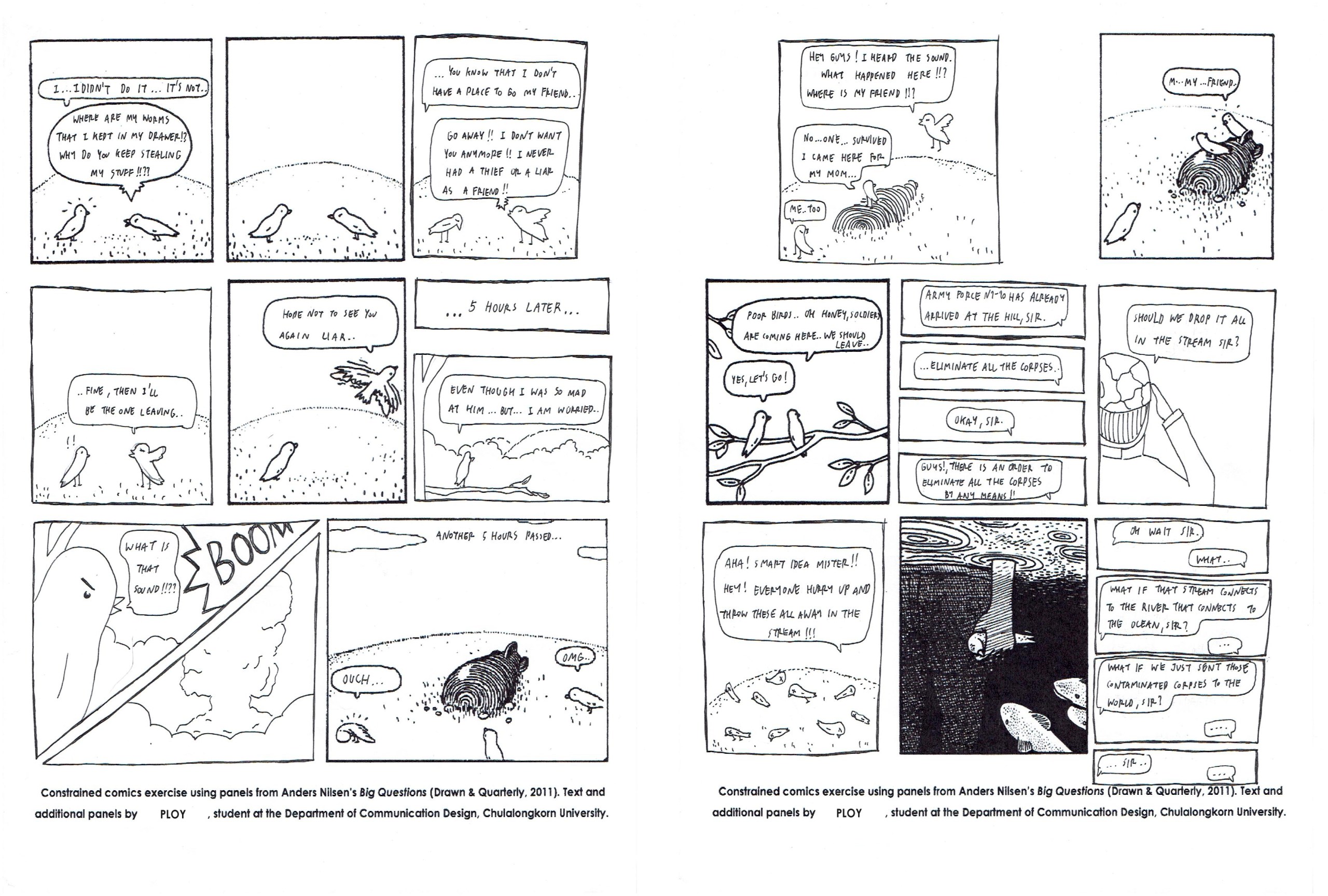
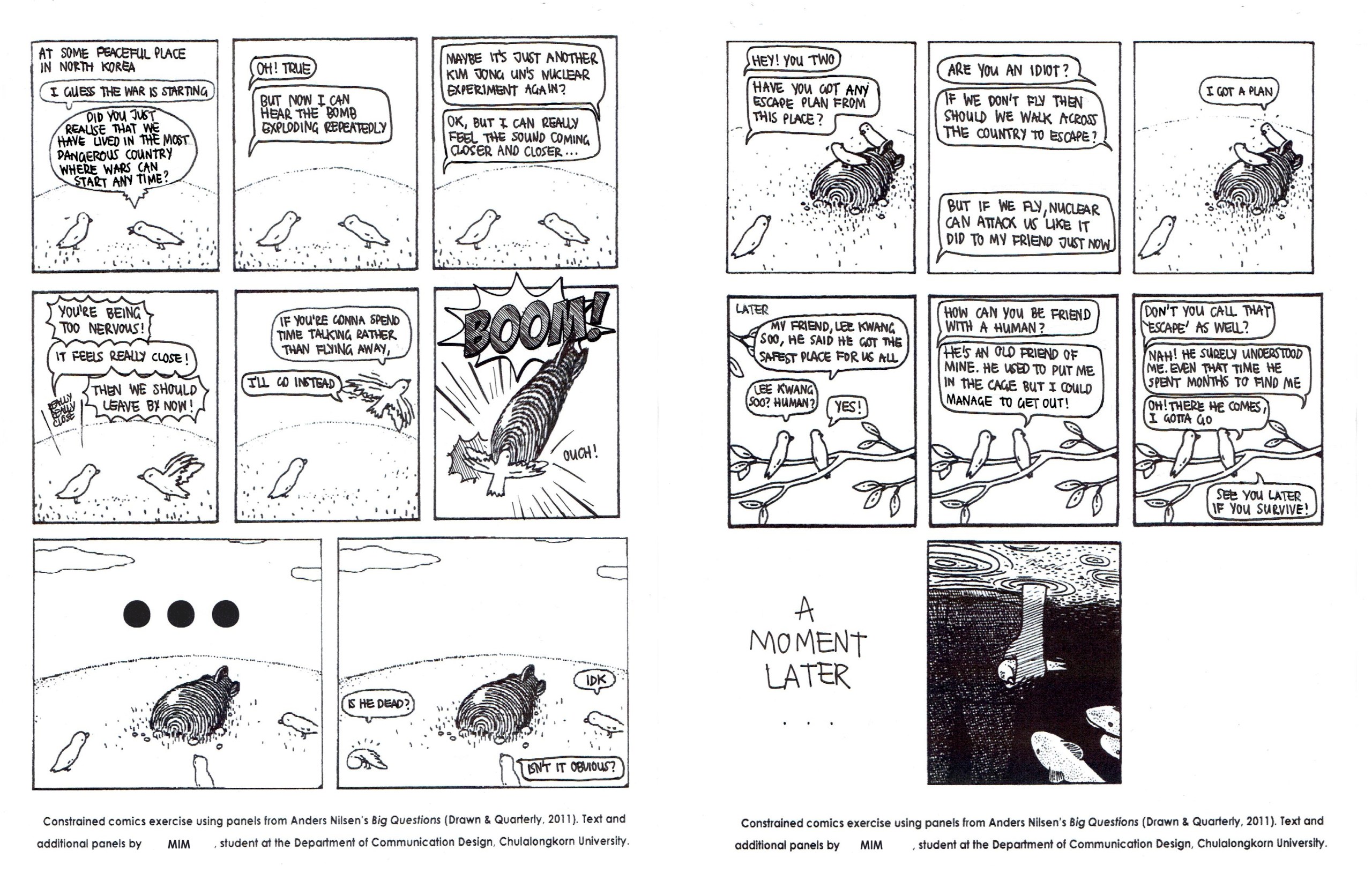
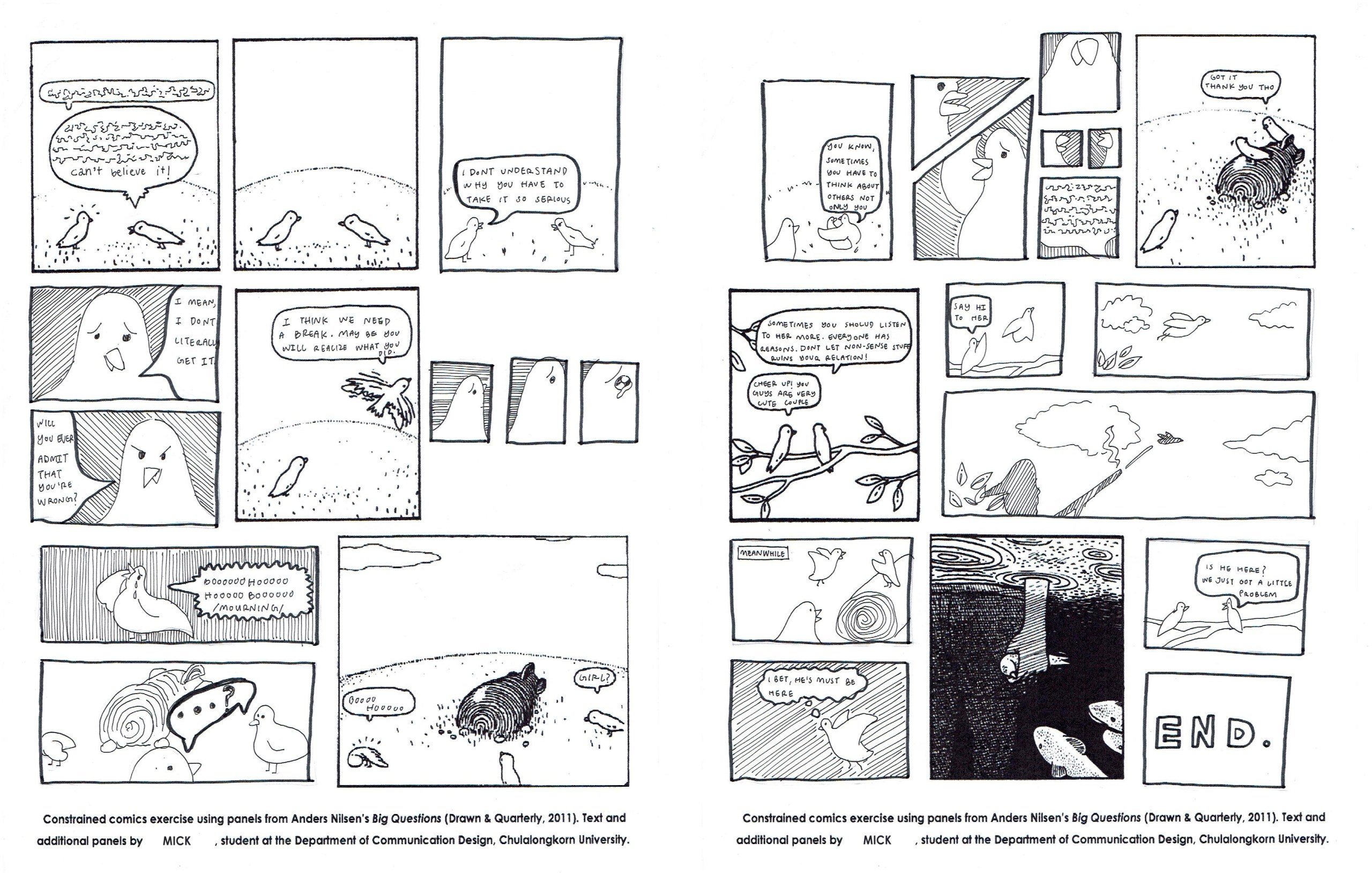
#BiggerQuestions: in-class creative assignment (Intro Comm course developed by the Faculty of Communication Arts; Interpersonal Communication chapter); weaving 7 scattered wordless panels (taken fromAnders Nilsen‘s Big Questions) into a 2-page graphic narrative.
BLURB!
“Great exercise!” Matt Madden(February 9, 2018), cartoonist and teacher best known for his book 99 Ways to Tell a Story: Exercises in Style (Penguin), as well as a member of OuBaPo (Workshop for Potential Comics), and later a French knight in the Order of Arts and Letters.
“More good stuff from [Bangkok], thanks for sharing!” Nick Sousanis (February 9, 2018), assistant professor of Humanities & Liberal Studies at San Francisco State University. He received his doctorate in education at Teachers College, Columbia University in 2014, where he wrote and drew his dissertation entirely in comic book form. Titled Unflattening, it argues for the importance of visual thinking in teaching and learning, and was published by Harvard University Press in 2015.
January 2018. Fifty (1st year) Thai students at the International Program in Communication Design (CommDe, Department of Industrial Design, Faculty of Architecture, Chulalongkorn University) received 2 pages displaying 7 scattered panels (with erased text) taken from various pages of the graphic novel Big Questions by American cartoonist Anders Nilsen. Within 90 minutes, they had to produce additional panels (if necessary) -and add dialogues- in order to bridge the imposed panels and weave a cohesive and convincing graphic narrative. Following brief comments provided on their comprehensive layouts, students finalized the artwork at home. See below for 20+ of their #BiggerQuestions constrained comics.
Inspired by on a constrained comics exercise used atPierre Feuille Ciseaux international comics residency-lab.
Pages from Anders Nilsen‘s Big Questions (Drawn & Quarterly, 2011).The 2 imposed pages -with scattered panels and blanked-out dialogues- taken from Anders Nilsen‘s Big Questions (Drawn & Quarterly, 2011).
CommDe student bridging the gaps between Anders Nilsen‘s panels.
CommDe students working on a “exercise in style”… with style!
CommDe student bridging the gaps between Anders Nilsen’s incomplete and scattered panels.
CommDe students bridging the gaps between Anders Nilsen’s incomplete and scattered panels.
Fifty CommDe students bridging the gaps between Anders Nilsen’s incomplete and scattered panels.
Click on the 2-pagers below for larger size.
“Bigger Questions” constrained comics by (1st year) CommDe student PLYE“Bigger Questions” constrained comics by (1st year) CommDe student YOSHIYUKI“Bigger Questions” constrained comics by (1st year) CommDe student BYRD“Bigger Questions” constrained comics by (1st year) CommDe student PT“Bigger Questions” constrained comics by (1st year) CommDe student SASINAN (PING)“Bigger Questions” constrained comics by (1st year) CommDe student CHICHI“Bigger Questions” constrained comics by (1st year) CommDe student OOM“Bigger Questions” constrained comics by (1st year) CommDe student AOM (P.)“Bigger Questions” constrained comics by (1st year) CommDe student TAT“Bigger Questions” constrained comics by (1st year) CommDe student PHURICH“Bigger Questions” constrained comics by (1st year) CommDe student SHARON“Bigger Questions” constrained comics by (1st year) CommDe student BASK“Bigger Questions” constrained comics by (1st year) CommDe student EVE“Bigger Questions” constrained comics by (1st year) CommDe student NENE“Bigger Questions” constrained comics by (1st year) CommDe student AOM (T.)“Bigger Questions” constrained comics by (1st year) CommDe student FAHSAI“Bigger Questions” constrained comics by (1st year) CommDe student LUKPEAR“Bigger Questions” constrained comics by (1st year) CommDe student SUNNY“Bigger Questions” constrained comics by (1st year) CommDe student PLOY“Bigger Questions” constrained comics by (1st year) CommDe student MIM“Bigger Questions” constrained comics by (1st year) CommDe student KARIN“Bigger Questions” constrained comics by (1st year) CommDe student MICK“Bigger Questions” constrained comics by (1st year) CommDe student PEACHY“Bigger Questions” constrained comics by (1st year) CommDe student KRIS
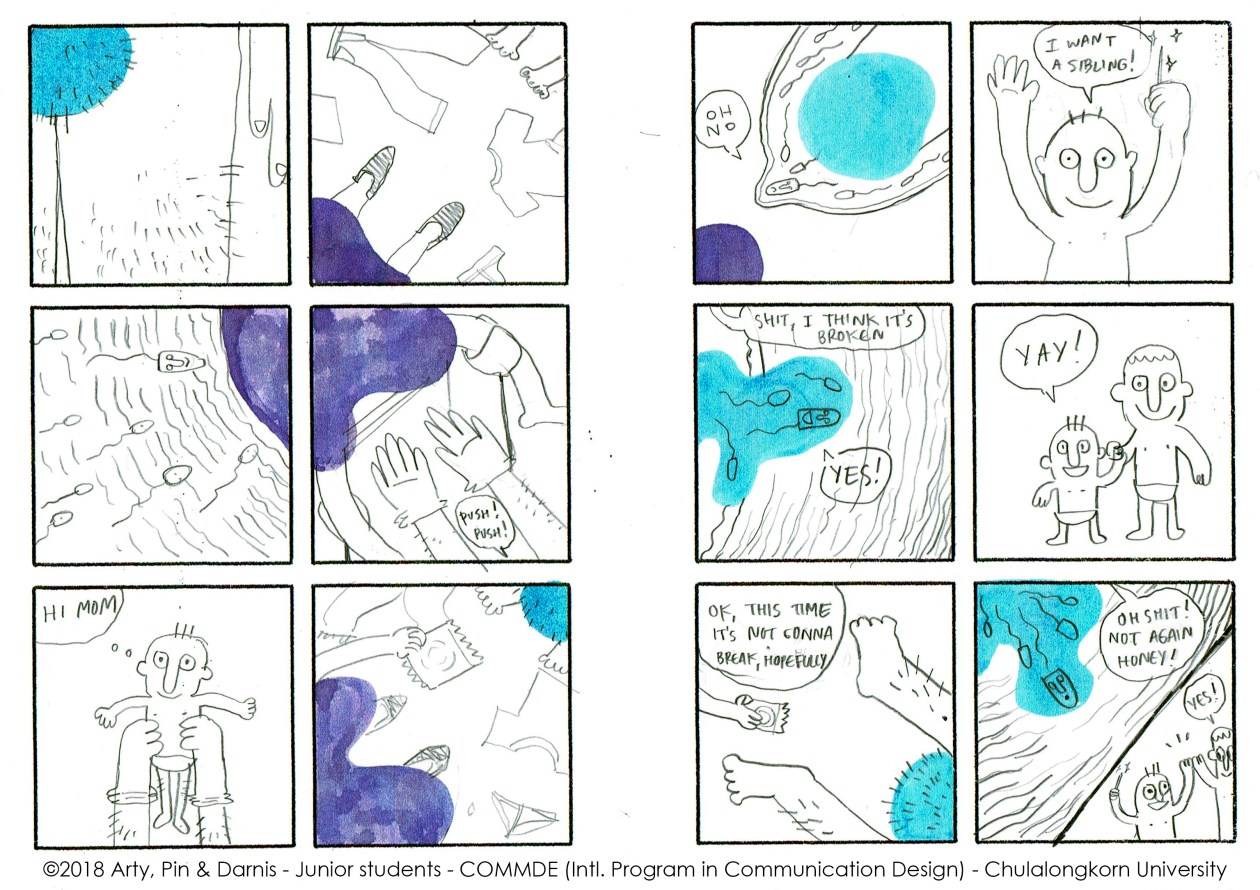
#UltraVioletChallenge: “Making Sense of Signs (and Fragments)” in-class creative assignment (“Intro Comm” & “Visual Media Studies” courses developed by the Faculty of Communication Arts; Semiotics chapter); create a figurative comics based on an imposed abstract comics (duration: 90′). Based on a constrained comics exercise used atPierre Feuille Ciseaux international comics residency-lab.
SEE MORE #ULTRAVIOLETCHALLENGE RESULTS HERE (PART 2) AND THERE (PART 3).
BLURB!
“Brilliant – thanks for sharing!” Nick Sousanis (January 16, 2018; commenting the page by Fern, Lukpearr, Oom & Bank), assistant professor of Humanities & Liberal Studies at San Francisco State University. He received his doctorate in education at Teachers College, Columbia University in 2014, where he wrote and drew his dissertation entirely in comic book form. Titled Unflattening, it argues for the importance of visual thinking in teaching and learning, and was published by Harvard University Press in 2015.
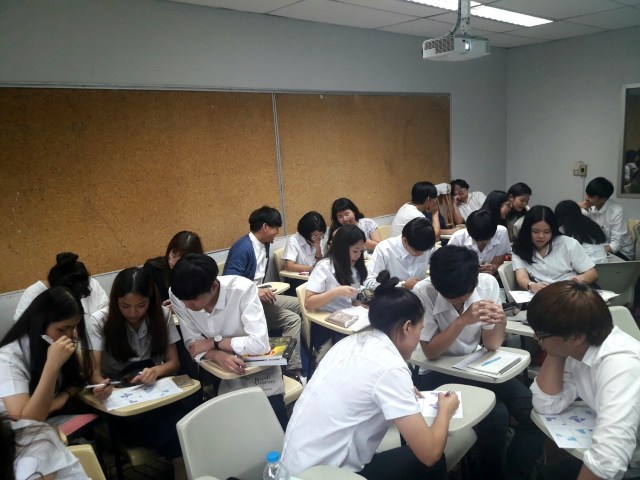
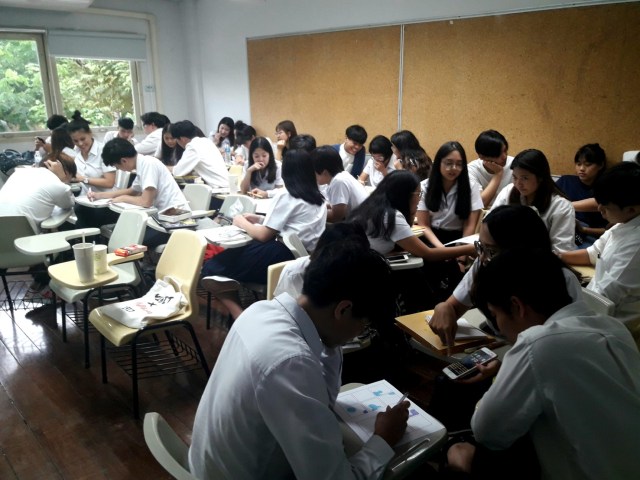
Students from the Faculties/Departments of Architecture (INDA), Communication Design (CommDe), Language & Culture (BALAC), and Engineering (ISE) creating their #UltraViolet comics. August 23, 2018. Visual Media Studies course, INDA, Chulalonglorn University.
SOME RESULTING NARRATIVES:
#UltraVioletChallenge final page by Fern, Lukpearr, Oom & Bank, fresh.wo.men students at CommDe, Chulalongkorn University.#UltraVioletChallenge final page by Arty, Pin & Darnis, junior students at CommDe, Chulalongkorn University.#UltraVioletChallenge final page by Pin, Fa & Pat, sophomore students at INDA, Chulalongkorn University.#UltraVioletChallenge final page by Gap & Yong, junior students at CommDe, Chulalongkorn University.#UltraVioletChallenge final page by Iced, Deedee, Fern & Jam, junior students at INDA, Chulalongkorn University.#UltraVioletChallenge final page by New, Uang and Wee, junior students at CommDe, Chulalongkorn University.Students from the Faculties/Departments of Architecture (INDA), Communication Design (CommDe), Language & Culture (BALAC), and Engineering (ISE) creating their #UltraViolet comics. August 23, 2018. Visual Media Studies course, INDA, Chulalonglorn University.
“Zig et Puce” by Alain Saint-Ogan (FR), and “Tintin” by Hergé (BE)
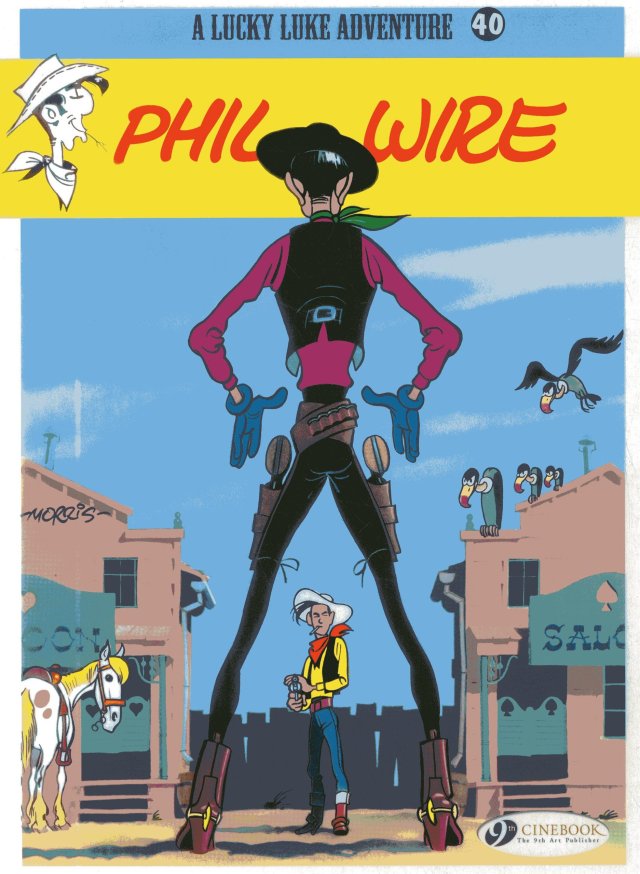
“Jerry Spring” by Jijé (BE) & Lob (FR), and “Lucky Luke” by Morris (BE) & René Goscinny (FR)
Some Franco-Belgian classic comics acquired at La Crypte Tonique (Brussels) to illustrate -materially- the two courses dedicated to the History of Franco-Belgian “bandes dessinées” at Chulalongkorn University, Bangkok. PS: Merci Philippe Capart!
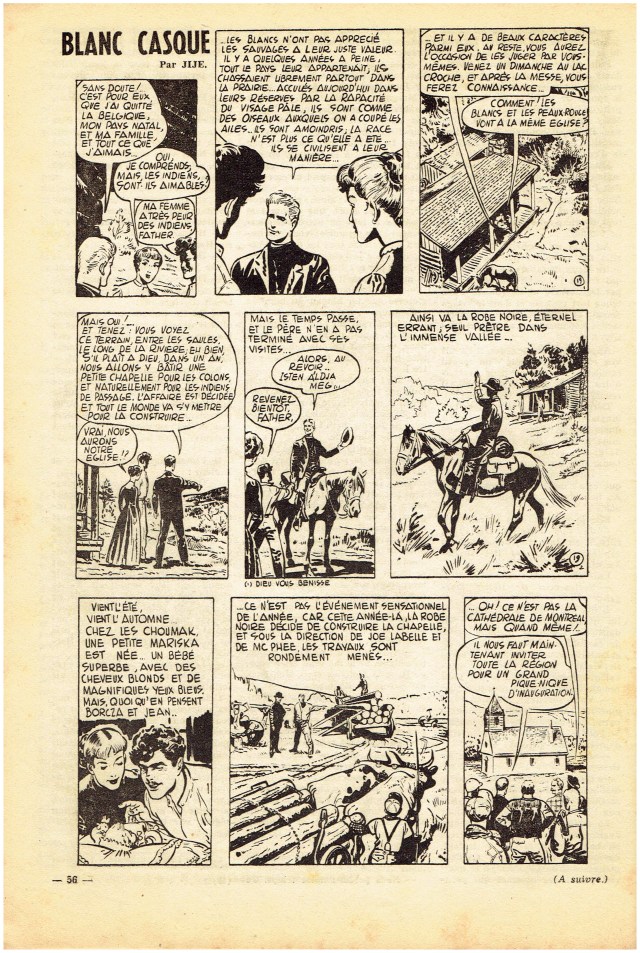
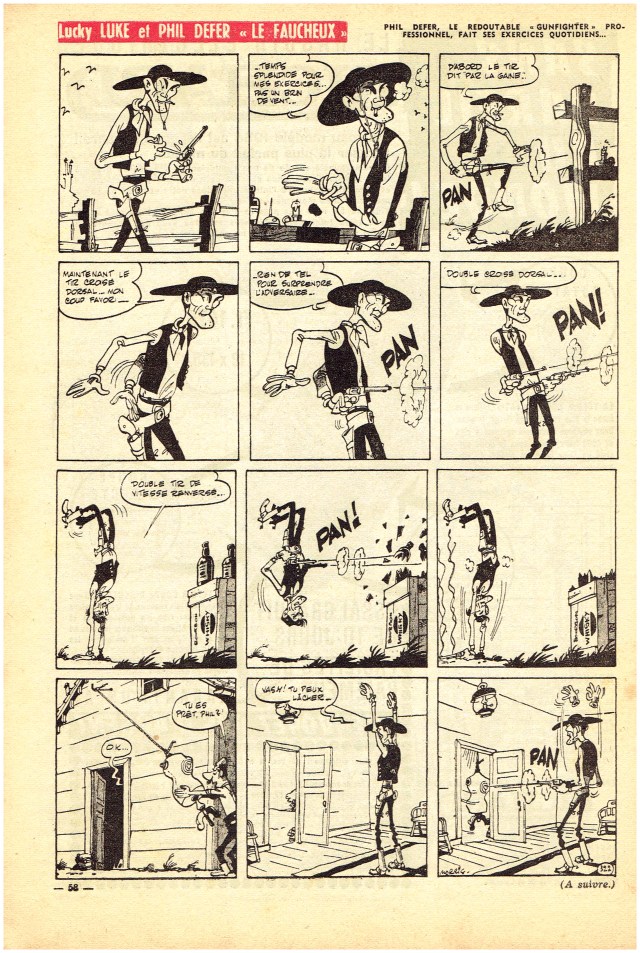
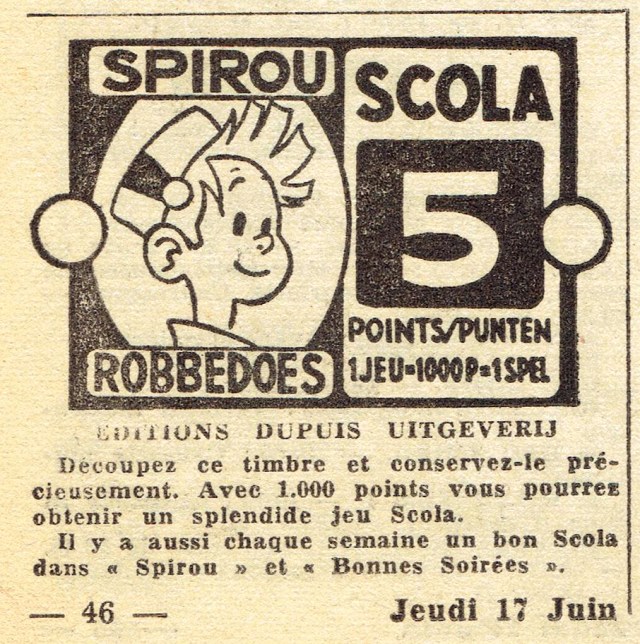
Cover of “Moustique” weekly magazine #1481 (Dupuis, BE, June 13, 1954).Page from “Blanc Casque'” by Jijé (BE, goo.gl/P3l4wh) as published in “Moustique” weekly magazine #1481 (Dupuis, BE, June 13, 1954). Based on the novel by Joseph Pirot.Page from “Lucky Luke et Phil Defer ‘Le Faucheux'” by Morris (BE) as published in “Moustique” weekly magazine #1481 (Dupuis, BE, June 13, 1954). Comics available in English language: goo.gl/o186fVLast tier of a page from “Lucky Luke et Phil Defer ‘Le Faucheux'” by Morris (BE) as published in “Moustique” weekly magazine #1481 (Dupuis, BE, June 13, 1954). Comics available in English language: goo.gl/o186fVCover of the English edition of “Lucky Luke contre Phil Defer” (Morris, BE): goo.gl/o186fV“Spirou” (goo.gl/wf4C73) voucher (to be collected every week in order to be redeemed for a board game) as published in “Moustique” weekly magazine #1481 (Dupuis, BE, June 13, 1954).
“Zig et Puce” by Alain Saint-Ogan (FR), and “Tintin” by Hergé (BE)
“Jerry Spring” by Jijé (BE) & Lob (FR), and “Lucky Luke” by Morris (BE) & René Goscinny (FR)
Some Franco-Belgian classic comics acquired at La Crypte Tonique (Brussels) to illustrate -materially- the two courses dedicated to the History of Franco-Belgian “bandes dessinées” at Chulalongkorn University, Bangkok. PS: Merci Philippe Capart!
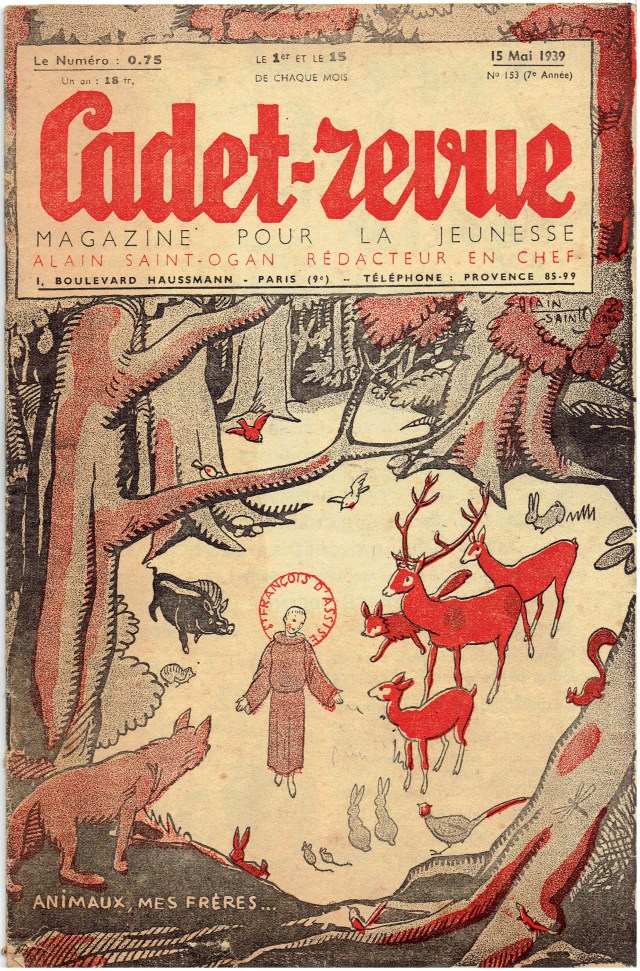
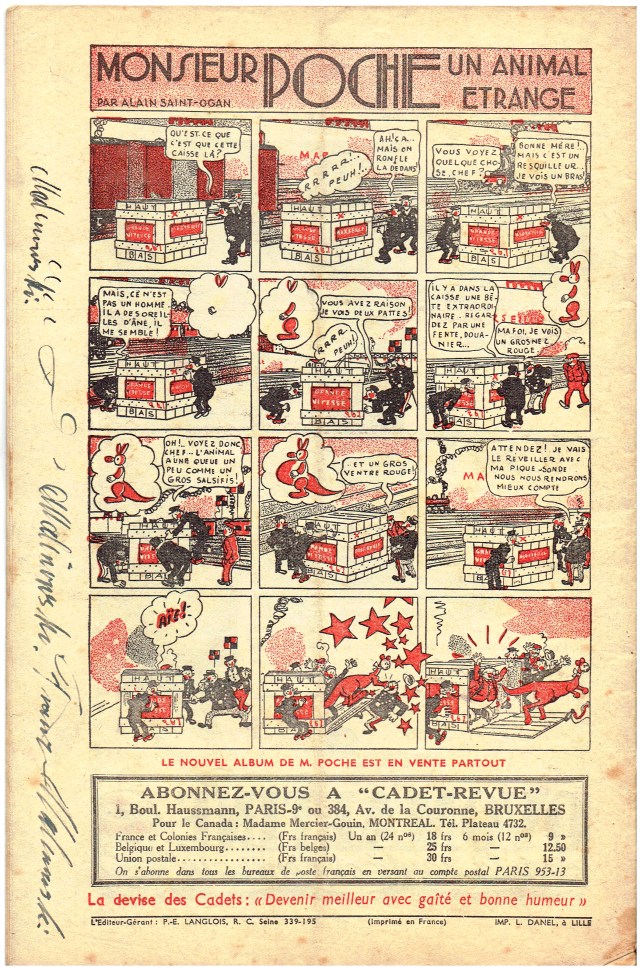
Front cover of “Cadet-revue”, May 15, 1939, France. “Saint Francis of Assisi – Animals, my brothers”; one of my favourite illustrations by French cartoonist and illustrator Alain Saint-Ogan (goo.gl/dKom7j).Back cover of “Cadet-revue”, May 15, 1939, France. One of my favourite pages by French cartoonist and illustrator Alain Saint-Ogan (goo.gl/dKom7j): “Monsieur Poche: un animal étrange.” First printed in “Dimanche illustré” #623, February 3, 1935, France.Original artwork of the page “Monsieur Poche: un animal étrange” first published in “Dimanche illustré” #623, February 3, 1935, France. Analysis by Thierry Groensteen: goo.gl/kamg93. In the collection of the Museum of the Cité Internationale de la Bande Dessinée et de l’Image, Angoulême, France.
For the first semester of 2017, the “Managing Creativity for Communicative Innovation” course (Communication Management, International Program, Faculty of Communication Arts, Chulalongkorn University, Bangkok, Thailand) had three main goals:
1) select, summarize and partly translate 9 Thai alternative comics, and contact a foreign publisher to get them signed abroad. This endeavor was highly successful as it resulted in the publication of 4 titles by Art Jeeno in French language from Éditions çà et là: see here.
2) Publish, promote and distribute our own zine gathering the constrained comics composed by former “Graphic Writing” CommArts students.
3) Organize an exhibition of the “Traumics” (Comics on Trauma) composed by CommArts & CommDe (Program in Communication Design, Department of Industrial Design, Faculty of Architecture, Chulalongkorn University) students.
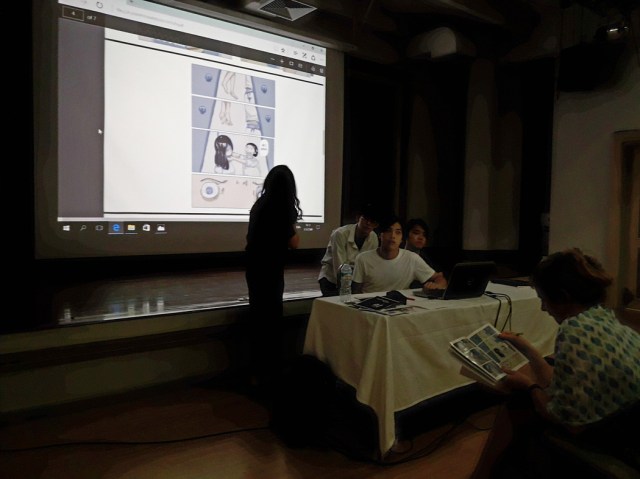
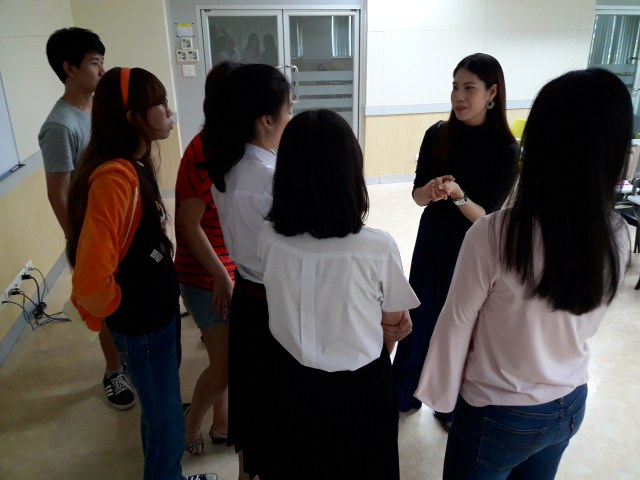
Second special guest: Belgian cartoonist & illustrator Ephameron for an afternoon of Comics Art Appreciation (with comments and tips). Students from the International Program in Communication Design (CommDe, Department of Industrial Design, Faculty of Architecture, Chulalongkorn University) presented their Traumics (or “Comics on Trauma”) in front of Ephameron and my CommArts students in order to select the trauma-related graphic narratives to be displayed in the exhibition. Bedankt Eva! ขอบคุณมากๆครับ CommDe for inviting Eva in the first place! This project was partly inspired by the literary educational comics produced by the award-winning non-profit (and our partner) PositiveNegatives.Ephameron giving comments and advices to a team of CommDe students presenting their Traumics (or “Comics on Trauma”).
CommDe student presenting her Traumics (or “Comics on Trauma”) to Ephameron and CommArts students.
CommDe student presenting his Traumics (or “Comics on Trauma”) to Ephameron and CommArts students.
A team of CommDe students presenting their Traumics (or “Comics on Trauma”) to Ephameron and CommArts students.
CommDe student presenting her Traumics (or “Comics on Trauma”) to Ephameron and CommArts students.
A team of CommDe student presenting their Traumics (or “Comics on Trauma”) to Ephameron and CommArts students.
CommDe student presenting her Traumics (or “Comics on Trauma”) to Ephameron and CommArts students.
A team of CommDe student presenting their Traumics (or “Comics on Trauma”) to Ephameron and CommArts students.
A team of CommDe student presenting their Traumics (or “Comics on Trauma”) to Ephameron and CommArts students.
A team of CommDe student presenting their Traumics (or “Comics on Trauma”) to Ephameron and CommArts students.
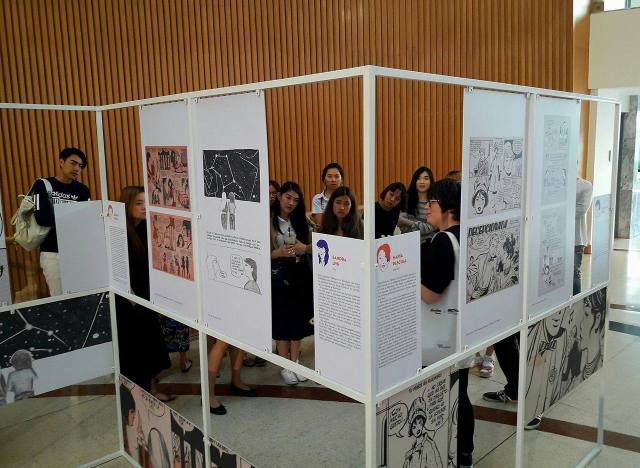
Third special guest (or rather host): Spanish cartoonist, curator & illustrator Carla Berrocaloffered us a private tour of the PRESENTES comics exhibition (Spanish Female Cartoonists of Yesterday and of Today). Discussion on the challenges (selecting pages, copyright issues, pairing different artists by themes or motifs…) offered by a Comics Art exhibition. Gracias Carla, Autoras de Cómic, and Maria & Joan from the Embassy of Spain in Bangkok. Thank you HeForShe Arts Week Bangkok, UN Women Asia and Pacific, and BACC (Bangkok Art Cultural Center)!
Third special guest (or rather host): Spanish cartoonist, curator & illustrator Carla Berrocal offered us a private tour of the PRESENTES comics exhibition (Spanish Female Cartoonists of Yesterday and of Today). Here presenting the work of internationally renown Spanish cartoonist Ana Miralles Lopez. Gracias Carla, Autoras de Cómic, and Maria & Joan from the Embassy of Spain in Bangkok. Thank you HeForShe Arts Week Bangkok, UN Women Asia and the Pacific, and BACC (Bangkok Art and Culture Center)!
At the PRESENTES comics exhibition (Spanish Female Cartoonists of Yesterday and of Today). Detail of a page by Spanish female cartoonist Maria Pascual (1933-2011).
At the PRESENTES comics exhibition (Spanish Female Cartoonists of Yesterday and of Today). Detail of a page by Spanish female cartoonist Mireia Pérez (1984-).
PRESENTES exhibition catalogue (Spanish Female Cartoonists of Yesterday and of Today). Spanish female cartoonist Núria Pompeia (1931-2016).
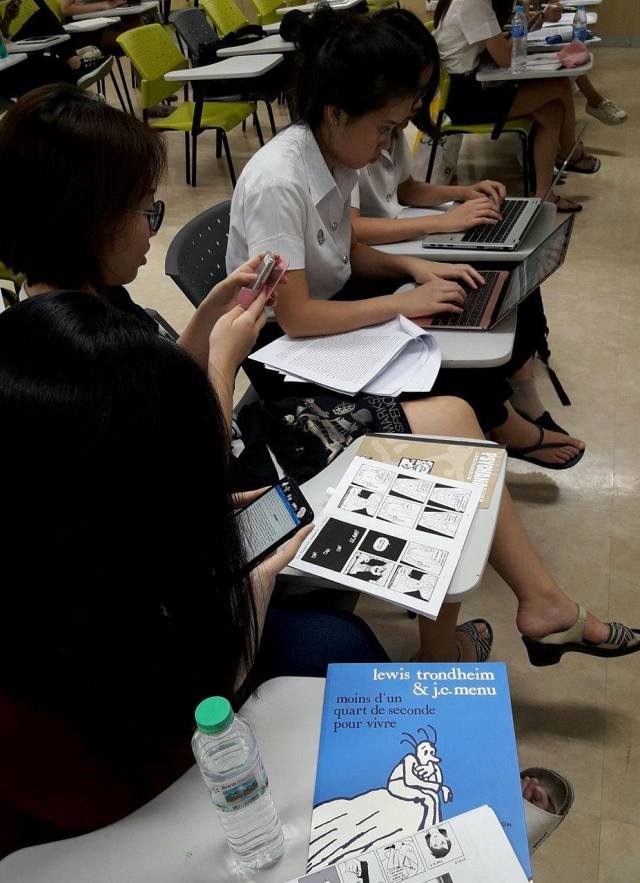
Writing the editorial content of our “Bang Bang You’re Dead” constrained comics zine, inspired by the OuBaPian experimental comics by Lewis Trondheim & Jean-Christophe Menu. Trying to explain, as clearly and shortly as possible, the multimodal challenges faced by CommArts students while composing their graphic narratives (using “iconic iteration” with limited sets of panels drawn by European cartoonists Pierre Alary, Sacha Goerg & Joseph Falzon specially for our “Graphic Writing” course).
Writing the editorial content of our “Bang Bang You’re Dead” constrained comics zine, inspired by the OuBaPian experimental comics by Lewis Trondheim & Jean-Christophe Menu. Trying to explain, as clearly and shortly as possible, the multimodal challenges faced by CommArts students while composing their graphic narratives (using “iconic iteration” with limited sets of panels drawn by European cartoonists Pierre Alary, Sacha Goerg & Joseph Falzon specially for our “Graphic Writing” course).
After hours to complete the editorial content of our “Bang Bang You’re Dead” constrained comics zine…
Partly translating one of the 9 Thai alternative comics selected to be presented to a foreign publisher in order to get them signed abroad.
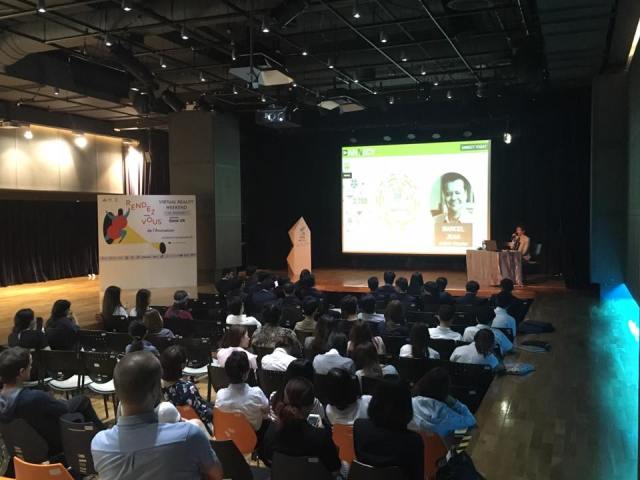
Masterclass on “Animated Film Festivals and Markets” with Geraldine Baché, head of Animation du Monde (MIFA-Annecy) at the RENDEZ-VOUS FRANCO-THAÏ DE L’ANIMATION (Embassy of France in Thailand, in collaboration with the World Film Festival of Bangkok, Mahidol University International College, SF Cinema and TK Park). Photograph by ‘Rendez-Vous Franco-Thaï de l’Animation.’Thai films selected at the Annecy International Animated Film Festival. During the masterclass on “Animated Film Festivals and Markets” with Geraldine Baché, head of Animation du Monde (MIFA-Annecy) at the RENDEZ-VOUS FRANCO-THAÏ DE L’ANIMATION (Embassy of France in Thailand, in collaboration with the World Film Festival of Bangkok, Mahidol University International College, SF Cinema and TK Park).Our fourth special guest; Ms. Pimpicha Utsahajit, Executive Director of Banlue Publications & CommArts alumnus, hold a talk on leading multi-platform content provider Banlue Group, with Banlue Sarn (humour comics magazines “Kai Hua Roh” and “Maha Sanook”), Vithita Animation, Salmon Books (publisher of alternative comics among others), digital platform MiniMore, Salmon House (production house of motion contents), Banlue Books, trendy free magazine Giraffe, or The MATTER and Pixniq among many other innovative content platforms! ขอบคุณมากๆครับ Ms. Pimpicha for the inspiring lecture and case studies (character development & licensing), and sharing with us your experience and expertise in so many fields!
With our fourth special guest; Ms. Pimpicha Utsahajit, Executive Director of Banlue Publications & CommArts alumnus.
With our fourth special guest; Ms. Pimpicha Utsahajit, Executive Director of Banlue Publications & CommArts alumnus.
With our fourth special guest; Ms. Pimpicha Utsahajit, Executive Director of Banlue Publications & CommArts alumnus.
Making Small Press the CommArts way; a Taylorist approach. For reasons beyond their will, my 20 students had only 3 hours -including their zine-making formation- to produce the 300 copies of the inaugural issue of our Constrained & Collaborative Comics Zine Series “Bang Bang You’re Dead!“. Challenge almost met with 281 issues produced, whilst avoiding too many flawed copies and finger losses…
Making Small Press the CommArts way; a Taylorist approach.
Making Small Press the CommArts way; a Taylorist approach.
Making Small Press the CommArts way; a Taylorist approach.
Making Small Press the CommArts way; a Taylorist approach.
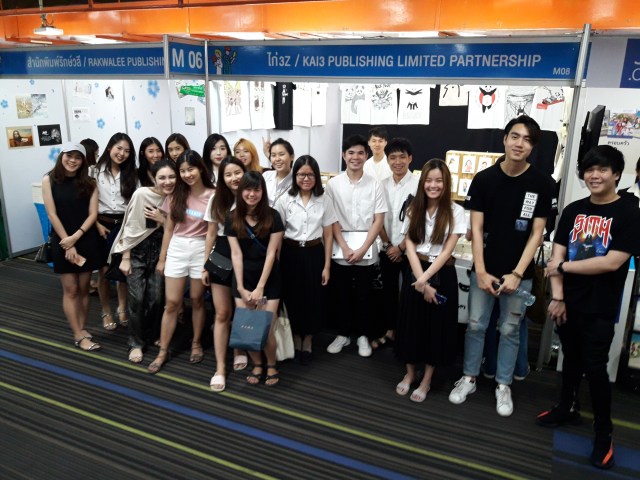
The inaugural issue of the comics zine series “Bang Bang You’re Dead!” edited & published by the students of the “Managing Creativity for Communicative Innovation” course, and collecting the experimental, thrilling & collaborative works of 8 CommArts students with European cartoonists Pierre Alary, Sacha Goerg & Joseph Falzon, under a cover by Thai cartoonist Note Piruck and with a free ‘Phi Krasue’ postcard by French cartoonist Tamia Baudouin (only for the first printing)! Limited to 300 copies, the zine will be distributed worldwide thanks to our French partner L’Association ChiFouMi! Our thanks are also due to khun Satya @Rabbit4Print, and Thai cartoonist Tunlaya Dunn for the logo design & inspiration! A word from the editorial team: “As evoked in its title, the ‘Bang Bang You’re Dead!’ zine invokes the playful yet serious aspects of constrained comics composition. Based on sets of speechless comics panels drawn especially for their Graphic Writing course by European cartoonists, 34 Thai senior students of the four-year program in Strategic Communication Management at the Faculty of Communication Arts, Chulalongkorn University (Bangkok, Thailand), duplicated, reframed, and combined the imposed drawings -with addition of textual elements- to create imaginative stories of their own. Without any particular drawing formation and facing the numerous and overlapping challenges posed by comics composition, our Faculty seniors were able to overcome the constraint of iconic iteration by thinking out of the box, using their creativity to cross formal, modal, cultural, and national borders.”Field trip with the editorial & production team of the inaugural issue the EuroThai Comics Zine “Bang Bang You’re Dead!” at the Bangkok International Book Fair (Queen Sirikit National Convention Center). The zine was on sale at the booth of the Thai indie comics publishing house Kai3. ขอบคุณครับ khun Peataya. Followed by a visit of the booths of publishers who collaborated on our projects (Salmon Books, Typhoon Studio & LET’S Comic). ขอบคุณครับ!
The “Bang Bang You’re Dead!” zine was on sale at the booth of the Thai indie comics publishing house KAI3.
The “Bang Bang You’re Dead!” zine was on sale at the booth of the Thai indie comics publishing house KAI3.
The “Bang Bang You’re Dead!” zine was on sale at the booth of the Thai indie comics publishing house KAI3.
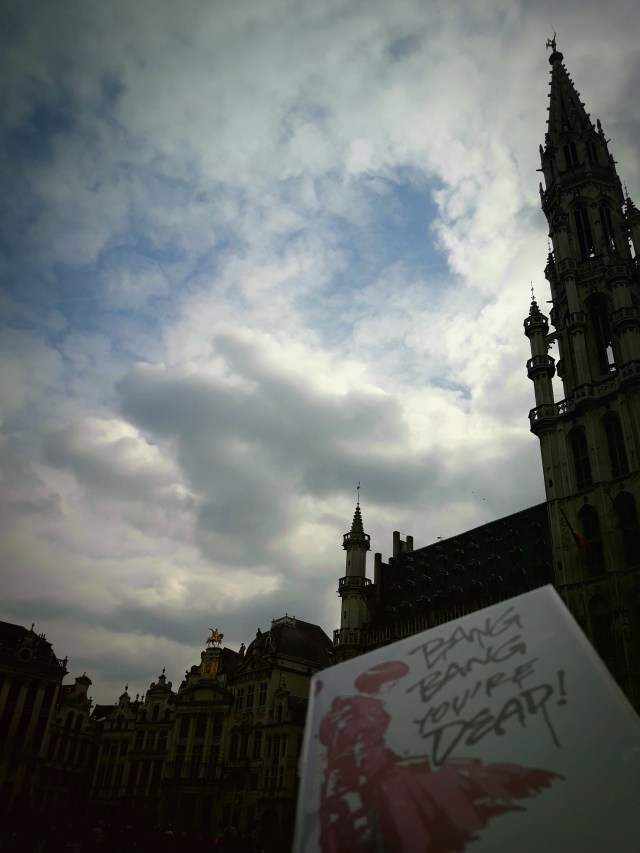
Copies of the inaugural issue of our EuroThai Experimental Comics Zine Series “Bang Bang You’re Dead!” have safely arrived in Belgium. The zines are now available at the comics bookstore Multi BD in Brussels.The inaugural issue of our EuroThai Experimental Comics Zine Series “Bang Bang You’re Dead!” is now available at the comics bookstore Multi BD in Brussels, Belgium.Second objective of the “Managing Creativity for Communicative Innovation” course: to promote contemporary Thai Comix abroad. 8 teams of students. 8 Thai comics profiles (with summary, chapters translated into English, author bio, and pros & cons of each book to fit the French market and a specific publisher’s catalogue). 8 Thailand/France Skype sessions with Serge Ewenczyk, founder of the French independent comics publishing house Çà et Là. Proud of my students who did a tremendous and critical work there! Merci Serge pour ta disponibilité et ta marque d’intérêt! ขอบคุณมากครับ to the Thai editors for the complementary copies! Now, let’s all cross our fingers and see what the Future holds for Thai Comics! (On the picture: Serge Ewenczyk & the “Loser Rainbow (by Puck)” Team).
Serge Ewenczyk & the “EverybodyEverything (by Wisut Ponnimit)” Team.
Serge Ewenczyk & the “Missed (by Tuna Dunn)” Team.
Serge Ewenczyk & the “Diner by Incense Light (by Jung)” Team.
Serge Ewenczyk & the “Romance (by Wisut Ponnimit)” Team.
Serge Ewenczyk & the “NangMai (by Teerawat Thienprasit)” Team.
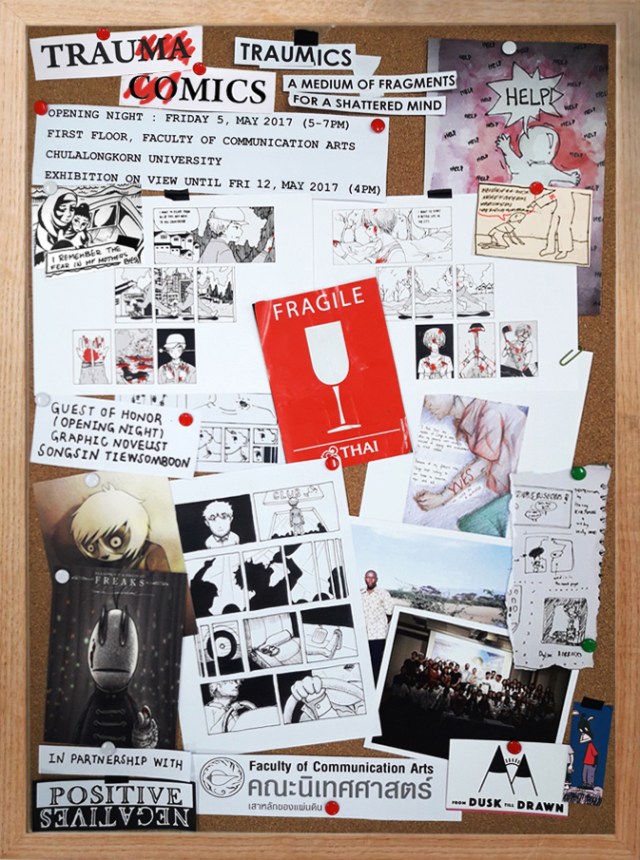
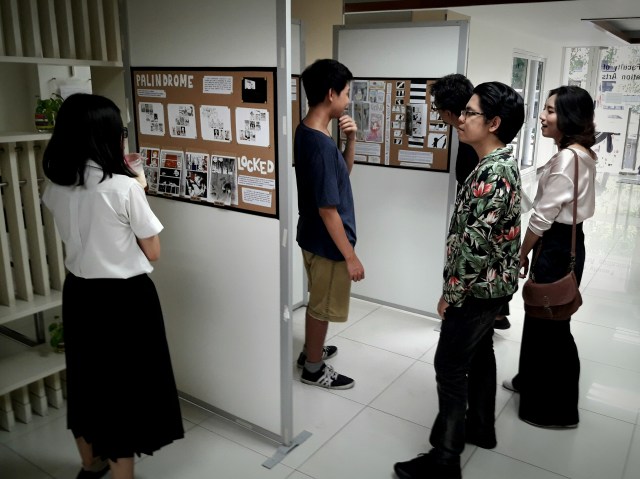
The exhibition “Traumics: a Medium of Fragments for a Shattered Mind” displayed 18 short Trauma-related comics narratives all composed by students in the Faculty of Communication Arts, the Communication Design Program (Faculty of Architecture) and other Departments at Chulalongkorn University (Bangkok, Thailand). From refugee stories to household accidents, from domestic violence to genocides (Congo, Shoah, Khmer Rouges), being fictional, autobiographic or based on victim testimonies, these narratives intend to raise awareness on social and human rights issues. Inspired by the literary educational comics produced by the award-winning non-profit -and our partner- PositiveNegatives, this project also highlights the ability of Comics Art -as a medium of fragments- to visually reveal how the minds of the victims were broken into pieces. As mentioned in the introduction to the Call for Papers for the conference Traumics: Comics Narratives of Trauma, comics -“with their syntax of panels, gutters, and pages and their use of the evocative power of image in conjunction with the precise communication of text- (…) are uniquely suited to delivering narratives of trauma.” The opening night was held on the 5th of May 2017 from 5pm until 7pm at the first floor of the Faculty of Communication Arts (Chulalongkorn University), in the presence of our guest of honour Songsin Tiewsomboon, author of famous graphic novels such as “Nine Lives” and the series “Beansprout and Firehead” & “Bobby Swingers.” The exhibition “Traumics: a Medium of Fragments for a Shattered Mind” was organized and curated by the students of the “Managing Creativity for Communicative Innovation” course, Communication Management, International Program, Faculty of Communication Arts, Chulalongkorn University (Bangkok, Thailand).Last project for the students of the “Managing Creativity for Communicative Innovation” course; to mount the exhibition “Traumics: a Medium of Fragments for a Shattered Mind” displaying 18 Trauma-related comics narratives composed by students at Chulalongkorn University.
Mounting the exhibition “Traumics: a Medium of Fragments for a Shattered Mind” displaying 18 Trauma-related comics narratives composed by students at Chulalongkorn University.
Mounting the exhibition “Traumics: a Medium of Fragments for a Shattered Mind” displaying 18 Trauma-related comics narratives composed by students at Chulalongkorn University.
Mounting the exhibition “Traumics: a Medium of Fragments for a Shattered Mind” displaying 18 Trauma-related comics narratives composed by students at Chulalongkorn University.
Mounting the exhibition “Traumics: a Medium of Fragments for a Shattered Mind” displaying 18 Trauma-related comics narratives composed by students at Chulalongkorn University.
Mounting the exhibition “Traumics: a Medium of Fragments for a Shattered Mind” displaying 18 Trauma-related comics narratives composed by students at Chulalongkorn University.
“Framing – Unframing – Reframing”, or mounting the exhibition “Traumics: a Medium of Fragments for a Shattered Mind” displaying 18 Trauma-related comics narratives composed by students at Chulalongkorn University.Opening of the “Traumics: a Medium of Fragments for a Shattered Mind” in the presence of our guest of honour Songsin Tiewsomboon, author of famous graphic novels such as “Nine Lives” and the series “Beansprout and Firehead” & “Bobby Swingers”, of graphic designer Ms. View, and of Thai alternative comics pioneer Suttichart Sarapaiwanich (“Joe the Sea-Cret Agent”).
Ms. Tee Tanyanurak, aka Sasi Tee, visiting the “Traumics: a Medium of Fragments for a Shattered Mind” exhibition .
Visit of Thai graphic designers khun Phatchara Pantanakul & khun Kullawat Kanjanasoontree (also author of the great Gekiga-style short comics “คดีทิ้งไฟ”, or “The Arson Case” in the “LET’S Comic Forbidden” issue).
Visitors.
Visit by Thai alternative comics pioneer Suttichart Sarapaiwanich (“Joe the Sea-Cret Agent”).
Visitor.
Visitor.
Opening in the presence of graphic novelist extraordinaire Songsin Tiewsomboon (“Nine Lives” and the series “Beansprout and Firehead” & “Bobby Swingers”, and our guest of honour), graphic designer Ms. View, and Thai alternative comics pioneer Suttichart Sarapaiwanich (“Joe the Sea-Cret Agent”) and CommArts students.
With polyptych, iconic iteration, bleed, braiding, narrative use of colours, parallel timelines, palindrome-like/mirror device, loop format, and other experimental features, or being straightforward visual narratives, the 18 Trauma-related short comics composed by students at Chulalongkorn University make full use of the hybrid art form to depict the victims’ shattered and alienated minds (and bodies), in order to raise awareness on social and human rights issues (from refugee stories to household accidents, from social conformity to domestic violence or genocides; being fictional, autobiographic or based on victim testimonies). I couldn’t be prouder by the meaningful work produced by Chulalongkorn University students from various Faculties; most of them being 1st year Thai students (and with a team of European exchange students), some of them without any prior artistic formation, and creating there their first ever comics. I only wish we could have displayed more of the dozens of Traumics created over the past two years. So many were equally deserving to be shown, and they will at some point, when I find the time, over here. To all, your works being displayed or not, artists or exhibition curators from the Mngt Comm Crea Inno course, for your talent and hard work, ขอบคุณมากนะครับ! Aj. Nicolas Verstappen
Traumics (Trauma-related comics) composed by students at Chulalongkorn University.
Traumics (Trauma-related comics) composed by students at Chulalongkorn University.
Traumics (Trauma-related comics) composed by students at Chulalongkorn University.
Traumics (Trauma-related comics) composed by students at Chulalongkorn University.
Traumics (Trauma-related comics) composed by students at Chulalongkorn University.
Traumics (Trauma-related comics) composed by students at Chulalongkorn University.
Traumics (Trauma-related comics) composed by students at Chulalongkorn University.
Traumics (Trauma-related comics) composed by students at Chulalongkorn University.
Well-deserved rest after 4 intensive months of work! ;^)
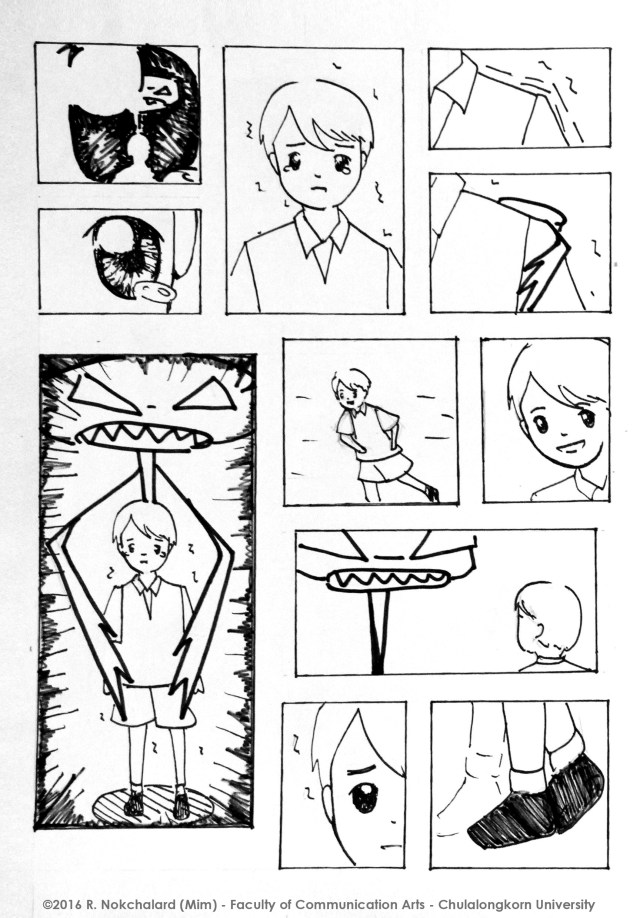
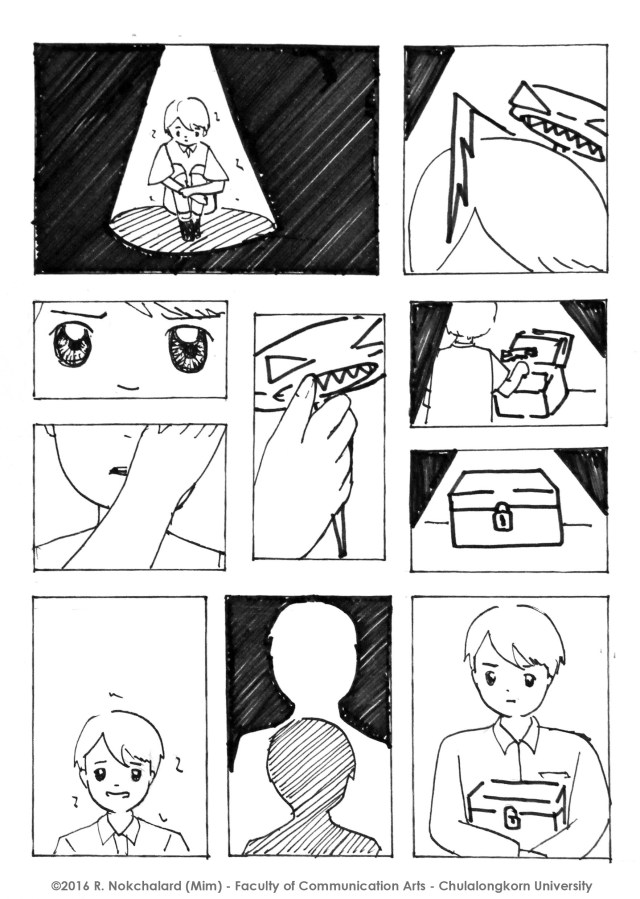
“Nailed” is a silent graphic narrative by Thai student Rattanakorn (Mim) for the IMGT COMM course (2800217), November 2016. In response to a video (see below) where a young child is the victim of a cruel joke perpetrated by adults, her comics captures how the child’s inner world is shattered by the traumatic psychological abuse and how it will affect his late life.
Description of the Imaginative Communication course: “Methods of conversing emotions, feelings, ideas, values, beliefs and meaning of life through the languages of the imaginative world in the form of poetry, music and songs, literature, drama, film or other creative works of Thai and foreign artists; relationship between science and art of communications; media design for imaginative works; analysis of images and narratives.” Thissemester’s theme: “Psychic Trauma; To Say the Unutterable”. Communication Management, International Program, Faculty of Communication Arts, Chulalongkorn University.


























































![20180108_233504[1]](https://from-dusk-till-drawn.com/wp-content/uploads/2018/02/20180108_2335041.jpg?w=640)





































 from-dusk-till-drawn.com